

Most engineering departments have a drawer full of finished projects that never became papers. A working prototype, real test data, a result the team was proud of — and then nothing, because the obvious journals all wanted something bigger.
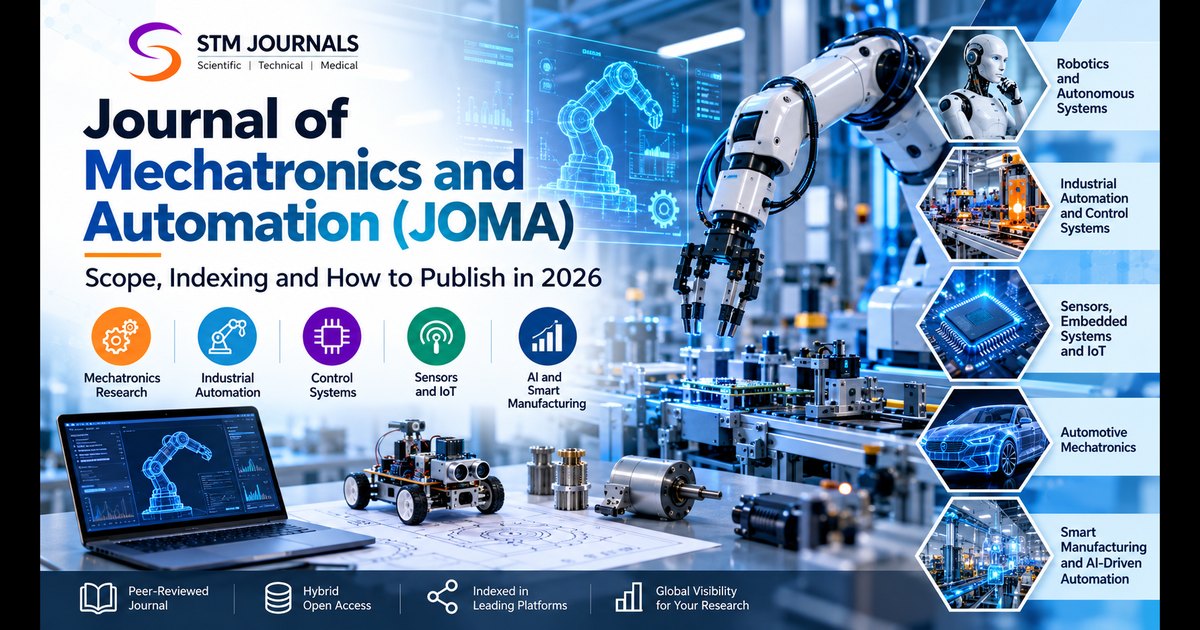
That gap is where the Journal of Mechatronics and Automation (JOMA) sits. It is a peer-reviewed, hybrid open access mechatronics journal published since 2014 by STM Journals, covering both theoretical and practical work in mechatronics and industrial automation.
Here is what it publishes, how it is indexed, and what a submission actually involves.
What JOMA Publishes
This mechatronics journal was set up to cover recent advancements across mechatronics and industrial automation, in both theory and practice. Three content types are accepted: original research papers, review papers, and patent alerts.
That last one is unusual. Most engineering journals have no route for a patent-stage disclosure. If your lab has filed and wants a citable academic record alongside it, this is a practical option.
| Detail | Value |
|---|---|
| E-ISSN | 2455-1988 |
| DOI prefix | 10.37591/JOMA |
| Launched | 2014 |
| Issues per year | 3 |
| Subject | Engineering |
| Access model | Hybrid Open Access |
| Licence | CC BY-NC-ND |
| Current issue | Volume 13, Issue 02, 2026 |
Every accepted paper receives a DOI. Full details are on the Focus and Scope page.
The Work That Actually Gets Published
In this mechatronics journal the published work falls A better signal is the recent issues, and in this mechatronics journal the published work falls into five clear groups.
Embedded Systems and Microcontroller Platforms
Arduino and ESP32-based systems appear constantly. Sensor interfacing, timing conflicts, PWM control, low-cost instrumentation. If you built something on a microcontroller and characterised how it performs, it fits.
Robotics and Autonomous Systems
Mobile robots, humanoid platforms, service robots. Both mechanism design and control, with a visible preference for work that includes a built prototype rather than simulation alone.
Industrial Automation and Smart Manufacturing
CNC process control, coolant systems, condition monitoring, IoT-enabled machine data. This is the automation half of the journal’s title, and it is well represented.
Automotive and ADAS
Sensor fusion, driver assistance, electric vehicle systems and motor selection. Recent work covers LiDAR-ultrasonic fusion and EV motor scheduling strategies.
AI and Machine Learning in Engineering Systems
A growing area. Generative AI, LLM-based systems, voice and vision pipelines applied to engineering problems rather than studied in the abstract.
Six Recent Papers
Concrete examples say more than a scope list.
A Reproducible Low-cost Adaptive Cruise Control Platform with Lidar–Ultrasonic Sensor Fusion — Nayak and colleagues build an ADAS platform on an Arduino UNO, including bit-banged PWM to avoid timer conflicts in servo-scanned blind-spot detection. The word “reproducible” in the title is the point: other labs can rebuild it.
Development of Smart Cooling Optimization System for CNC Machining Applications — Veerababu and Srinivas tackle heat at the tool–workpiece interface with an embedded multi-level coolant system using an MLX90614 sensor, measuring the effect on tool life and surface roughness.
Speech-Text-Speech Translator: A Generative AI Framework for Real-Time, Identity-Preserving S2S Translation — Yadav and co-authors combine zero-shot TTS, voice cloning and an LLM for context-aware translation across Indic languages.
Design and Development of a Pond Surface Cleaning Robot with Solar Power Integration — Saini and team build a solar-powered ESP32 robot for collecting floating waste, with Bluetooth control and water quality monitoring.
Advancements in Humanoid Robotics for Intelligent Automation — Chopada and Tated present a 19-DoF humanoid on Arduino Mega for STEM teaching.
A Review Paper on Scheduling of Electric Vehicle using Different Types of Electric Motor — Prakash and Kumar compare PMSM, BLDC, switched reluctance and induction motors for EV scheduling and energy optimisation.
The pattern is consistent: a defined system, a working implementation, measured results. Pure theory without a build is rarer here.
Indexing and Metrics
This mechatronics journal is indexed in Google Scholar , Advanced Science Index, Index Copernicus, Scientific Literature (SCILIT) and SJIF.
Its Index Copernicus Value has moved as follows: 53.42 in 2022, 64.42 in 2023, and 61.92 in 2024. SJIF has sat near 6.0 for five years, at 6.002 in both 2023 and 2024.
Worth stating plainly: JOMA is not currently indexed in Web of Science or Scopus, and SJIF is not Clarivate’s Journal Impact Factor. If your university counts only WoS or Scopus publications for promotion or thesis credit, verify your own requirements first. If you need your applied mechatronics work peer-reviewed, DOI-assigned and discoverable through Google Scholar, this journal does that.
Who Handles Your Paper
The Editor-in-Chief is Dr. S. M. Kulkarni, Professor in the Department of Mechanical Engineering at the National Institute of Technology Karnataka, Surathkal. The board is made up of practising researchers, and papers are routed to editors with matching expertise.
For an applied mechatronics submission, having an NITK mechanical engineering professor at the top of the masthead means your sensor fusion or machining paper is read by someone who has supervised similar work.
How to Submit
Confirm the fit first. Your paper needs a mechatronics or automation core — a mechanical system with sensing, control or actuation. Pure software with no physical system, or pure electrical work with no mechanical element, tends to be out of scope.
Pick the right paper type. Original research, review paper, or patent alert. Choose before you write, because the structure differs.
Follow the guidelines. The Author Guidelines and Instructions for Authors cover structure, references and figures.
Submit through the portal. Upload via the manuscript submission system, where you can track status and contact the editorial office.
Check the APC. As a hybrid open access journal, JOMA charges a processing fee for the open access route. Details are on the Article Processing Charges page.
Before You Submit: What Reviewers Look For
Applied mechatronics papers get rejected for predictable reasons. Check these first.
- Full hardware specification. Exact microcontroller, sensor part numbers, actuator ratings, power supply. “A temperature sensor” is not reproducible; “MLX90614” is.
- Control logic described, not just named. Give the loop, the sampling rate, the tuning method. A block diagram labelled “PID” tells reviewers nothing.
- Quantified performance. Response time, accuracy, error, power draw — with units. A prototype that “works well” is not a result.
- Repeat trials, not one run. State how many, and report variation across them.
- A comparison point. Your system against the conventional approach, a published alternative, or a clearly defined baseline.
- Limitations stated honestly. Range, environment, failure modes. Reviewers trust papers that name their own boundaries.
- Clear photographs of the build. Blurry phone shots of a breadboard undermine otherwise solid work.
- Current references. Mechatronics moves quickly; a reference list that stops at 2018 reads as stale.
Conclusion
This mechatronics journal is not competing with the flagship IEEE titles, and pretending otherwise would waste your time. What it offers is specific: a decade-old peer-reviewed mechatronics journal with an NITK professor as Editor-in-Chief, three issues a year, DOI assignment, a route for patent alerts, and a demonstrated willingness to publish working prototypes and applied automation systems rather than only large-scale theoretical studies.
For a final-year or master’s project with real results, a lab paper on an embedded or robotic system, or an industrial automation study that a general mechanical journal would call too narrow, that combination is genuinely useful.
If that sounds like your work, read the author guidelines, run through the checklist above, and submit your manuscript.
Frequently Asked Questions
What does JOMA publish?
This mechatronics journal publishes research on industrial automation, including embedded systems, robotics, smart manufacturing, automotive and ADAS systems, and AI applied to engineering problems. It accepts original research papers, review papers and patent alerts.
Is JOMA a peer-reviewed journal?
Yes. It is a refereed journal, and manuscripts are reviewed by subject experts before any decision.
Where is JOMA indexed?
Google Scholar, Advanced Science Index, Index Copernicus, SCILIT and SJIF. It is not currently in Web of Science or Scopus.
What is the impact factor of JOMA?
Its SJIF was 6.002 in 2024. Its Index Copernicus Value was 61.92 in 2024, up from 53.42 in 2022. Note that SJIF is not the Clarivate Journal Impact Factor.
Who is the Editor-in-Chief?
Dr. S. M. Kulkarni, Professor of Mechanical Engineering at the National Institute of Technology Karnataka, Surathkal.
Can students submit final-year or master’s project work?
Yes, provided it meets research standards — a defined system, quantified results, repeat trials and a comparison baseline. Recent issues include Arduino and ESP32-based platforms from student teams.


