
Dibua Redeemed,
- Research Scholar, Federal university of technology, ,
Abstract
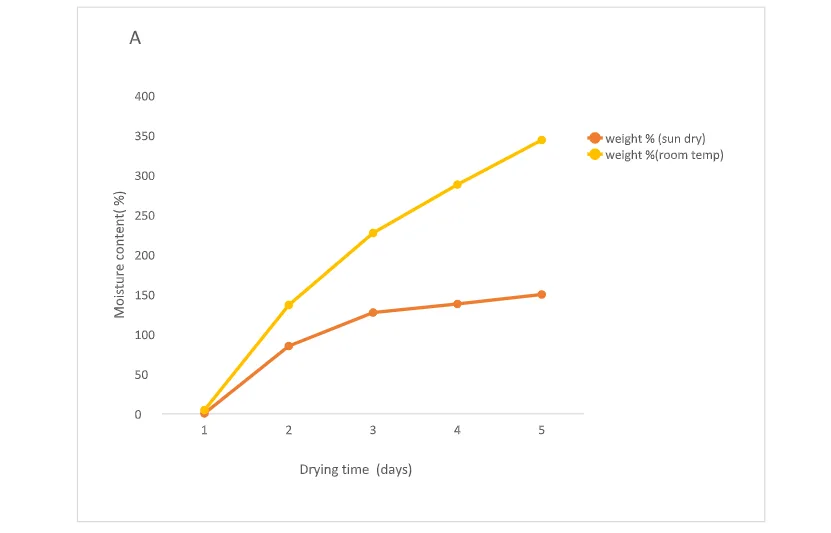
One of the earliest techniques for food preservation is the drying method. Drying is important because it reduce the moisture content of the food hence reducing the breeding ground for microorganism that causes food spoilage. Due to this marked effect, the study was aimed at investigating the effect of temperature on the drying characteristic of bitter leave (Vernonia Amygdalina) and Soursop (Annona Muricata). The methodologies employed in this researches are drying kinetics and Rehydration ratio. Result obtained from this research shows that there was a remarkable loss of water as the days increases in both the samples dried at room temperature and those dried in the sun interestingly, those dried in the sun lost more water than those dried at the room temperature this result was significant at p(<0.05). 2 Furthermore, as the day increase the rate of drying of both plant subjected to different temperatures (sundried and room temperature) decreases. Also, the rehydration capacity and rehydration ratio of the plant was higher in the sample dried at room temperature. However, bitter had a higher rehydration capacity and rehydration ratio than sour sop. This was significant at p (<0.05). It proves that the rehydration capacity and ratio of bitter was higher than that of sour sop leaves. From this study, it is important to note that temperature may affect the drying characteristic of plant samples and may play a role in the nutritional properties and also the shear life of plants.
Keywords: bitter leave, soursop, drying temperature, room temperature and sundried
[This article belongs to Research & Reviews : Journal of Food Science & Technology ]
References
1. Ahmed, J., Shivhare, U.S. and Singh, G. (2001). Drying characteristics and product
quality of coriander leaves,Trans I Chem E, (79):103-106.
2. Anuragi, H., Dhaduk, H. L., Kumar, S., Dhruve, J. J., Parekh, M. J. & Sakure, A. A.
(2016) Molecular diversity of Annona species and proxi¬mate fruit composition of
selected genotypes. 3 Biotech. 6, 204. https://doi.org/10.1007/ s13205-016-0520-9.
3. Badrie, N. & Schauss, A. G. (2010) Soursop (Annona muricata L.): composition,
nutritional value, medicinal uses and toxicology. In: Ronald Ross Watson & Victor R.
Preedy (eds) Bio¬active Foods in Promoting Health. Academ¬ic Press: Oxford, pp
621 – 643. https://doi. org/10.1016/B978-0-12-374628-3.00039-6
4. Bennamoun, L., and Li, J. (2018). Drying process of food: fundamental aspects and
mathematical modeling. In A. Grumezescu & A. M. Holban (Eds.), Natural and
artificial flavoring agents and food dyes (32nd ed., Vol. 722-729). USA: Elsevier.
http://dx.doi.org/10.1016/ B978-0-12-811518-3.00002-8.
5. Burton, L. (2018). “Food Preservation Methods & Guidance.” The Hub. High Speed
Training. Available online: www.highspeedtraining.co.uk/hub/food-preservation-
methods/ (accessed on 10 April 2022).
6. Donald, G.M. (2014). An Introduction to the dehydration and drying of fruits and
vegetables. Department of Food Science, University of Guelph, Ontario, Canada,
ISBN 978-0- 88955-621-8.
7. Farombi, E.O, and Owoeye O. (2011). Antioxidative and chemopreventive properties
of Vernonia amygdalina and Garcinia biflavonoid. International Journal of
Environmental Research and Public Health. 8(6):2533-55.
8. Fasakin, A. O., Fehintola, E. O., Obijole, O. A. & Oseni, O. A. (2008) Compositional
analyses of seed of Soursop Annona muricata L. as a potential animal feed
supplement. Sci. Res. Essays 3(10), 521 – 523.
9. Gao, Q.H.; Wu, C.S.; Wang, M.; Xu, B.N.; Du, L.J. (2012). Effect of drying of
jujubes ( Ziziphus jujuba Mill.) on the contents of sugars, organic acids, α-tocopherol,
β-carotene, and phenolic compounds. J. Agric. Food Chem. (60): 9642–9648,
doi:10.1021/jf3026524.
10. Hamzah RU, Jigam AA, Makun HA, Egwin EC.2013. Antioxidant Properties of
Selected African Vegetables, Fruits and Mushrooms: A Review. Intech 9: 203- 250.
11. Hernández Fuentes, L. M., Montalvo González, E., García Magaña, M. L., Anaya
Esparza, L. M., Nolasco González, Y., Villagrán, Z., González Torres, S., Velázquez
Monreal, J. J. & Morelos Flores, D. A. (2022). Current Situation and perspectives of
fruit Annonaceae in Mexico: biological and agronomic importance and bioactive
properties. Plants 11(1), 7. https://doi.org/10.3390/ plants11010007.
12. Ho WY, Liang WS, Yeap SK, Beh BK, Yousr AHN. (2012). In vitro and in vivo
antioxidant activity of Vernonia amygdalina water extracts, Afric J Biotech., 11(17):
4090–4094.
13. Jayathunge, K.G.L.R. and Illeperuma, C.K. (2001). Dehydratio of oyster mushroom
and studies on acceptability and storability of the product. Tropical Agricultural
Research, 13:69-77.
14. Jokić, S., Mujić, I., Martinov, M., Velić, D., Bilić, M.and Jasmina Lukinac (2009).
Influence of drying procedure on colour and rehydration characteristic of wild
asparagus. Czech J. Food Sci., 27(3):171-177.
15. Kaymak-Ertekin, F. (2002). Drying and rehydrating kinetics of green and red peppers.
Journal of Food Science, 67(1): 168–175.
16. Krokida, M.K. and Philippopoulos, C. (2005). Rehydration of Dehydrated foods.
International Journal of Drying Technology, 23(4):799-830.
17. Mahesh, K., Kulbir, S.B., Ghuman, B.S. and Sherya. (2017). Drying behavior of some
selected vegetables of Punjab. Punjab Horticultural Postharvest Technology Centre,
Punjab Agricultural University, Ludhiana.
18. Mouhoubi, K., Boulekbache-Makhlouf, L., Madani, K., Palatzidi, A., Perez-Jimenez,
J., Mateos-Aparicio, I. and Garcia-Alonso, A. (2022). Phenolic compounds and
antioxidant activity are differentially affected by drying processes in celery, coriander
and parsley leaves. Int. J. Food Sci. Technol. (57): 3467–3476.
19. Nwosu, S.I., Stanley, H.O. and Okerentugba, P.O. (2013). Occurrence, types and
location of calcium oxalate crystals in Vernonia amydalina Del (Asteraceae) Int. J.
Sci. Nat. 4(3):533-537
20. Paull, R. E., Deputy, J. & Chen, N. J. (1983). Changes in organics, acids, sugar and
volatiles during fruit ripening of soursop (Annona muricata L.). J. Am. Soc. Hortic.
Sci. 108, 931 – 934.
21. Pinto, A. C. Q., Cordeiro, M. C. R., De Andrade, S. R. M., Ferreira, F. R., Filgueiras,
H. A. C., Alves, R. E. & Kinpara, D. I. (2005). Annona species. International Centre
for Underutilied Crops, University of Southampton, South¬ampton SO17 1BJ, UK,
268.
22. Rao, T.S.B. and Murugan, S. (2021). Solar drying of medicinal herbs: A review. Sol.
Energy (223): 415–436.
23. Rastogi, N.K., Angersbach, A., Niranjan, K and Knorr, D. (2000). “Rehydration
kinetics of high pressure pre-treated and osmotically dehydrated pineapple,” Journal
of Food Science, 65(5):838–841
24. Velić D., Planinić M., Tomas S., and Bilić M. (2004). Influence of airflow velocity on
kinetics of convection apple drying. Journal of Food Engineering, (64): 97–102.
Research & Reviews : Journal of Food Science & Technology
| Volume | 12 | |
| Issue | 03 | |
| Received | 23/10/2024 | |
| Accepted | 24/10/2024 | |
| Published | 26/10/2024 | |
| Publication Time | Days |