
Anas Ali Sayyed,
Ruchika Bhawsar,
Neha Yadav,
Rajni Chouhan,
Mitalee Soni,
Mukesh Jamod,
Ritika Chouhan,
- Assistant Professor, School of Sciences, Abhyuday University, Khargone, Madhya Pradesh, India
- Assistant Professor, School of Sciences, Abhyuday University, Khargone, Madhya Pradesh, India
- Assistant Professor, School of Sciences, Abhyuday University, Khargone, Madhya Pradesh, India
- M.Sc. Scholar, School of Sciences, Abhyuday University, Khargone, Madhya Pradesh, India
- M.Sc. Scholar, School of Sciences, Abhyuday University, Khargone, Madhya Pradesh, India
- M.Sc. Scholar, School of Sciences, Abhyuday University, Khargone, Madhya Pradesh, India
- M.Sc. Scholar, School of Sciences, Abhyuday University, Khargone, Madhya Pradesh, India
Abstract
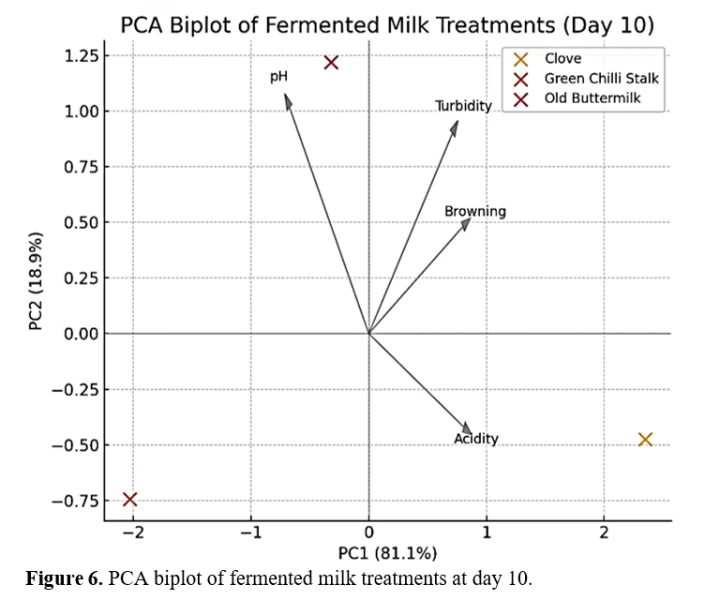
Background: Fermented milk products are a staple of traditional diets and offer considerable nutritional and health benefits due to their probiotic and bioactive compounds. While conventional starters, like old buttermilk are widely used, alternative plant-based starters, like clove and green chili stalk, have potential advantages, including enhanced antioxidant properties and cultural relevance. Objectives: This study aimed to compare the fermentation dynamics of milk inoculated with clove, green chili stalk, and old buttermilk over a 10-day period, assessing their effects on key physicochemical and sensory parameters. Methods: Fresh buffalo milk was inoculated with each of the three starters and incubated at 43°C. Samples were collected daily and analyzed for pH, titratable acidity, browning index (melanoidin formation), and turbidity (a proxy for microbial load). Data were analyzed using descriptive statistics, two-way ANOVA, Pearson’s correlation analysis, and Principal Component Analysis (PCA). Results: Clove treatment exhibited the fastest pH decline and highest titratable acidity, browning index, and turbidity by Day 10, indicating robust fermentative activity. Buttermilk treatment also performed well, showing a significant negative correlation between pH and acidity (r = −0.75, p = 0.013) and a strong positive correlation between turbidity and pH (r = +0.75, p = 0.012). The green chili stalk resulted in milder fermentation, with none of the measured correlations reaching significance. PCA revealed clear separation of the treatments on Day 10, with clove strongly associated with acidity, browning, and turbidity. Conclusion: Among the tested starters, clove demonstrated superior performance in promoting acidification, microbial growth, and browning, making it a promising alternative to conventional starters. This study highlights the potential of culturally significant plant-based materials to enhance the quality and functional properties of fermented milk.
Keywords: Fermented milk, clove, green chili stalk, buttermilk, pH, titratable acidity, PCA
[This article belongs to Research and Reviews : Journal of Dairy Science and Technology ]


References
- Bintsis T, Papademas P. The evolution of fermented milks, from artisanal to industrial products. Fermentation. 2022;8(12):679. doi: 10.3390/fermentation8120679.
- Marina Mefleh M, Darwish AMG, Mudgil P, Maqsood S, Boukid F. Traditional fermented dairy products in Southern Mediterranean countries: From tradition to innovation. Fermentation. 2022;8(12):743. doi: 10.3390/fermentation8120743.
- Wiyanto R, Cahyadi P, Septiani R. Yogurt making as a tool to understand the food fermentation process. J Microbiol Biol Educ. 2019;20(2).
- Pandey VK, Shams R, Singh R, Dar AH, Pandiselvam R, Rusu AV, et al. A comprehensive review on clove (Caryophyllus aromaticus L.) essential oil and its significance in edible coatings for food applications. Front Nutr. 2022;9:987674. doi: 10.3389/fnut.2022.987674.
- Sharma S, Jain S, Nair GN, Ramachandran S. Capsicum annuum enhances L-lactate production by Lactobacillus acidophilus: Implication in curd formation. J Dairy Sci. 2013;96(7):4142–4148. doi: 10.3168/jds.2012-6243.
- Nuñez IM, Verni MC, Martinez FEA, Babot JD, Terán V, Danilovich ME, et al. Novel lactic acid bacteria strains from regional peppers with health-promoting potential. Fermentation. 2024;10(4):209. doi: 10.3390/fermentation10040209.
- Olatide M, Arawande JO, George OO, Aborisade AB, Olasupo AD. Pilot study on chili stalks as a source of non-dairy lactic acid bacteria in yogurt making. Appl Food Sci J. 2019;3(1):5–8.
- Kim SH, Seo JH, Jeong YJ. Quality comparison of non-thermal sterilized raw apple vinegar and commercial products. Food Sci Preserv. 2024;31(2):235–244. doi: 10.11002/fsp.2024.31.2.235.
- Mira P, Yeh P, Hall BG, et al. Estimating microbial population data from optical density. PLoS One. 2022;17(7):e0267134. doi: 10.1371/journal.pone.0276040.
- Rasane P, Kailey R, Singh SK. Fermented indigenous Indian dairy products: Standards, nutrition, technological significance and opportunities for its processing. J Pure Appl Microbiol. 2017;11(2):1199–1213. doi: 10.22207/JPAM.11.2.68.
- Tomovska J, Gjorgievski N, Makarijoski B. Examination of pH, titratable acidity and antioxidant activity in fermented milk. J Mater Sci Eng A. 2016;6(11–12):326–33. doi: 10.17265/2161-6213/2016.11-12.006.
- Goa T, Beyene G, Mekonnen M, Gorems K. Isolation and characterization of lactic acid bacteria from fermented milk produced in Jimma Town, Southwest Ethiopia, and evaluation of their antimicrobial activity against selected pathogenic bacteria. Int J Food Sci. 2022;2022:2076021. doi: 10.1155/2022/2076021.
- Kang M, Park J, Yoo S. Effect of clove powder on quality characteristics and shelf life of kimchi paste. Food Sci Nutr. 2019;7(2):537–546. doi: 10.1002/fsn3.833.
- Bikheet MM, Hassan HM, Omar MO, Abdel-Aleem WM, Galal SM, Korma SA, et al. Effects of clove (Syzygium aromaticum) extract on antibacterial activity, phytochemical properties, and storage quality of flavored milk beverages. J Dairy Sci. 2025;108(4):3300–3313. doi: 10.3168/jds.2024-26023.
- Sangeeta S, Rai S, Ramachandran P, Yadav P, Chandola G. Value Addition of Spices Processing Industrial Waste. In: Selvamuthukumaran M, editor. Wealth out of Food Processing Waste: Ingredient Recovery and Valorization. 1st ed. Boca Raton: CRC Press; 2024. p. 188-223.
- Widyastuti Y, Febrisiantosa A. The role of lactic acid bacteria in milk fermentation. Food Nutr Sci. 2014;5(4):435–442. doi: 10.4236/fns.2014.54051.

Research and Reviews : Journal of Dairy Science and Technology
| Volume | 14 | |
| Issue | 03 | |
| Received | 17/07/2025 | |
| Accepted | 04/09/2025 | |
| Published | 05/09/2025 | |
| Publication Time | 50 Days |