
Ramesh Chandra Vagile,
Pankaj Agarwal,
Sanjay Jain,
Pradeep Singh,
- Research scholar, Department of Mechanical Engineering, Samrat Ashok Technological Institute, Vidisha, Madhya Pradesh, India
- Professor and HOD, Department of Mechanical Engineering, Samrat Ashok Technological Institute, Vidisha, Madhya Pradesh, India
- Associate Professor, Department of Mechanical Engineering, Samrat Ashok Technological Institute, Vidisha, Madhya Pradesh, India
- Assistant Professor, Department of Mechanical Engineering, Samrat Ashok Technological Institute, Vidisha, Madhya Pradesh, India
Abstract
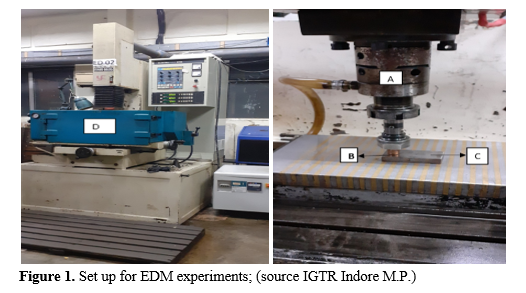
An alternative to conventional machining methods, Electrical Discharge Machining (EDM) uses electrical current for generating controlled sparks that erode surface of the material through thermal energy. Unlike traditional cutting processes, hard and electrically conductive materials with high precision can be machines very easily, which make it suitable for applications in tool and die manufacturing, aerospace, and automotive industries. Tool Wear Rate (TWR) and Material Removal Rate (MRR) for mild steel and cast iron are examined in relation to process factors including peak current, cutting speed, pulse-on time, and pulse-off time. Experiments were conducted using the ELEKTRA EMS 5535 die-sinker EDM, and the Taguchi Method (L-9 orthogonal arrays) was employed for the design of experiments. When both Keeping the pulse-off time and current constant, the MRR for cutting mild steel rose as the cutting speed increased. The ratio of TWR to peak current also rose when the former rose. Furthermore, the cutting speed of 3 µm/10 sec, 200 µs for the pulse-on length, 5 µs for the pulse-off time, and 8 A for the current produced the highest metal removal rate (MRR) for cast iron, which was 0.202 g/min. It was also found that TWR exhibited a tendency to rise even when current was constant, highlighting the influence of thermal stress and tool–workpiece interaction.
Keywords: Mild steel, EDM, Taguchi’s method, material removal rate, tool wear rate
[This article belongs to Special Issue under section in Journal of Polymer & Composites (jopc)]
References
- Choudhary SK, Jadoun R. Current advanced research development of electric discharge machining (EDM): a review IJRAT.2014;2(3):273–97p.
- Yang RT, Tzeng CJ, Yang YK,et al. Optimization of wire electrical discharge machining process parameters for cutting tungsten. Int.J.Adv.Manuf.Technol.2012;60:135–47p.
- Jeevamalar J, Ramabalan S, Sivashanmugam N. Influence of EDM process parameters on material removal rate. Int.J.Appl.Eng.Res. 2015;10:14041–51p.
- Gaikwad V, Jatti VS. Optimization of material removal rate during electrical discharge machining of cryo-treated NiTi alloys using Taguchi’s method. J. King Saud Uni.Eng.Sc. 2018;30:266–72p.
- Kishan B, SudheerPremkumar B, Gajanana S,et al. Development of regression model for Al6061+ SiC tool and optimization of process parameters on electro discharge machining. J. Phys. Conf.Ser.2020;1455(1); 1–10p.
- Khan MY, Rao PS. Optimization of process parameters of electrical discharge machining process for performance improvement. IJITEE 2019;8(11):3830–36p.
- Vagile RC,Agarwal P, Singh P et al.A Review on Electrical Discharge Machining Tool. EUSRM .2023 ; 15 (7);1–5p
- Kumar MR, Krishnaiah A, Kalva RS. Experimental study on micro machining of SS304 by using electric discharge machining. Materials Today: Proceedings. 2018;5:27269–76p.
- Pandey A, Singh S. Current research trends in variants of Electrical Discharge Machining: A review. Int.J. Eng. Sci.Technol. 2010;2(6):2172–91p.
- Ho K, Newman S.T.State of the art electrical discharge machining (EDM). Int. J.Mach. Tools Manuf. 2003;43:1287–300p.
- Kuppan P, Rajadurai A, Narayanan S. Influence of EDM process parameters in deep hole drilling of Inconel 718. Int.J. Adv.Manuf.Technol. 2008;38:74–84p.
- Aharwal K, Sitaram,Krishna C. Optimization of material removal rate and surface roughness in EDM machining of metal matrix composite using genetic algorithm. Materials Today: Proceedings. 2018;5(2):5391–7p.
- Vats N, Nandal R, Dhuhan R. Multiple-Performance Optimization of Wire EDM Parameters for HDS H13 BY Using Taguchi Method.IJRASET.2021;9(12);2291–94p.
- Sahani OP, Kumar R, Vashista M. Effect of electro discharge machining process parameters on material removal rate. JBAER. 2014;1(2):17–20p.
- Chandramouli S. Shrinivas B U and Eswarraiah K.Optimization of Electrical Discharge Machining Process Parameters Using Taguchi Method .IJAME. 2014 ;4(4);425–34p
- Mahajan R, Krishna,H, Singh AK et al. A Review on Copper and its alloys used as electrode in EDM IOP Conf. Ser. ;Mater. Sci. Eng.2018;377;1–11p.
- Ndaliman MB, Khan AA, Ali MY. Influence of dielectric fluids on surface properties of electrical discharge machined titanium alloy. Proc I MechE Part B J Engineering Manufacture. 2013;227(9):1310–16p.
- Kumar S S, Varol T, Canakci A et al. A review on the performance of the materials by surface modification through EDM. Int. J. Lightweight Mater Manuf ,2021;4(1); 127–44p.
- Dadge M S,Ranganath M S,Vipin A Detailed Review of Input and Output Parameters of EDM. IJNIET.2019;11(1);48–64p.
- Torres A, Luis C, Puertas I. Analysis of the influence of EDM parameters on surface finish, material removal rate, and electrode wear of an INCONEL 600 alloy. Int. J. Adv. Manuf. Technol. 2015;80:123–40p.
- Sapkal SU, Jagtap PS. Optimization of micro EDM drilling process parameters for titanium alloy by rotating electrode. Procedia Manufacturing. 2018;20:119–26p.
- Das MK, Kumar K, Barman TK,et al.Optimization of surface roughness and MRR in EDM using WPCA. Procedia Engineering. 2013;64:446–55p.

Journal of Polymer & Composites
| Volume | 14 | |
| Special Issue | 01 | |
| Received | 03/09/2025 | |
| Accepted | 19/09/2025 | |
| Published | 11/11/2025 | |
| Publication Time | 69 Days |