
Haydar U. Zaman,
- Assist. Prof., Department of Physics, National University of Bangladesh and Institute of Radiation and Polymer Technology, Bangladesh Atomic Energy Commission, Savar, Dhaka, Bangladesh
Abstract
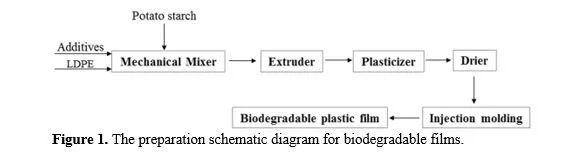
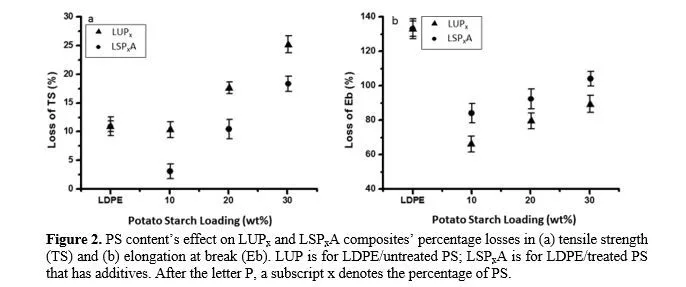
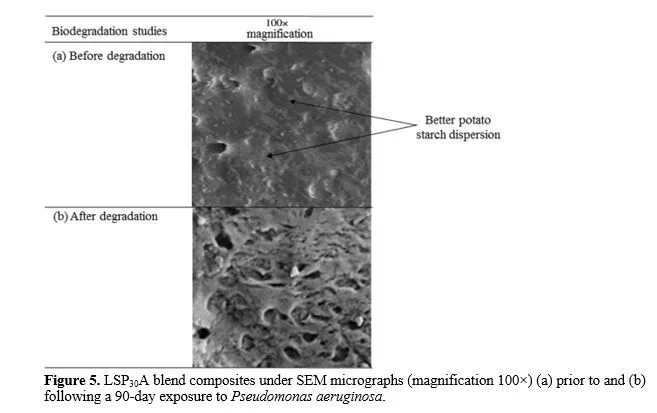
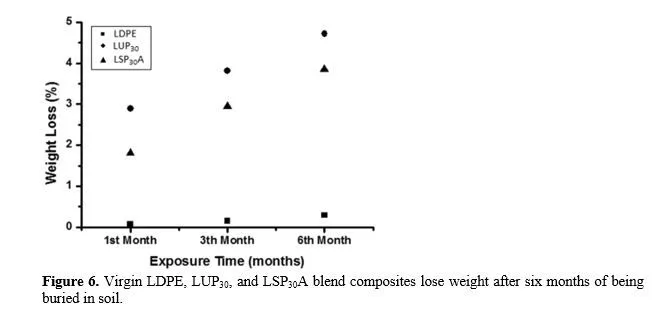
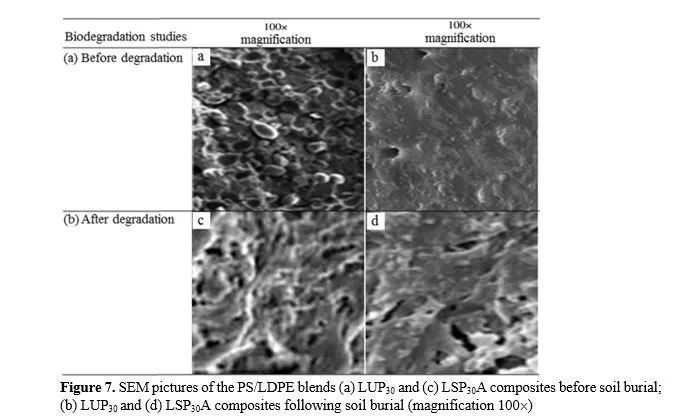
Plastic is a vital component of modern life, commonly used in daily food packaging for its convenience and durability. Plastic marketing bags are manufactured from low-density polythene (LDPE) which causes ecological inconvenience as most of the plastic components are stored in waste and underground conditions for an elongated time. Plastic is a synthetic or semi-synthetic material that does not decompose naturally, and its primary drawback is its environmental impact, prompting ongoing efforts to accelerate its biodegradation. A material that must be eroded, developed for any cause, such as Pseudomonas aeruginosa, as well as being buried in the ground, is interesting enough to be revealed. In this study, potato starch (PS) was blended with LDPE by using melt compound technique, Destructibility followed by injection molding for PS/LDPE composite formation. The influence of PS concentration and starch cross-linker sodium tripolyphosphate with the additive of composite properties was examined. Mechanical assessment outcomes exhibit that with increasing PS content there is an increase in loss of tensile strength and elongation at break of untreated and treated composites. Exposure to PS/LDPE composites in P. aeruginosa as well as soil environments was implemented to analyze the biodegradability of the composite. P. aeruginosa and the soil environment have lost weight and lost tensile properties due to increased PS and exposure periods, respectively. Modified PS composites also show less corrosion than unmodified PS/LDPE composites.
Keywords: Potato starch, LDPE, mechanical properties, morphology, biodegradability.
[This article belongs to Journal of Nanoscience, NanoEngineering & Applications ]
References
- Kyrikou I, Briassoulis D. Biodegradation of agricultural plastic films: A critical review. J Polym Environ. 2007;15(2):125–150. doi: 10.1007/s10924-007-0053-8.
- Olivera S, Muralidhara HB, Venkatesh K, Guna VK, Gopalakrishna K, and Kumar K Y. Potential applications of cellulose and chitosan nanoparticles/composites in wastewater treatment: A review. Carbohydr Polym. 2016;153:600–618. doi: 10.1016/j.carbpol.2016.08.017.
- Sajjadi, M. Nasrollahzadeh M, Tahsili MR. Catalytic and antimicrobial activities of magnetic nanoparticles supported N-heterocyclic palladium (II) complex: A magnetically recyclable catalyst for the treatment of environmental contaminants in aqueous media. Separation and Purification Technology. 2019;227:115716. doi: 10.1016/j.seppur.2019.115716.
- Yusof Y, Kadir MFZ. Electrochemical characterizations and the effect of glycerol in biopolymer electrolytes based on the methylcellulose-potato starch blend. Mol Cryst Liq Cryst. 2016;627(1):220–233. doi: 10.1080/15421406.2015.1137115.
- Ooi ZX, Ismail H, Bakar AA, Aziz NAA. Properties of the crosslinked plasticized biodegradable poly (vinyl alcohol)/rambutan skin waste flour blends. J Appl Polym Sci. 2012;125(2):1127–1135. doi: 10.1002/app.34860.
- Zaman H, Beg MDH. Effect of filler starches on mechanical, thermal and degradation properties of low-density polyethylene composites. Prog Appl Sci Tech. 2021;11(2):26–36. doi: 10.14456/past.2021.10.
- Zaman H, Beg MDH. Study on binary low-density polyethylene (LDPE)/thermoplastic sago starch (TPS) blend composites. Prog Appl Sci Tech. 2021;11(1):53–65. doi: 10.14456/past.2021.5.
- Babu RP, O’connor K, Seeram R. Current progress on bio-based polymers and their future trends. Prog Biomater. 2013;2(1):1–16. doi: 10.1186/2194-0517-2-8.
- Zobel H. Molecules to granules: A comprehensive starch review. Starch‐Stärke. 1988;40(2):44–50. doi: 10.1002/STAR.19880400203.
- Janssen LPBM, Karman AP, de Graaf RA. Material properties and glass transition temperatures of different thermoplastic starches after extrusion processing. Starch‐Stärke. 2003;55(2):80–86. doi: 10.1002/star.200390020.
- Khan MA, Khan RA, Haydaruzzaman, Ghoshal S, Siddiky M, Saha M. Study on the physicomechanical properties of starch-treated jute yarn-reinforced polypropylene composites: Effect of gamma radiation. Polymer-Plastics Technology, and Engineering. 2009;48(5):542–548. doi: 10.1080/03602550902824358.
- Zaman HU, Khan MA, Khan RA. Physico-mechanical and degradation properties of banana fiber/LDPE composites: Effect of acrylic monomer and starch. Compos Interfaces. 2011;18(8):685–700. doi: 10.1163/156855412X626261.
- Zhang C, Lim ST, Chung HJ. Physical modification of potato starch using mild heating and freezing with the minor addition of gums. Food Hydrocoll. 2019;94(1):294–303. doi: 10.1016/j.foodhyd.2019.03.027.
- Alvani K, Qi X, Tester RF, Snape CE. Physico-chemical properties of potato starches. Food Chem. 2011;125(3):958–965. doi: 10.1016/j.foodchem.2010.09.088.
- Wootton M Bamunuarachchi A. Water binding capacity of commercial produced native and modified starches. Starch‐Stärke. 1978;30(9):306–309. doi: 10.1002/STAR.19780300905.
- Wang J, Zhu H, Li S, Wang S, Wang S, Copeland L. Insights into structure and function of high pressure-modified starches with different crystalline polymorphs. Int J Biol Macromol. 2017;102:414–424. doi: 10.1016/j.ijbiomac.2017.04.042.
- L.Q.a.C.S.W.S.m.a.a.F.C.C. Xie S X. Physical Properties, and Application ed S W Cui (Boca Raton: CRC Press) chapter 8 2005. pp. 357–390. (2005).
- Lim S, Seib P. Preparation and pasting properties of wheat and corn starch phosphates. Cereal Chem. 1993;70(2):137–137.
- Passauer L, Bender H, Fischer S. Synthesis and characterization of starch phosphates. Carbohydr Polym. 2010;82(3):809–814. doi: 10.1016/j.carbpol.2010.05.050.
- Stahl J, Lobato L, Bochi V, Kubota E, Gutkoski L, Emanuelli T. Physicochemical properties of Pinhão (Araucaria Angustifolia, Bert, O. Ktze) starch phosphates. LWT-Food Sci Technol. 2007;40(7):1206–1214. doi: 10.1016/j.lwt.2006.07.015.
- Abed A, Assoul N, Ba M, Derkaoui SM, Portes P, Louedec L, et al. Influence of polysaccharide composition on the biocompatibility of pullulan/dextran‐based hydrogels. J Biomed Mater Res A. 2011;96(3):535–542. doi: 10.1002/jbm.a.33007.
- Carbinatto FM, de Castro AD, Cury BS, Magalhães A, Evangelista RC. Physical properties of pectin–high amylose starch mixtures cross-linked with sodium trimetaphosphate. Int J Pharm. 2012;423(2):281–288. doi: 10.1016/j.ijpharm.2011.11.042.
- Racksanti A, Janhom S, Punyanitya S, Watanesk R, Watanesk S. An approach for preparing an absorbable porous film of silk fibroin–rice starch modified with trisodium trimetaphosphate. J Appl Polym Sci. 2015;132(8). doi: 10.1002/app.41517.
- Racksanti A, Janhom S, Punyanitya S, Watanesk R, Watanesk S. editors. Crosslinking density of silk fibroin–rice starch hydrogels modified with trisodium trimetaphosphate. Applied Mechanics and Materials; 2014;446–447:366. doi: 10.4028/www.scientific.net/AMM.446-447.366.
- Chandra R, Rustgi R. Biodegradable polymers. Prog Polym Sci. 1998;23(7):1273–1335. doi: 10.1016/S0079-6700(97)00039-7.
- Zaman HU, Beg MDH. Biodegradable composites manufactured from low-density polyethylene and thermoplastic sago starch: Preparation and characterization. Prog Appl Sci Tech. 2021;11(2):42–49. doi: 10.14456/past.2021.16.
- Chandra R, Rustgi R. Biodegradation of maleated linear low-density polyethylene and starch blends. Polym Degrad Stab. 1997;56(2):185–202. doi: 10.1016/S0141-3910(96)00212-1.
- Lee WJ, Youn YN, Yun YH, Yoon SD. Physical properties of chemically modified starch (RS4)/PVA blend films-part 1. J Environ Polym Degrad. 2007;15(1):35–42. doi: 10.1007/s10924-006-0040-5.
- Obasi HC. Studies on biodegradability and mechanical properties of high-density polyethylene/corncob flour-based composites. IJSER. 2012;3(8):259–272.
- Febrianto F, Setyawati D, Karina M, Bakar ES, Hadi YS. Influence of wood flour and modifier contents on the physical and mechanical properties of wood flour-recycle polypropylene composites. J Biol Sci. 2006;6(2):337–343. doi: 10.3923/jbs.2006.337.343.
- Wang YJ, Liu W, Sun Z. Effects of glycerol and PE‐g‐MA on morphology, thermal and tensile properties of LDPE and rice starch blends. J Appl Polym Sci. 2004;92(1):344–350. doi: :10.1002/app.20015.
- Gattin R, Copinet A, Bertrand C, Couturier Y. Biodegradation study of a coextruded starch and poly (lactic acid) material in various media. J Appl Polym Sci. 2003;88(3):825–831. doi: 10.1016/S0964-8305(02)00039-2.
- Agamuthu P, Faizura PN. Biodegradability of degradable plastic waste. Waste Manag Res. 2005;23(2):95–100. doi: 10.1177/0734242X05051045.
- Miltz J, Narkis M. The effect of ultraviolet radiation on chemically crosslinked low‐density polyethylene. J Appl Polym Sci. 1976;20(6):1627–1633. doi: 10.1002/app.1976.070200620.
- Danjaji I, Nawang R, Ishiaku U, Ismail H, Ishak ZM. Degradation studies and moisture uptake of sago-starch-filled linear low-density polyethylene composites. Polym Test. 2002;21(1):75–81. doi: 10.1016/S0142-9418(01)00051-4.
- Orhan Y, Hrenović J, Büyükgüngör H. Biodegradation of plastic compost bags under controlled soil conditions. Acta Chim Slov. 2004;51:579–588.

Journal of Nanoscience, NanoEngineering & Applications
| Volume | 14 | |
| Issue | 03 | |
| Received | 26/09/2024 | |
| Accepted | 07/10/2024 | |
| Published | 23/10/2024 | |
| Publication Time | Days |