
A. S. Maheshwari,
- Associate Professor, Department of Biotechnology, University College of Engineering BIT Campus, Anna University, Tiruchirappall, Tamil Nadu, India
Abstract
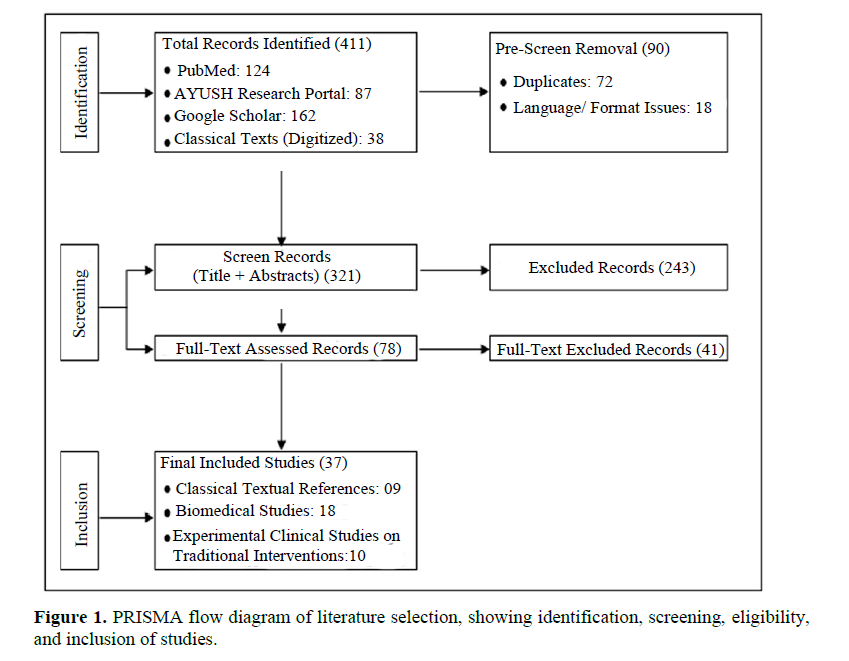
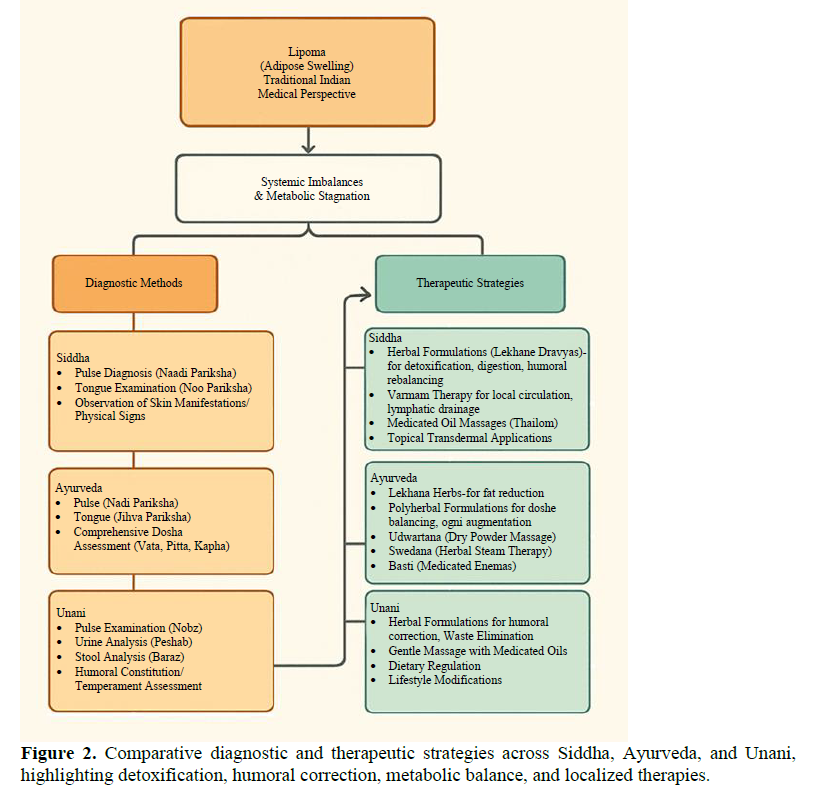
Background: Lipoma is the most common benign soft tissue tumor, with an incidence of approximately 2 per 1,000 individuals annually. Modern biomedicine attributes its pathogenesis to genetic abnormalities like HMGA2 rearrangements and dysregulated adipogenesis via PPARγ pathways. Effective pharmacological therapies are lacking. Traditional Indian systems – Siddha, Ayurveda, and Unani – offer unique perspectives and non‑surgical approaches yet remain underexplored in integrative research. Objective: To critically evaluate the descriptions, pathophysiological concepts, and therapeutic approaches to lipoma in Siddha, Ayurveda, and Unani systems, and to correlate these with contemporary biomedical insights. Methods: A qualitative literature review was conducted using classical Siddha, Ayurvedic, and Unani treatises along with indexed biomedical databases (PubMed, AYUSH Research Portal). A total of 411 relevant publications (1980–2024) were screened, of which 37 were included for thematic synthesis. Analogous conditions to lipoma were identified and their management principles extracted. Comparative analysis was performed with current biomedical literature on lipoma pathophysiology, including molecular and metabolic mechanisms. Findings: Ayurveda classifies lipoma as Medoja Granthi, caused by Kapha–Meda derangement, and managed through Lekhaniya herbs and Panchakarma. Siddha refers to Vali Iyyam Pinais, attributed to Vali–Iyyam imbalance, and treated with purgatives, metallic preparations, and medicated oils. Unani describes Waram‑e‑Shahmiya as a phlegmatic tumor, addressed through Ilaj bilTadbeer and Muhallil formulations. These align with biomedical features such as adipocyte proliferation, cytokine activity, and hypoxia signaling. Preliminary pharmacological studies support anti‑lipogenic and anti‑inflammatory effects of traditional formulations. Conclusion: Traditional systems provide comprehensive frameworks for understanding and managing lipoma, offering parallels with modern molecular mechanisms. Their integration with biomedical diagnostics may yield effective non‑surgical, individualized therapies. Further pharmacological validation and clinical trials are needed robustly to establish efficacy.
Keywords: Ayurveda, HMGA2, integrative medicine, lipoma, non‑invasive therapy, PPARγ, Siddha, Unani
[This article belongs to Research & Reviews : A Journal of Unani, Siddha and Homeopathy ]
References
- Thappa DM, Venkatesan S. Common skin tumors. Indian J Dermatol. 2000;45(3):128–132.
- Kransdorf MJ. Benign soft tissue tumors in a large referral population: Distribution of specific diagnoses by age, sex, and location. AJR Am J Roentgenol. 1995;164(2):395–402.
- Enzinger FM, Weiss SW. Soft tissue tumors. 3rd ed. St. Louis: Mosby; 1995.
- Yang L, Weiss SW. Lipomas: Pathology and classification. Semin Diagn Pathol. 2001;18(4):203–213.
- Debnath A, Ghosh S. Concepts of Granthi in Ayurveda with special reference to benign neoplasms. J Ayurveda Integr Med. 2020;11(3):326–332.
- Ramachandran S, Saravanan A. Interpretation of benign tumours based on Siddha literature. Int J Siddha Res. 2021;6(1):22–27.
- Trikamji Y. Charaka Samhita of Agnivesha, Chikitsa Sthana, Chapter 12. Varanasi: Chaukhamba Surbharati; 2011.
- Sharma PV. Sushruta Samhita, Nidana Sthana, Chapter 11. Varanasi: Chaukhamba Visvabharati; 2009.
- Ameen M, Ansari AH. Aetiology and classification of tumors in Unani medicine: A review. J Res Unani Med. 2018;7(2):87–92.
- Gunalan R, Rajalakshmi M, Rajkumar K. Understanding Pinais in Siddha system of medicine. Indian J Tradit Knowl. 2019;18(4):731–737.
- Dwivedi A, Tripathi R. Ayurvedic approach to benign growths. AYU. 2017;38(1):41–46.
- Ahmad S, Farooq M. Waram e Shahmiya: A Unani perspective on lipoma. J Unani Med. 2016;9(2):115–119.
- Sharma R, Singh A. Kanchanara Guggulu in the management of Medoja Granthi: A clinical evaluation. AYU. 2015;36(2):186–191.
- Ramalingam V, Meenakshi S. Siddha pharmacotherapeutics of lipoma: A case documentation. J Res Siddha Med. 2020;2(1):33–38.
- Central Council for Research in Ayurvedic Sciences (CCRAS). Ayurvedic pharmacopoeia of India. Vol. 3. New Delhi: Government of India; 2001.
- Ministry of AYUSH. Siddha formulary of India. Part I. New Delhi: Government of India; 2008.
- Central Council for Research in Unani Medicine (CCRUM). National formulary of Unani medicine. Part II. New Delhi: Government of India; 2007.
- Qasmi IA, Akhtar J. Traditional regimenal therapies for benign tumors: A review. Hamdard Med. 2021;64(2):85–91.
- Kumar V, Abbas AK, Aster JC. Robbins and Cotran pathologic basis of disease. 10th ed. Philadelphia: Elsevier; 2020.
- Rao UNM, Medeiros LJ, Mooney EE. Cytogenetic and molecular genetic studies of lipomas. Mod Pathol. 1997;10(6):571–577.
- Bartuma H, Domanski HA, Vult von Steyern F, Mandahl N, Mertens F. Molecular pathology of adipocytic tumors. Virchows Arch. 2007;451(1):27–34.
- Farmer SR. Transcriptional control of adipocyte formation. Cell Metab. 2006;4(4):263–273.
- Kim JB, Spiegelman BM. ADD1/SREBP1 promotes adipocyte differentiation and gene expression linked to lipid metabolism. Genes Dev. 1996;10(9):1096–1107.
- Mandahl N, Mertens F. Genetics of soft tissue tumors. Semin Diagn Pathol. 2014;31(5):341–352.
- Rao S, Miettinen M. HMGA2 gene rearrangement in lipoma: An overview. Mod Pathol. 2009;22(3):292–297.
- Rosen ED, Spiegelman BM. PPARγ: A nuclear regulator of metabolism, differentiation, and tumorigenesis. J Biol Chem. 2001;276(41):37731–37737.
- Yoon M. The role of PPARα in lipid metabolism and obesity: Focusing on adipose tissue. Int J Mol Sci. 2009;10(5):1730–1744.
- Ahmad S, Mahmood S. Phlegmatic conditions and obesity: A Unani analysis. J Res Tradit Med. 2018;4(2):88–93.
- Lee MJ, Wu Y, Fried SK. Adipose tissue remodeling in pathophysiology of lipomas: Role of hypoxia and VEGF. Obes Rev. 2010;11(5):331–339.
- Rajalakshmi M, Kalaiselvi M. Siddha etiopathology of Vali Iyyam Pinais and its correlation with modern benign swellings. Int J Res Siddha. 2021;3(1):15–22.
- Gustafson B, Smith U. Regulation of white adipogenesis and its relation to Wnt signaling in lipoma formation. Mol Cell Endocrinol. 2012;350(1):44–50.
- Singh R, Sharma V. Antilipolytic effect of Triphala Guggulu in experimental hyperlipidemia. Int J Ayurveda Res. 2010;1(4):220–224.
- Sharma S, Thakur R. Antioxidant and anti-obesity potential of Kanchanara Guggulu: An in vivo study. J Ayurveda Integr Med. 2017;8(3):178–185.
- Narayanasamy V, Karthick V. A clinical study on the effect of Siddha regimen in lipoma: Preliminary observations. J Siddha Clin Res. 2021;7(2):49–53.
- Ali R, Qazi GN. Experimental validation of Unani drug Zarooni in subcutaneous fat tumors. J Ethnopharmacol. 2015;162:121–127.

Research & Reviews : A Journal of Unani, Siddha and Homeopathy
| Volume | 13 | |
| Issue | 01 | |
| Received | 30/11/2025 | |
| Accepted | 01/02/2026 | |
| Published | 02/02/2026 | |
| Publication Time | 64 Days |