Maahi Paliwal,
Shreya Roy,
Vibha Gupta,
- M. Sc. Student, Department of Biotechnology, Jaypee Institute of Information Technology, Sector-62, Noida, Uttar Pradesh, India
- Research Scholar, Department of Biotechnology, Jaypee Institute of Information Technology, Sector-62, Noida, Uttar Pradesh, India
- Associate Professor, Department of Biotechnology, Jaypee Institute of Information Technology, Sector-62, Noida, Uttar Pradesh, India
Abstract
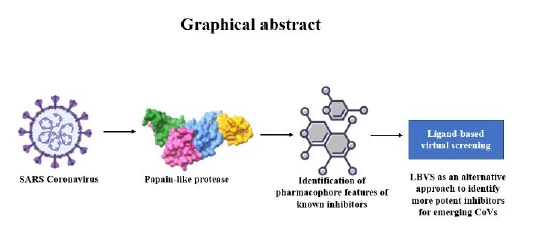
Re-emerging Corona viruses (CoVs), including SARS-CoV (S-CoVs), and SARS-CoV-2 (S-CoV-2), continue to pose a global health threat due to their high mutation rates, zoonotic spillover potential, and capacity for immune evasion. The global pandemic of year 2019, caused by S-CoV-2, has highlighted the importance for robust antiviral strategies beyond vaccines and RNA polymerase or main protease inhibitors, which are susceptible to resistance. One promising therapeutic target is the S-CoV-2 papain-like protease (PLpro), a conserved cysteine protease essential for viral polyprotein processing and suppression of host innate immunity via deubiquitination and deISGylation. This review explores the structural and functional features of PLpro, comparing its domain architecture and catalytic mechanisms across CoVs, and emphasizing its high conservation among variants. Recent advances in structure-based drug discovery have facilitated the discovery of several novel PLpro inhibitors, many of which demonstrate enhanced potency, improved target specificity, and, in some cases, dual inhibitory activity against both PLpro and the main protease (Mpro). Although early candidates have shown promising results in preclinical studies, their progression to clinical application is hindered by limitations related to potency, selectivity, and pharmacokinetic properties. This review underscores the therapeutic relevance of PLpro as an antiviral target and highlights how the availability of well-characterized PLpro inhibitors provides a valuable foundation for discovering more potent candidates through ligand-based virtual screening, thus speeding up the development of potent antivirals against S-CoV-2 and future β-CoVs.
Keywords: SARS-CoV-2, papain-like protease (PLpro), viral protease inhibitors, structure-based drug discovery
[This article belongs to Research and Reviews : A Journal of Life Sciences ]

References
- Severe Acute Respiratory Syndrome Coronavirus-2 (S-CoV-2): An update. Cureus. 2020 Mar.
- Cui J, et al. Origin and evolution of pathogenic CoVs. Nat Rev Microbiol. 2019 Mar;17(3):181–92.
- Zhu N, et al. A novel coronavirus from patients with pneumonia in China, 2019. N Engl J Med. 2020 Feb;382(8):727–33.
- Dhar Chowdhury S, Oommen AM. Epidemiology of COVID-19. J Dig Endosc. 2020;11(1):3–7.
- Rut W, et al. Activity profiling and crystal structures of inhibitor-bound S-CoV-2 papain-like protease: A framework for anti–COVID-19 drug design. Sci Adv. 2020 Oct;6(42):eabd4596.
- Sia SF, et al. Pathogenesis and transmission of S-CoV-2 in golden hamsters. Nature. 2020 Jul;583(7818):834–8.
- Monteil V, et al. Inhibition of S-CoV-2 infections in engineered human tissues using clinical-grade soluble human ACE2. Cell. 2020 May;181(4):905–913.e7.
- Yang H, Rao Z. Structural biology of S-CoV-2 and implications for therapeutic development. Nat Rev Microbiol. 2021 Nov;19(11):685–700.
- Wrapp D, et al. Cryo-EM structure of the 2019-nCoV spike in the prefusion conformation. Science. 2020 Mar;367(6483):1260–3.
- Naqvi AAT, et al. Insights into S-CoV-2 genome, structure, evolution, pathogenesis and therapies: Structural genomics approach. Biochim Biophys Acta Mol Basis Dis. 2020 Oct;1866(10):165878.
- Bai C, et al. “Overview of S-CoV-2 Genome-encoded Proteins.” Sci China Life Sci. 2021 Aug;65(2):280–94.
- Kang S, et al. “Crystal structure of S-CoV-2 nucleocapsid protein RNA binding domain reveals potential Unique Drug Targeting Sites.” Acta Pharm Sin B. 2020 Jul;10(7):1228–38.
- Cao Y, et al. “Characterization of the SARS‐CoV‐2 E Protein: Sequence, Structure, Viroporin, and Inhibitors.” Protein Sci. 2021Jun;30(6):1114–30.
- Lu R, et al. “Genomic Characterisation and Epidemiology of 2019 Novel Coronavirus: Implications for Virus Origins and Receptor Binding.” The Lancet. 2020 Feb;395(10224):565–74.
- “Structural Biology of S-CoV-2: Open the door for novel therapies.” Signal Transduct Target Ther. 2022 Jan;7(1):73. doi:10.1038/s41392-022-00884-5.
- Shin D, et al. “Papain-like Protease regulates S-CoV-2 viral spread and Innate immunity.” Nature. 2020 July;587(7835):657–62.
- Wydorski PM, et al. “Dual domain recognition determines S-CoV-2 PLpro selectivity for human ISG15 and K48-linked Di-ubiquitin.” Nat Commun. 2023 Apr;14(1).
- Báez-Santos YM, et al. “The SARS-coronavirus papain-like protease: Structure, function and inhibition by designed antiviral compounds.” Antiviral Res. 2014 Dec;115:21–38.
- Cui W, et al. “Structural review of S-CoV-2 antiviral targets.” Structure. 2024 Sept;32(9):1301–21.
- Kandeel M, et al. “The Emerging SARS‐CoV‐2 papain‐like protease: Its relationship with recent coronavirus epidemics.” J Med Virol. 2020 Sept;93(3):1581–8.
- Gao X, et al. “Crystal structure of S-CoV-2 papain-like protease.” Acta Pharm Sin B. 2020 Sept;11(1):237–45.
- Ferreira GM, et al. “Inhibitor induced conformational changes in S-COV-2 papain-like protease.” Sci Rep. 2022 Jul;12(1).
- “A noncovalent class of papain-like protease/deubiquitinase inhibitors block SARS virus replication.” Proc Nati Acad Sci. 2008 Oct;105(42):16119–24.
- Fu Z et al. “The complex structure of GRL0617 and S-CoV-2 PLpro reveals a hot spot for antiviral drug discovery.” Nat commun. 2021 Jan;12(1):488.
- Ewert W, et al. “Hydrazones and thiosemicarbazones targeting protein-protein-interactions of S-CoV-2 ppain-like protease.” Front Chem. 2022 Apr;10.
- Taylor AJ, et al. “Fragment-based screen of S-CoV-2 papain-like protease (PLpro).” ACS Med Chem Lett. 2024 July;15(8):1351–7.
- Hu H, et al. “Identification of C270 as a novel site for allosteric modulators of S-CoV-2 papain-like protease.” bioRxiv (Cold Spring Harbor Laboratory). 2022. Mar.
- Shao Q, et al. “Unraveling the catalytic mechanism of S-CoV-2 papain-like protease with allosteric modulation of C270 mutation using multiscale computational approaches.” Chem Sci, 2023 Jan;14(18):4681–96.
- Van Vliet VJE, et al. “Ubiquitin variants potently inhibit S-CoV-2 PLpro and viral replication via a novel site distal to the protease active site.” PLoS Pathog. 2022 Dec;18(12):e1011065.
- Identification of novel allosteric sites of S-CoV-2 papain-like protease (PLpro) for the development of COVID-19 antivirals. J Biol Chem. 2024 Sept;107821.
- Yang M, et al. Jun12682, a potent S-CoV-2 papain-like protease inhibitor with exceptional antiviral efficacy in mice. Acta Pharm Sin B. 2024;14(9):4189–92.
- Discovery of S-CoV-2 Papain-like Protease (PLpro) inhibitors with efficacy in a murine infection model. Sci Adv. 2024 Aug;10(35).
- Anders BC, et al. Potent and selective covalent inhibition of the papain-like protease from S-CoV-2. Nat Commun. 2023 Mar 28;14(1):1733.
- Shen Z, et al. Design of S-CoV-2 PLpro inhibitors for COVID-19 antiviral therapy leveraging binding cooperativity. J Med Chem. 2022;65(4):2940–55.
- Lu Y, et al. Discovery of orally bioavailable S-CoV-2 papain-like protease inhibitor as a potential treatment for COVID-19. Nat Commun. 2024 Nov;15(1).
- Antiviral activity of natural phenolic compounds in complex at an allosteric site of S-CoV-2 papain-like protease. Commun Biol. 2022 Aug;5(1).
- Osipiuk J, et al. Structure of papain-like protease from S-CoV-2 and its complexes with non-covalent inhibitors. Nat Commun. 2021 Feb;12(1).
- Calleja DJ, et al. Insights into drug repurposing, as well as specificity and compound properties of piperidine-based S-CoV-2 PLpro inhibitors. Front Chem. 2022 Apr;10.
- Zhao Y, et al. High-throughput screening identifies established drugs as S-CoV-2 PLpro inhibitors. Protein Cell. 2021 Apr;12(11):877–88.
- Papain-like protease of S-CoV-2 in complex with remodilin NCGC 390004. Forthcoming publication.
- Kralj S, et al. Identification of triazolopyrimidinyl scaffold S-CoV-2 papain-like protease (PLpro) inhibitor. Pharmaceutics. 2024 Jan;16(2):169.
- Bader SM, et al. A novel PLpro inhibitor improves outcomes in a pre-clinical model of long COVID. Nat Commun. 2025 Apr;16(1).
- Wadanambi PM, et al. Evaluating phytochemicals as S-CoV-2 papain-like protease inhibitors: A docking, ADMET and molecular dynamics investigation. Chem Pap. 2025 Mar.
- Aziz S, et al. Exploring natural compounds and synthetic derivatives as potential inhibitors of S-CoV-2 PLpro: A computational approach with enzyme inhibition and cytotoxicity assessment. J Biomol Struct Dyn. 2025 Feb:1–21.
- Delgado C, et al. In silico and in vitro studies of the approved antibiotic ceftaroline fosamil and its metabolites as inhibitors of S-CoV-2 replication. Viruses. 2025 Mar;17(4):491.
- Jadhav P, et al. Design of quinoline S-CoV-2 papain-like protease inhibitors as oral antiviral drug candidates. Nat Commun. 2025 Feb;16(1).
- Jiang Y, et al. Fragment-based drug discovery strategy and its application to the design of S-CoV-2 main protease inhibitor. Curr Med Chem. 2024 Mar;31(38):6204–26.
- Lee D, et al. Bioengineered amyloid peptide for rapid screening of inhibitors against main protease of S-CoV-2. Nat Commun. 2024 Mar;15(1).
- Chan CCY, et al. Identification of novel small-molecule inhibitors of S-CoV-2 by chemical genetics. Acta Pharm Sin B. 2024 May;14(9):4028–44.
- Hammond J, et al. Oral nirmatrelvir for high-risk, nonhospitalized adults with COVID-19. N Engl J Med. 2022 Feb;386(15):1397–408.
- James VK, et al. Native mass spectrometry reveals binding interactions of S-CoV-2 PLpro with inhibitors and cellular targets. ACS Infect Dis. 2024 Sep.
- Evdokimova M, et al. Coronavirus endoribonuclease antagonizes ZBP1-mediated necroptosis and delays multiple cell death pathways. Proc Natl Acad Sci U S A. 2025 Mar;122(10).
- Bowden-Reid E, et al. Harnessing antiviral RNAi therapeutics for pandemic viruses: S-CoV-2 and HIV. Drug Deliv Transl Res. 2025 Jan.
- Dehesh E, Dehesh F. Nanotechnology in COVID-19 and S-CoV-2: Advances in antiviral therapies and applications. J Complement Altern Med Res. 2025 Jan;26(1):87–105.
- Wang X, et al. Preparation of selective organ-targeting (SORT) lipid nanoparticles (LNPs) using multiple technical methods for tissue-specific mRNA delivery. Nat Protoc. 2022 Oct;18(1):265–91.
- Yin J, et al. Advances in the development of therapeutic strategies against COVID-19 and perspectives in the drug design for emerging S-CoV-2 variants. Comput Struct Biotechnol J. 2022 Jan;20:824–37.

Research and Reviews : A Journal of Life Sciences
| Volume | 15 | |
| Issue | 03 | |
| Received | 07/06/2025 | |
| Accepted | 25/07/2025 | |
| Published | 26/07/2025 | |
| Publication Time | 49 Days |