
Kaisar Ahmad Bhat,
Jasmina Javaid Shah,
Abid Hussain,
Sheezan Shafi,
- Lecturer, Department of Operation Theatre Technology and Anesthesia Technology, Jammu University, Jammu & Kashmir, India
- Assistant Professor, Department of Medical Lab & Technology, BEE ENN College of Nursing, Kainkh, Jammu & Kashmir, India
- Lecturer, Department of Radioimaging Technology, BEE ENN College of Nursing, Kainkh, Jammu & Kashmir, India
- Tutor, Department of Operation Theatre Technology and Anesthesia Technology, BEE ENN College of Nursing, Kainkh, Jammu & Kashmir, India
Abstract
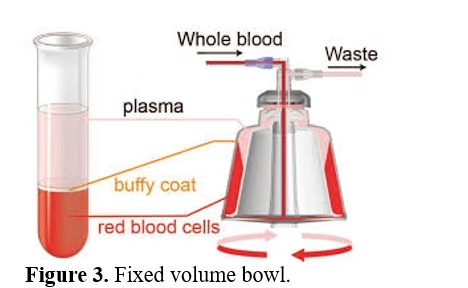
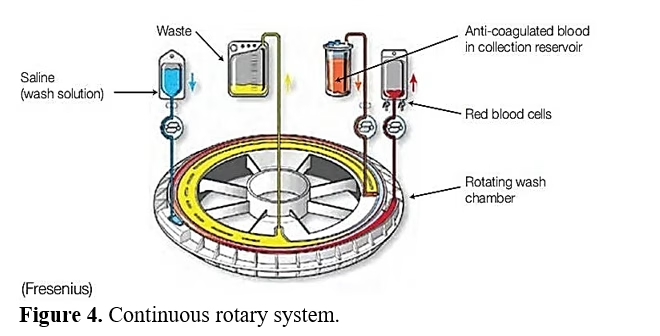
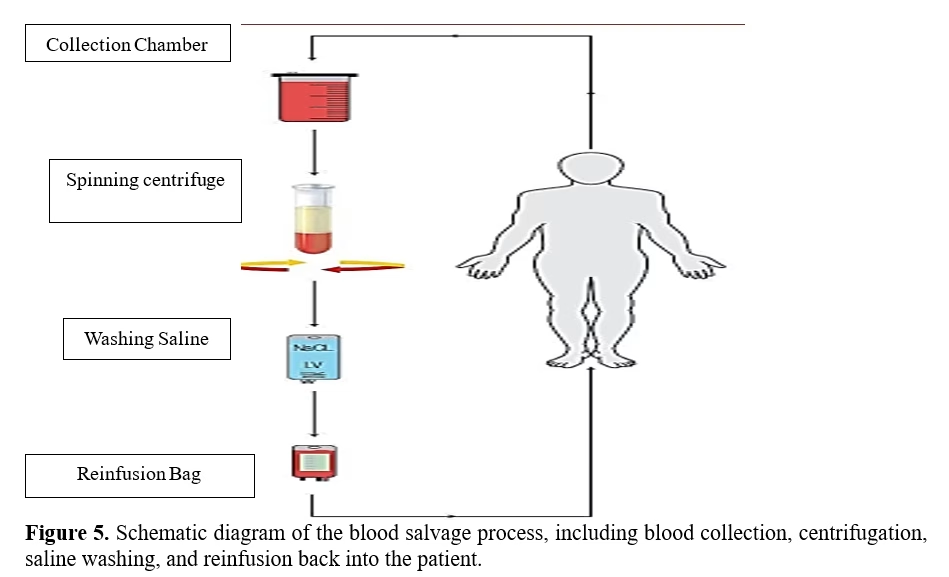
Intraoperative Cell Salvage (ICS) is a crucial technique in modern surgical practice aimed at minimizing the need for allogeneic blood transfusions. By collecting, filtering, washing, and re-infusing a patient’s own blood lost during surgery, ICS provides a safer and cost-effective alternative to donor transfusion, reducing the risk of transfusion-related infections and immunologic reactions. Initially conceptualized in the early 19th century, ICS technology evolved significantly with the introduction of the Cell Saver by Haemonetics in 1976. Today, it is widely adopted in both elective and emergency surgeries, including orthopaedic, cardiac, vascular, and obstetric procedures. The process involves anticoagulating collected blood, centrifuging to separate red blood cells (RBCs), and washing them with saline before reinfusion. Several system variants exist, such as fixed volume bowl, variable volume disk, and continuous rotary systems, each with specific advantages depending on surgical circumstances. While ICS offers substantial benefits, contraindications include contamination by bowel contents, infection, or specific patient conditions like sickle cell disease. Special considerations are required in oncological and obstetric cases due to the risk of reinfusing malignant cells or amniotic fluid. Advances in filtration, including leukodepletion filters, have addressed some of these risks. Patient consent and ethical considerations are integral, especially for those with religious objections to donor blood. Effective implementation of ICS also involves careful clinical judgment regarding when and how to process and reinfuse salvaged blood. Despite limitations, ICS significantly contributes to blood management strategies, conserving donor blood supplies and improving surgical outcomes.
Keywords: Intraoperative Cell Salvage (ICS), Autologous Blood Transfusion, Blood Management in Surgery, Cell Saver Machine, Allogeneic Transfusion Alternative.
[This article belongs to Research and Reviews : A Journal of Life Sciences ]


References
- Fourtounas M. Cell saver physics–a review. South Afr J Anaesth Analg. 2020 Nov 13;26(6):S49–54.
- Burman JF, Westlake AS, Davidson SJ, Rutherford LC, Rayner AS, Wright AM, et al. Study of five cell salvage machines in coronary artery surgery. Transfus Med. 2002 Jun;12(3):173–9.
- Vermeijden WJ, Hagenaars A, van Oeveren W, de Vries AJ. Do repeated runs of a cell saver device increase the pro-inflammatory properties of washed blood? Eur J Cardiothorac Surg. 2008 Aug 1;34(2):350–3.
- Oon CJ, Hobbs JR. Clinical applications of the continuous flow blood separator machine. Clin Exp Immunol. 1975 Apr;20(1):1.
- Qudeimat A, Zandaki DA, Bi Y, Li Y, Davis K, Alloush L, et al. Comparison of Haemonetics Cell Saver 5+ and manual density separation for optimum depletion of red blood cells and preservation of CD34+ cells in major ABO-incompatible bone marrow grafts. Cytotherapy. 2023 Nov 1;25(11):1145–8.
- Eichert I, Isgro F, Kiessling AH, Saggau W. Cell saver, ultrafiltration and direct transfusion: comparative study of three blood processing techniques. Thorac Cardiovasc Surg. 2001 Jun;49(3):149–52.
- Vermeijden WJ, Hagenaars A, van Oeveren W, de Vries AJ. Do repeated runs of a cell saver device increase the pro-inflammatory properties of washed blood? Eur J Cardiothorac Surg. 2008 Aug 1;34(2):350–3.
- Muñoz M, Slappendel R, Thomas D. Laboratory characteristics and clinical utility of post-operative cell salvage: washed or unwashed blood transfusion? Blood Transfus. 2011 Jul;9(3):248.
- Bennett‐Guerrero E, Kirby BS, Zhu H, Herman AE, Bandarenko N, McMahon TJ. Randomized study of washing 40‐to 42‐day‐stored red blood cells. Transfusion. 2014 Oct;54(10):2544–52.
- Gruber M, Breu A, Frauendorf M, Seyfried T, Hansen E. Washing of banked blood by three different blood salvage devices. Transfusion. 2013 May;53(5):1001–9.

Research and Reviews : A Journal of Life Sciences
| Volume | 15 | |
| Issue | 02 | |
| Received | 07/02/2025 | |
| Accepted | 20/04/2025 | |
| Published | 21/04/2025 | |
| Publication Time | 73 Days |