
Utkarsha Srivastava,
Ashwani Mathur,
- Research Scholar, Department of Biotechnology, Jaypee Institute of Information Technology, Noida, Uttar Pradesh, India
- Associate Professor, Department of Biotechnology, Jaypee Institute of Information Technology, Noida, Uttar Pradesh, India
Abstract
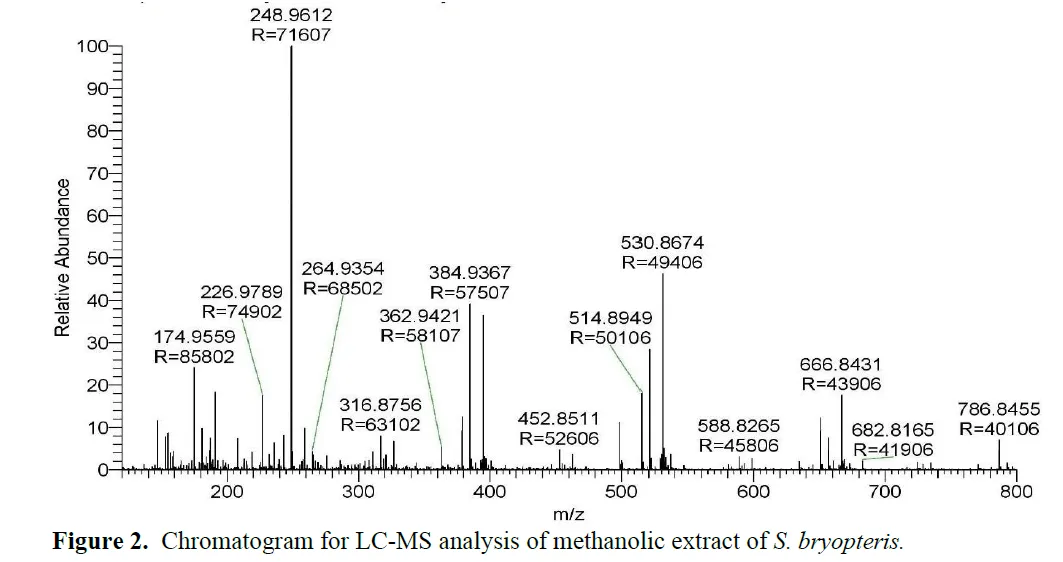
Selaginella bryopteris (L.) Baker, an endemic pteridophyte is found restricted to the Indian subcontinent mostly because of its environmental requirements of cool temperatures and optimum water availability. It is a drought-resistant species and shows curling in limited water supply reviving when water conditions are restored. This property makes this species a suitable plant for exploration of medicinal properties, although its restricted occurrence has limited this evaluation. The current study explores the role of hydrophobic (acetone) and hydrophilic solvents on the phytochemical profiles of the extracts from the dried Selaginella bryopteris, from northern terrain of India. The study is pivotal considering the demographic and environment mediated changes in the compositions of the plant. The results have shown, comparatively higher yield of phenolic and flavonoid, to be 36.67 mg/mL and 96.17 mg/mL, respectively in the methanolic extract of the plant. In the absence of limited studies on high yield extraction of the phytocompounds in methanolic extract, further characterization of the extract was performed using LC/MS analysis. The LC/MS analysis revealed a rich consortium of diverse catalogues of compounds including flavonoids and bi-flavonoids. Some of the key compounds observed, and are known for therapeutic potential such as anticancer, antioxidant and antifungal activities are Gingerol, Sciadopitysin, Ginkgetin and Amentoflavone, to name a few. The presence of such rare phytocompounds obtrude the methanolic extracts a pool of therapeutic compounds consortia that may be evaluated for the bioactivities including therapeutic potential against different model systems. The study will provide an avenue for quantification of the different compounds and their assessment of dose dependent therapeutic potential.
Keywords: Selaginella bryopteris, Amentoflavone, Sciadopitysin, LC/MS, phytoconstituents
[This article belongs to Research & Reviews : Journal of Herbal Science ]

References
- Adnan, , Siddiqui, A. J., Arshad, J., Hamadou, W. S., Awadelkareem, A. M., Sachidanandan, M., & Patel, M. (2021). Evidence-based medicinal potential and possible role of selaginella in the prevention of modern chronic diseases: Ethnopharmacological and ethnobotanical perspective. Records of Natural Products, 15(5), 355.
- Ainsworth, E. , & Gillespie, K. M. (2007). Estimation of total phenolic content and other oxidation substrates in plant tissues using Folin–Ciocalteu reagent. Nature protocols, 2(4), 875- 877.
- Antony, R., & Thomas, R. (2011). A mini review on medicinal properties of the resurrecting plant Selaginella bryopteris (Sanjeevani). International Journal of Pharmacy & Life Sciences, 2(7).
- Auwal, M. S., Saka, S., Mairiga, I. A., Sanda, K. A., Shuaibu, A., & Ibrahim, A. (2014). Preliminary phytochemical and elemental analysis of aqueous and fractionated pod extracts of Acacia nilotica (Thorn mimosa). In Veterinary research forum: an international quarterly journal (Vol. 5, 2, p. 95). Faculty of Veterinary Medicine, Urmia University, Urmia, Iran.
- Cao, , Tan, N. H., Chen, J. J., Zeng, G. Z., Ma, Y. B., Wu, Y. P., … & Wang, Q. (2010).Bioactive flavones and biflavones from Selaginella moellendorffii Hieron. Fitoterapia, 81(4), 253-258.
- Jagadish, K., Krishnan, V. V., Shenbhagaraman, R., & Kaviyarasan, V. (2009). Comparitive study on the antioxidant, anticancer and antimicrobial property of Agaricus bisporus (JE Lange) Imbach before and after boiling. African Journal of Biotechnology, 8(4).
- Jucá, M., Cysne Filho, F. M. S., de Almeida, J. C., Mesquita, D. da S., Barriga, J. R. de M., Dias, K. C. F., … Vasconcelos, S. M. M. (2018). Flavonoids: biological activities and therapeutic potential. Natural Product Research, 34(5), 692–705. https://doi.org/10.1080/14786419.2018.1493588
- Pang X, Yi T, Yi Z, Cho SG, Qu W, Pinkaew D, Fujise K, Liu Morelloflavone, a biflavonoid, inhibits tumor angiogenesis by targeting rho GTPases and extracellular signal-regulated kinase signaling pathways. Cancer Res. 2009 Jan 15;69(2):518-25. doi: 10.1158/0008-5472.CAN-08- 2531. PMID: 19147565; PMCID: PMC2662342.
- Pandey, S., Shukla, A., Pandey, S., & Pandey, A. (2017). An overview of resurrecting herb ‘Sanjeevani’(Selaginella bryopteris) and its pharmacological and ethnomedicinal uses. The Pharma Innovation, 6(2, Part A), 11.
- Patel DK. Biological Importance of a Biflavonoid ‘Bilobetin’ in the Medicine: Medicinal Importance, Pharmacological Activities and Analytical Infect Disord Drug Targets. 2022;22(5):e210322202490. doi: 10.2174/1871526522666220321152036. PMID: 35319397.
- Sun CM, Syu WJ, Huang YT, Chen CC, Ou JC. Selective cytotoxicity of ginkgetin from Selaginella J Nat Prod. 1997 Apr;60(4):382-4. doi: 10.1021/np960608e. PMID: 9134745.
- Susilo, S., & Wardhani, R. K. (2023). Phytoconstituents profiling of Selaginella willdenowii (Desv.) Baker and Pharmacological Potential. Research Journal of Pharmacy and Technology, 16(12), 5978-5985.
- Sarvade, D. D. (2020). Quantification of total alkaloid, tannin, flavonoid, phenolic, and chlorogenic acid contents of Leea macrophylla Roxb. Ex Hornem. International Journal of Green Pharmacy, 14(2).
- Sharma, T., Pandey, B., Shrestha, B. K., Koju, G. M., Thusa, R., & Karki, N. (2020). Phytochemical screening of medicinal plants and study of the effect of phytoconstituents in seed germination. Tribhuvan University Journal, 35(2), 1-11.
- Tiwari P, Kumar B, Kaur M, Kaur G, Kaur H (2011) Phytochemical screening and extraction: a review. Internationale pharmaceutica sciencia 1(1): 98-106.
- Thouri, , Chahdoura, H., El Arem, A., Omri Hichri, A., Ben Hassin, R., & Achour, L. (2017). Effect of solvents extraction on phytochemical components and biological activities of Tunisian date seeds (var. Korkobbi and Arechti). BMC complementary and alternative medicine, 17, 1-10.
- Wang, , Zhang, C., Yang, G., & Yang, Y. (2014). Biological properties of 6-gingerol: a brief review. Natural product communications, 9(7), 1934578X1400900736.
- Xiong X, Tang N, Lai X, Zhang J, Wen W, Li X, Li A, Wu Y, Liu Z. Insights Into Amentoflavone: A Natural Multifunctional Biflavonoid. Front Pharmacol. 2021 Dec 22;12:768708. doi: 10.3389/fphar.2021.768708. PMID: 35002708; PMCID: PMC8727548.

Research & Reviews : Journal of Herbal Science
| Volume | 14 | |
| Issue | 01 | |
| Received | 14/10/2024 | |
| Accepted | 08/11/2024 | |
| Published | 26/11/2024 | |
| Publication Time | 43 Days |