
Babita Srivastava,
Aman Harjai,
- Principal, Department of Architecture, Sukriti Professional Academy Kalkaji, New Delhi, India
- Architecture, Department of Landscape Architecture, Chandigarh University, Chandigarh, India
Abstract
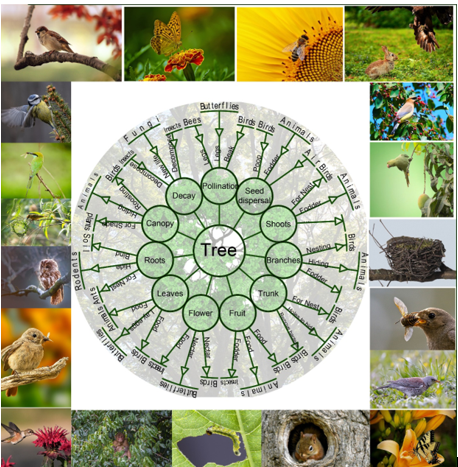
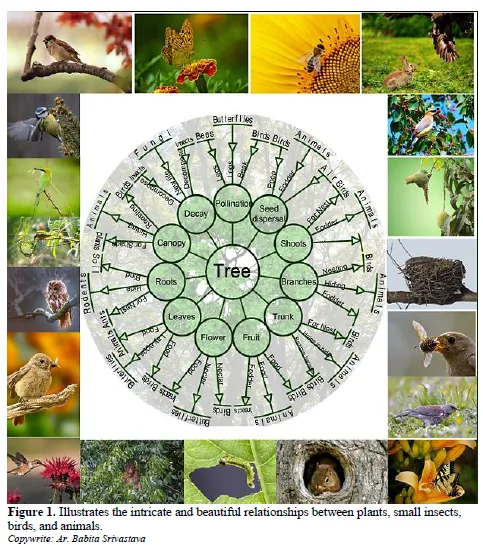
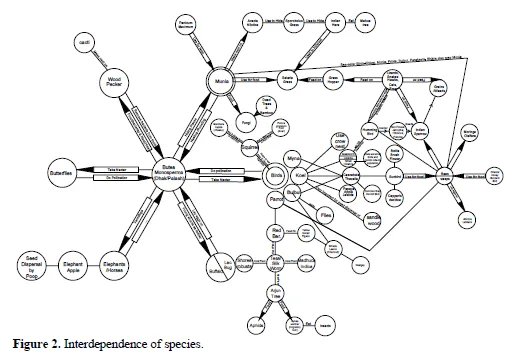
For the survival of every species, a reliance on compatible counterparts is essential. This compatibility can be examined through various aspects, with food and shelter emerging as the most common yet crucial factors. In the realm of plants, sustenance plays a pivotal role in ensuring survival. Whether it be a tree, shrub, ground cover, creeper, climber, or any other category, the availability of sufficient food is paramount. The prospects of survival are significantly diminished if any part of the plant kingdom lacks ample nutrients. Unlike animals, plants lack internal causes of death or disease, with external forces being the primary contributors to their health deterioration. Maintaining their health is heavily dependent on adequate nourishment, while other factors can be more adaptable. Conversely, in the animal kingdom, both food and shelter are integral to species’ survival. Animals require a habitat for various activities such as resting, hiding, reproducing, and even dying. While food serves as a major source for a healthy life, shelter becomes a crucial dependency. Unlike plants, animals cannot produce their food, earning them the title of consumers. They rely on consuming producers, ensuring the survival of their respective species. The Earth hosts an incredible diversity of billions and trillions of plants, animals, microorganisms, and single-cell entities, each differing in shape, size, and color. Across the globe, these organisms choose their habitats based on individual requirements for survival, encompassing needs like food, shelter, climate, temperature, topography, hydrology, geological aspects, and more. Various species exhibit diverse preferences for hosts; some choose a wide array, while others depend on a select few. For instance, small birds like munia select thin grass blades to construct their nests. The foundational plants for these nests may exhibit a bushy structure be it sturdy or not. The insects and seeds preferred by these birds are contingent on their host plants, which serve as both shelter and a food source for insects, as well as producers of seeds.
Keywords: Species, Biodiversity, butea monosperma, Sturnia pagodarum.
[This article belongs to Research & Reviews : Journal of Ecology ]
References
- Hatcher MJ, Dick JT, Dunn AM. Diverse effects of parasites in ecosystems: linking interdependent processes. Front Ecol Environ. 2012;10:186–94. DOI: 10.1890/110016.
- Hagen M, Kissling WD, Rasmussen C, De Aguiar MAM, Brown LE, Carstensen DW, Alves-dos-Santos I, Dupont YL, Edwards FK, Genini J, et al. Biodiversity, species interactions and ecological networks in a fragmented world. In: Advances in Ecological Research. Cambridge (USA): Academic Press; 2012. p. 46. DOI: 10.1016/B978-0-12-396992-7.00002-2.
- Pfaff A, Walker R. Regional interdependence and forest ‘transitions’: substitute deforestation limits the relevance of local reversals. Land Use Policy. 2010;27:119–29. DOI: 10.1016/j.landusepol.2009.07.010.
- Adebayo O. Loss of biodiversity: the burgeoning threat to human health. Ann Ib Postgrad Med. 2019;17:1–3. PubMed: 31768149.
- Alho CJR. The value of biodiversity. Braz J Biol. 2008;68(Suppl):1115–8. DOI: 10.1590/s1519-69842008000500018. PubMed: 19197481.
- Bowker GC. Biodiversity data diversity. Soc Stud Sci. 2000;30:643–83. DOI: 10.1177/030631200030005001.
- Burton PJ, Balisky AC, Coward LP, Kneeshaw DD, Cumming SG. The value of managing for biodiversity. For Chron. 1992;68:225–37. DOI: 10.5558/tfc68225-2.
- Cardinale BJ, Duffy JE, Gonzalez A, Hooper DU, Perrings C, Venail P, Narwani A, Mace GM, Tilman D, Wardle DA, et al. Biodiversity loss and its impact on humanity. Nature. 2012;486:59–67. DOI: 10.1038/nature11148. PubMed: 22678280.
- Kark S. Effects of ecotones on biodiversity. In: Levin SA, editor. Encyclopedia of biodiversity. 3rd ed. New York (USA): Academic Press; 2013. p. 142–8.
- Simberloff D. The role of science in the preservation of forest biodiversity. For Ecol Manag. 1999;115:101–11. DOI: 10.1016/S0378-1127(98)00391-0.
Research & Reviews : Journal of Ecology
| Volume | 13 | |
| Issue | 02 | |
| Received | 24/05/2024 | |
| Accepted | 03/07/2024 | |
| Published | 20/07/2024 | |
| Publication Time | Days |