
Sayali S. Shelar,
Rajendra K. Surawase,
- Research Scholar, Department of Pharmaceutics, Loknete Dr. J. D. Pawar College of Pharmacy, Maharashtra, India
- Assistent Professor, Department of Pharmaceutics, Loknete Dr. J. D. Pawar College of Pharmacy, Maharashtra, India
Abstract
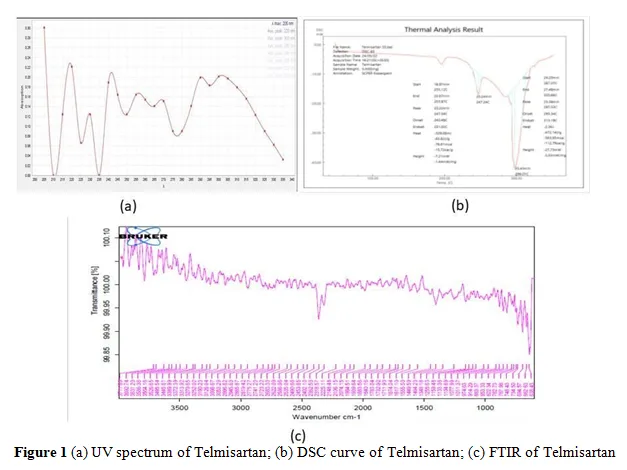
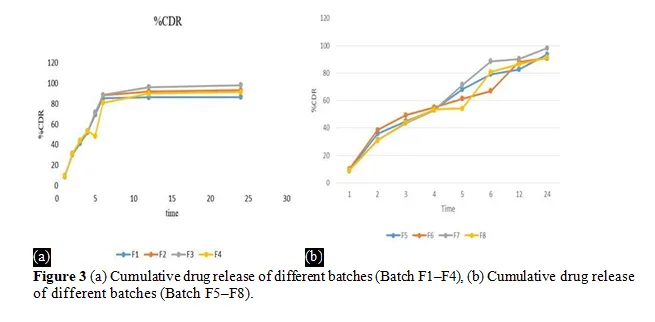
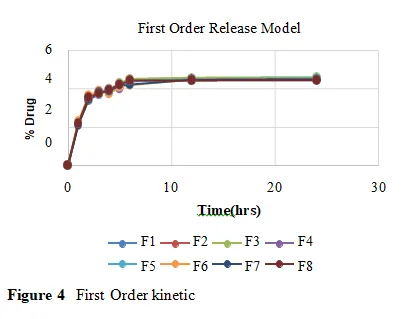
Introduction: The antihypertensive medication Telmisartan (TEL) is a member of BCS class II, which is distinguished by limited oral rate and extent and water solubility. By localizing the medication release in the stomach, gastro-retentive floating bead devices may be able to address the issues related to partial absorption and the low solubility of TEL. The preparation of TEL floating alginate beads was the aim of this investigation. The current work aims to extend the duration of TEL’s gastric residence period. Two-tiered factorial layout was employed in the development and optimization of eight formulations of TEL alginate beads. The con. of calcium chloride, sodium alginate, and olive oil are independent variables, and the dependent parameters are the drug release, entrapment efficiency, and in vitro buoyancy. Several formulations of TEL alginate beads were made using the emulsion gelation process and calcium chloride is used as cross-linking agent. The in vitro buoyancy, in vitro drug release, and trapping efficiency of each formulation were assessed. The components’ compatibility was established by DSC and FTIR spectroscopy. Results: The resultant beads showed excellent entrapment efficiency, prolonged drug release, and in vitro buoyancy. DSC and IR spectroscopy confirmed that TEL was safe to use with other ingredients. To assess the kinetics and the drug release, the drug release data was fitted to several mathematical models, including the Korsmeyer-Peppas model, the Higuchi equation, the zero-order, and the first-order models. Firstorder drug release was seen, and a non-Fickian mechanism was identified. Conclusion: We conclude that this novel approach to delivering TEL alginate beads is a potentially useful tool for improving medication solubility, oral bioavailability, and therapeutic efficacy, ultimately leading to improved patient adherence. The invitro dissolution study indicates that the F3 formulation has more drug release than other formulations. Finally, it is concluded that the F3 batch is the optimized formulation because it shows maximum drug release up to 98.13% as compared to other formulations due to concentration of oil and sodium alginate used as release rate retardant and gives a better result for drug release characteristics.
Keywords: Antihypertensive, telmisartan, beads, sodium alginate, gastric retention.
[This article belongs to Research & Reviews: A Journal of Drug Formulation, Development and Production ]

References
1. Zhang Y, Jiang T, Zhang Q, Wang S. Inclusion of telmisartan in mesocellular foam nanoparticles: Drug loading and release property. Eur J Pharm Biopharm. 2010;76(1):17–23. doi: 10.1016/j.ejpb.2010.05.010.
2. Reda WW, Mohamed AM, Razaak A, EL-Gindy G, Fathalla D. Formulation and assessment of celecoxib floating beads in capsule using 2^ 3 full factorial design. J Adv Biomedical Pharm Sci. 2022;5(3):101–112. doi: 10.21608/JABPS.2022.136094.1157.
3. Sharma M. Formulation and evaluation of sodium alginate beads by emulsion gelation method. AJP. 2017;11(01). doi: 10.22377/AJP.V11I01.1096.
4. Rasel MA, Hasan M. Formulation and evaluation of floating alginate beads of diclofenac sodium. Dhaka Univ J Pharm Sci. 2012;11(1):29–35. doi: 10.3329/dujps.v11i1.12484.
5. Takka S, Gürel A. Evaluation of chitosan/alginate beads using experimental design: formulation and in vitro characterization. Aaps Pharmscitech. 2010;11(1):460–466. doi: 10.1208/s12249-010-9406-z.
6. Krishna BS, Gavini V, Meenakshi BM, Mounika B, Rajitha B, Balamani B. Controlled release microbeads of zidovudine incorporated with natural waxes: Design and characterization. Am J PharmTech Res. 2015;6(1):1–13.
7. Telmisartan: Uses, interactions, mechanism of action | DrugBank Online [Internet]. Drugbank.com. DrugBank; 2016 [Accessed from October 2024]. Available from: https://go.drugbank.com/drugs/DB00966
8. Sharma YR. Elementary organic spectroscopy. S. Chand Publishing; 2007.
9. Bairagi PD, Gondkar SB, Saudagar RB. Formulation development and evaluation of floating wax microspheres of tizanidine hydrochloride. Asian J Pharm Pharmacol. 2018;4(5):673–679. doi: 10.31024/ajpp.2018.4.5.19.
10. Montgomery DC. Design and analysis of experiments. 10th edition John Wiley & Sons; 2017.
11. More KS, Sonawan MP, Kor VB, Bhamare DB. Formulation development and evaluation of wax incorporated floating beads of dapagliflozin. Int J Pharm Sci Nanotechnol (IJPSN). 2023;16(5):6953–6957. doi: 10.37285/ijpsn.2023.16.5.3.
12. Birajdar AA, Deshmukh MT, Shete RV. A review on gastro-retentive floating microspheres. JDDT. 2021;11(1-s):131–138. doi: 10.22270/jddt.v11i1-s.4518.
13. Arora S, Ali J, Ahuja A, Khar RK, Baboota S. Floating drug delivery systems: A review. AAPS PharmSciTech. 2005;6:E372–E390. doi: 10.1208/pt060347.
14. Bairagi PD, Gondkar SB, Saudagar RB. Formulation development and evaluation of floating wax microspheres of tizanidine hydrochloride. Asian J Pharm Pharmacol. 2018;4(5):673–679.
15. Pund AU, Shendge RS, Pote AK. Current approaches on gastroretentive drug delivery systems. JDDT. 2020;10(1):139–146.
16. Uthumansha U, Prabahar K, Gajapathy DB, El-Sherbiny M, Elsherbiny N, Qushawy M. Optimization and in vitro characterization of telmisartan loaded sodium alginate beads and its in vivo efficacy investigation in hypertensive induced animal model. Pharmaceutics. 2023;15(2):709. doi: 10.3390/pharmaceutics15020709.
17. Thakur S, Sharma B, Verma A, Chaudhary J, Tamulevicius S, Thakur VK. Recent progress in sodium alginate based sustainable hydrogels for environmental applications. J Clean Prod. 2018;198:143–159. doi: 10.1016/j.jclepro.2018.06.259.
18. Council GC. The GCC guidelines for stability testing of drug substances and pharmaceutical products. Publication (online). Edition Two; 2011;1428:22.

| Volume | 11 | |
| Issue | 03 | |
| Received | 19/08/2024 | |
| Accepted | 05/10/2024 | |
| Published | 26/10/2024 | |
| Publication Time | 68 Days |