
P.O. Asipita,
H.O. Haruna,
M.M. Ambursa,
I.G. Wawata,
F.A. Atiku,
J. Ibrahim,
L.A. Musa,
- Research Scholar, Department of Science and Technology Education, Confluence University of Science and Technology, Osara, Nigeria
- Research Scholar, Department of Science and Technology Education, Confluence University of Science and Technology, Osara, Nigeria
- Research Scholar, Department of Pure and Applied Chemistry, Kebbi State University of Science and Technology, Aliero, Nigeria
- Research Scholar, (Ph.D), Department of Industrial Chemistry, KIU Western Campus Bushenyi, Uganda, East Africa
- Research Scholar, (Ph.D.), School of Chemical & Process Engineering, University of Leeds,, LS2 9JT,, United Kingdom
- Research Scholar, Department of Chemistry, Confluence University of Science and Technology, Osara, Nigeria
- Research Scholar, Department of Chemistry, Confluence University of Science and Technology, Osara, Nigeria
Abstract
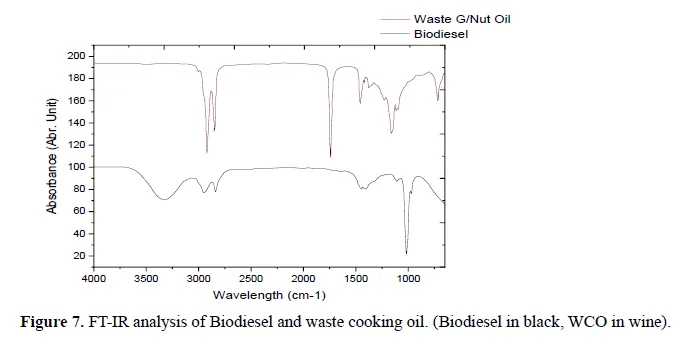
The Polyoxo vanadate catalytic trans-esterification of waste cooking oil (WCO) was carried out by optimizing four reaction parameters which include: catalyst loading, methanol/oil ratio, temperature, and reaction time. These optimized parameters are 0.5 g, 0.8 g, and 1.2 g catalyst loading, 3:1, 6:1 and 9:1 methanol/oil ratio, 45°C, 60°C and 65°C reaction temperature, 45 min, 60 min and 90 min reaction time. The regression equation in the uncoded units of the optimization revealed that for every 1% increment in catalyst loading there tends to be a 15.64% increment of the biodiesel yield, more so 1% decrease in the interaction of methanol and time tends to increase the yield of the diesel by 0.0691% though under an ideal condition if there are no methanol/oil ratio, catalyst, methanol/oil * Time, 43.7 % is given for the unexplained parameter residual in the equation. A normal probability plot shows that, all the observations of % yield fit in the same line or trend. The Pareto chart of standardized shows that the catalyst loading has a high and strong effect on the biodiesel yield as it is the only parameter with such a standard effect of 1.492, the effect of methanol/oil interaction tends to follow the catalyst loading with a less standard effect of 1.0. The Contour plot of % yield vs Time, methanol/oil ratio reveals that at constant catalyst loading the interaction deepens when yield is above 50%. When the time is held constant, the Surface plot reveals the best output of the yield with catalyst loading of 0.8 g, methanol/oil ratio of 9:1, and 90 min reaction time. However, the R-squared value standard reports that about 34.52% of the parameters are explained by the yield which might be diagnostic for unusual observation on the yield with the value of 50.23% and 76.44% attributed by random chance. The biodiesel sample’s FTIR measurement clearly verifies that waste oil was converted to biodiesel.
Keywords: Biodiesel, catalyst, optimization, parameter, pollution, polyoxovanadate, transesterification
[This article belongs to OmniScience: A Multi-disciplinary Journal ]


References
1. Gupta AR, Rathod VK. Waste cooking oil and waste chicken eggshells derived solid base catalyst for the biodiesel production: Optimization and kinetics. Waste Manag. 2018 Sep 1;79:169–78.
2. Vicente G, Martínez M, Aracil J. Optimization of integrated biodiesel production. Part I. A study of the biodiesel purity and yield. Bioresour Technol. 2007;98(9):1724–33. doi:10.1016/j.biortec.2006.7.024
3. Zhang P, Chen X, Leng Y, Dong Y, Jiang P, Fan M. Biodiesel production from palm oil and methanol via zeolite derived catalyst as a phase boundary catalyst: An optimization study by using response surface methodology. Fuel. 2020 Jul 15; 272:117680.
4. Dunn, RO. Effect of minor constituents on cold flow properties and performance of biodiesel. Prog Energy Combust Sci. 2009;35(6):481–9. doi:10.1016/j.pecs.2009.07.002
5. Patil PD, Gude VG, Reddy HK, Muppaneni T, Deng S. Biodiesel production from waste cooking oil using sulfuric acid and microwave irradiation processes. J Environ Protect. 2012 Jan 5;3(1):107–13.
6. Boakye P, Boakye P. Biodiesel production from selected non-edible feedstocks using unsupported potassium carbonate. M.Sc. Thesis, Kwame Nkrumah University of Science and Technology; 2013. Retrieved from: http://hdl.handle.net/123456789/5515
7. Sadaf S, Iqbal J, Ullah I, Bhatti HN, Nouren S, Nisar J, et al. Biodiesel production from waste cooking oil: an efficient technique to convert waste into biodiesel. Sustain Cities Soc. 2018;41:220–6.6.
8. Leung DYC, Guo Y. Transesterification of neat and used frying oil: optimization for biodiesel production. Fuel Process Technol. 2006;87(10):883–90.
9. Wawata IG, Ambursa MM, Asipita PO, Obaid FA, Babayemi W. Polyoxovanadate Catalyzed Synthesis of Biodiesel (Methyl Esters) from Waste Cooking Oil. KJSET. 2023;2(2):157–65. doi:10.59568/KJSET-2023-2-1-20
10. Abdulkareem AS, Uthman H, Afolabi AS, Awenebe OL. Extraction and optimization of oil from Moringa oleifera seed as an alternative feedstock for the production of biodiesel. Sustainable Growth Appl Renew Energy Sourc. 2011;244–68.
11. Cd AO. Cd 3-25. Official Method Saponification Value, Sampling and Analysis of Commercial Fats and Oils. Urbana (IL): The American Oil Chemists’ Society; 2003.
12. Chavarria-Hernandez JC, Pacheco-Catalán DE. Predicting the kinematic viscosity of FAMEs and biodiesel: Empirical models. Fuel. 2014 May 15;124:212–20.
13. Huang Y, Li F, Bao G, Wang W, Wang H. Estimation of kinematic viscosity of biodiesel fuels from fatty acid methyl ester composition and temperature. J Chem Eng Data. 2020;65(5):2476–85.
14. Mostafa SS, El-Gendy NS. Evaluation of fuel properties for microalgae Spirulina platensis bio-diesel and its blends with Egyptian petro-diesel. Arab J Chem. 2017;10:S2040–5.

OmniScience: A Multi-disciplinary Journal
| Volume | 14 | |
| Issue | 03 | |
| Received | 29/10/2024 | |
| Accepted | 01/11/2024 | |
| Published | 06/11/2024 | |
| Publication Time | Days |