
Ankit Kumar,
Vibha Rani,
- PhD Scholar, Department of Biotechnology, Jaypee Institute of Information Technology, A-10, Sector-62, Noida-201309, Uttar Pradesh, India
- Professor, Department of Biotechnology, Jaypee Institute of Information Technology, A-10, Sector-62, Noida-201309, Uttar Pradesh, India
Abstract
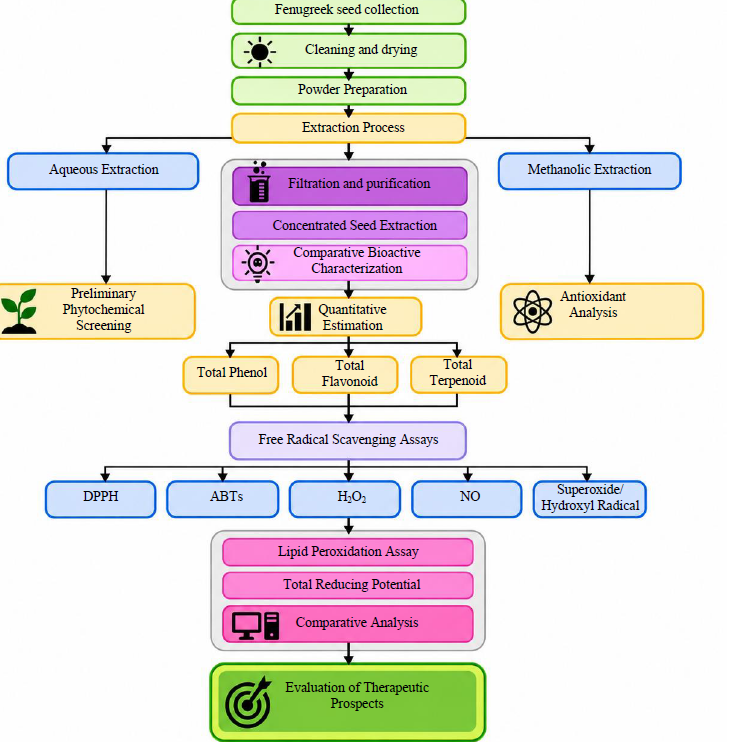
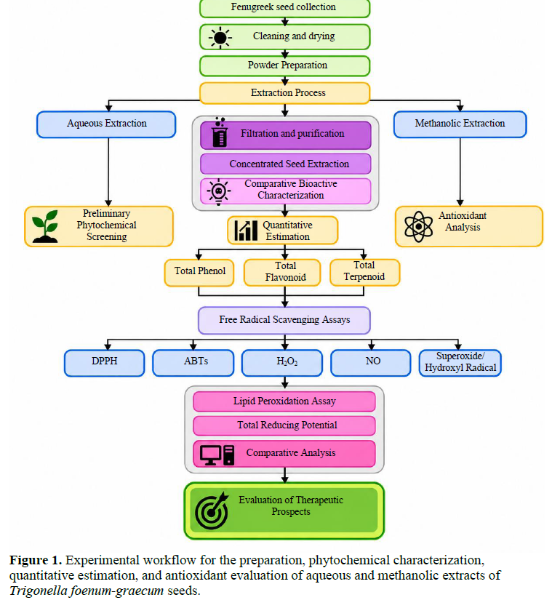
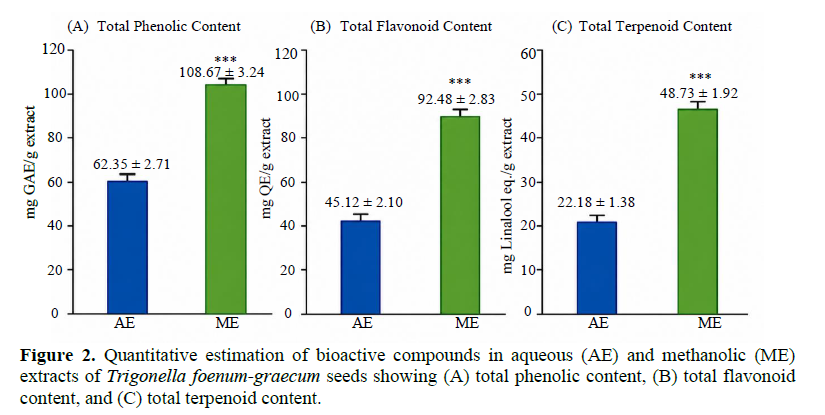
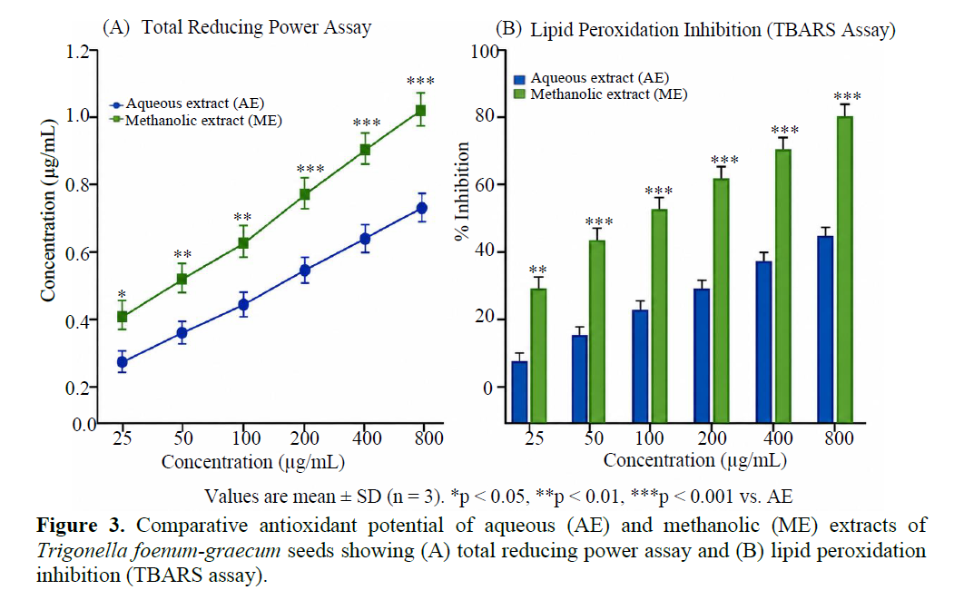
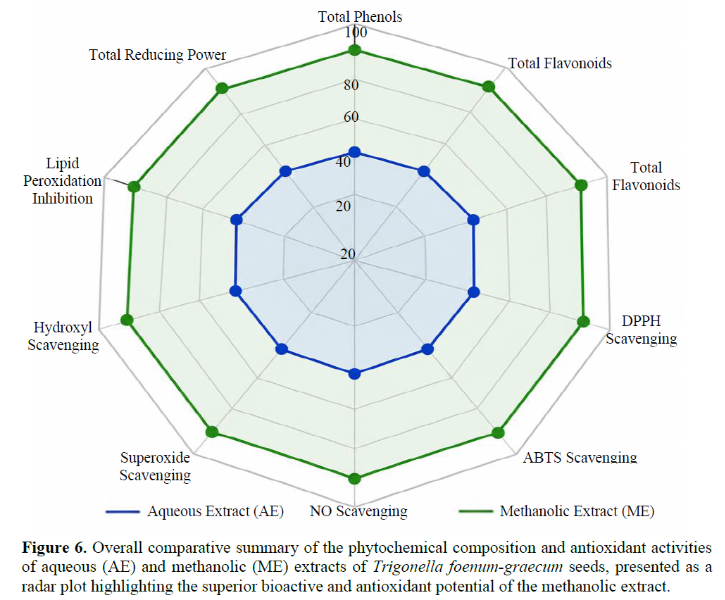
A medicinal plant with substantial therapeutic potential, fenugreek (Trigonella foenum-graecum L.) is rich in bioactive phytoconstituents. The phytochemical makeup and antioxidant properties of aqueous and methanolic fenugreek seed extracts were compared in this study. Phenolics, flavonoids, terpenoids, alkaloids, tannins, and saponins were found in both extracts, with the methanolic fraction showing greater intensity, according to preliminary phytochemical screening. The methanolic extract has higher levels of phenolic, flavonoid, and terpenoid content, according to quantitative analyses. Antioxidant analysis showed that the methanolic extract had better reducing potential and lipid peroxidation inhibition than the aqueous extract. Additionally, the methanolic extract showed increased capacity to scavenge free radicals from DPPH, ABTS, hydrogen peroxide, nitric oxide, superoxide, and hydroxyl radicals. The richer phytochemical composition of the methanolic extract may be responsible for its increased bioactivity. Overall, the results demonstrate the therapeutic value of fenugreek seed extracts, especially the methanolic extract, for possible phytopharmaceutical and nutraceutical uses in conditions linked to oxidative stress.
Keywords: Methanolic extract, Aqueous extract, Phytochemicals, Antioxidant activity, Free radical scavenging, Phenolic compounds, Flavonoids, Terpenoids, Oxidative stress, Therapeutic potential.
[This article belongs to Research & Reviews : Journal of Botany ]
References
- Khan F, Negi K, Kumar T. Effect of sprouted fenugreek seeds on various diseases: A review. J Diabetes Metab Disord Control. 2018 Aug;5(4):119–25. doi:10.15406/JDMDC.2018.05.00149.
- Dahab AA, et al. Seed disinfection treatments minimized microbial load and enhanced nutritional properties of fenugreek sprouts which alleviated diabetes-negative disorders in diabetic rats. Nutrients. 2024 Aug;16(16):2635. doi:10.3390/nu16162635.
- Chauhan G, Sharma M, Varma A, Kharkwal H. Phytochemical analysis and anti-inflammatory potential of fenugreek. Med Plants Int J Phytomed Relat Ind. 2010;2(1):39–44. doi:10.5958/J.0975-4261.2.1.005.
- Singh P, Bajpai V, Gond V, Kumar A, Tadigoppula N, Kumar B. Determination of bioactive compounds of fenugreek (Trigonella foenum-graecum) seeds using LC-MS techniques. Methods Mol Biol. 2020;2107:377–93. doi:10.1007/978-1-0716-0235-5_21.
- Inamdar W, Sultana A, Mubeen U, Rahman K. Clinical efficacy of Trigonella foenum-graecum (fenugreek) and dry cupping therapy on intensity of pain in patients with primary dysmenorrhea. Chin J Integr Med. 2016;22(12):1–8. doi:10.1007/S11655-016-2259-X.
- Es-Safi NE, Gómez-Cordovés C. Characterization of flavonoid glycosides from fenugreek (Trigonella foenum-graecum) crude seeds by HPLC-DAD-ESI/MS analysis. Int J Mol Sci. 2014;15(11):20668–85. doi:10.3390/ijms151120668.
- Kumar P, Bhandari U, Jamadagni S. Fenugreek seed extract inhibits fat accumulation and ameliorates dyslipidemia in high fat diet-induced obese rats. Biomed Res Int. 2014;2014:606021. doi:10.1155/2014/606021.
- Katalinic V, Milos M, Kulisic T, Jukic M. Screening of 70 medicinal plant extracts for antioxidant capacity and total phenols. Food Chem. 2006;94(4):550–7. doi:10.1016/J.FOODCHEM.2004.12.004.
- Schieber A, Keller P, Carle R. Determination of phenolic acids and flavonoids of apple and pear by high-performance liquid chromatography. J Chromatogr A. 2001;910(2):265–73. doi:10.1016/S0021-9673(00)01217-6.
- Wong CC, Li HB, Cheng KW, Chen F. A systematic survey of antioxidant activity of 30 Chinese medicinal plants using the ferric reducing antioxidant power assay. Food Chem. 2006;97(4):705–11. doi:10.1016/J.FOODCHEM.2005.05.049.
- Shakuntala S, Pura Naik J, Jeyarani T, Madhava Naidu M, Srinivas P. Characterisation of germinated fenugreek (Trigonella foenum-graecum L.) seed fractions. Int J Food Sci Technol. 2011;46(11):2337–43. doi:10.1111/J.1365-2621.2011.02754.X.
- Re R, Pellegrini N, Proteggente A, Pannala A, Yang M, Rice-Evans C. Antioxidant activity applying an improved ABTS radical cation decolorization assay. Free Radic Biol Med. 1999;26(9–10):1231–7. doi:10.1016/S0891-5849(98)00315-3.
- Benzie IFF, Strain JJ. The ferric reducing ability of plasma (FRAP) as a measure of antioxidant power: The FRAP assay. Anal Biochem. 1996;239(1):70–6. doi:10.1006/abio.1996.0292.
- Hancock JT, Neill SJ. Nitric oxide: Its generation and interactions with other reactive signaling compounds. Plants (Basel). 2019;8(2):41. doi:10.3390/plants8020041.
- Hooda S, Jood S. Effect of soaking and germination on nutrient and antinutrient contents of fenugreek (Trigonella foenum-graecum L.). J Food Biochem. 2003;27(2):165–76. doi:10.1111/J.1745-4514.2003.TB00274.X.
- del Hierro JN, Reglero G, Martin D. Chemical characterization and bioaccessibility of bioactive compounds from saponin-rich extracts and their acid-hydrolysates obtained from fenugreek and quinoa. Foods. 2020;9(9):1159. doi:10.3390/foods9091159.
Research & Reviews : Journal of Botany
| Volume | 15 | |
| Issue | 02 | |
| Received | 05/07/2026 | |
| Accepted | 10/07/2026 | |
| Published | 11/07/2026 | |
| Publication Time | 6 Days |