
This is an unedited manuscript accepted for publication and provided as an Article in Press for early access at the author’s request. The article will undergo copyediting, typesetting, and galley proof review before final publication. Please be aware that errors may be identified during production that could affect the content. All legal disclaimers of the journal apply.
Surya Prakash,
Bhawana Thakkar,
Mohd Arham,
Nitin Verma,
- Assistant Professor, Department of Biotechnology, Meerut Institute of Engineering and Technology, Meerut, Uttar Pradesh, India
- B.Tech Student, Department of Biotechnology, Meerut Institute of Engineering and Technology, Meerut, Uttar Pradesh, India
- B.Tech Student, Department of Biotechnology, Meerut Institute of Engineering and Technology, Meerut, Uttar Pradesh, India
- Professor, Department of Biotechnology, Meerut Institute of Engineering and Technology, Meerut, Uttar Pradesh, India
Abstract
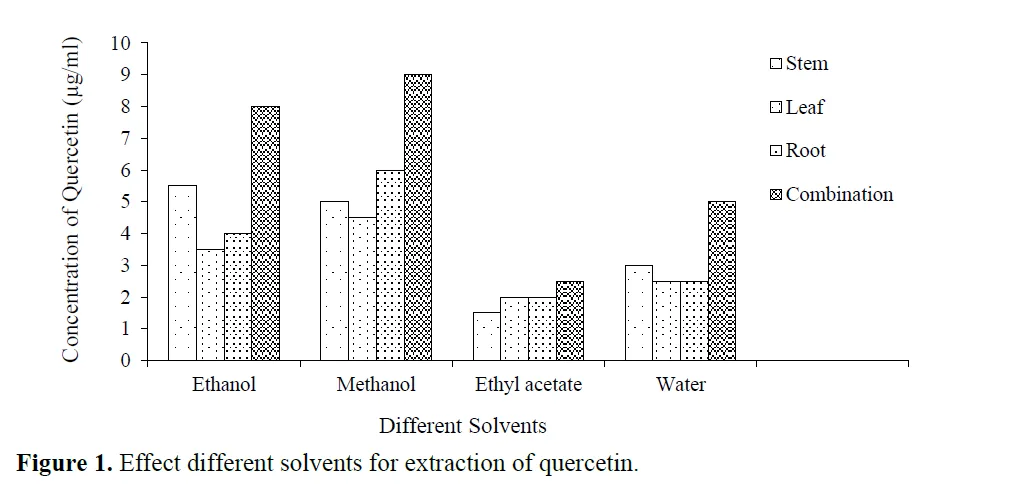
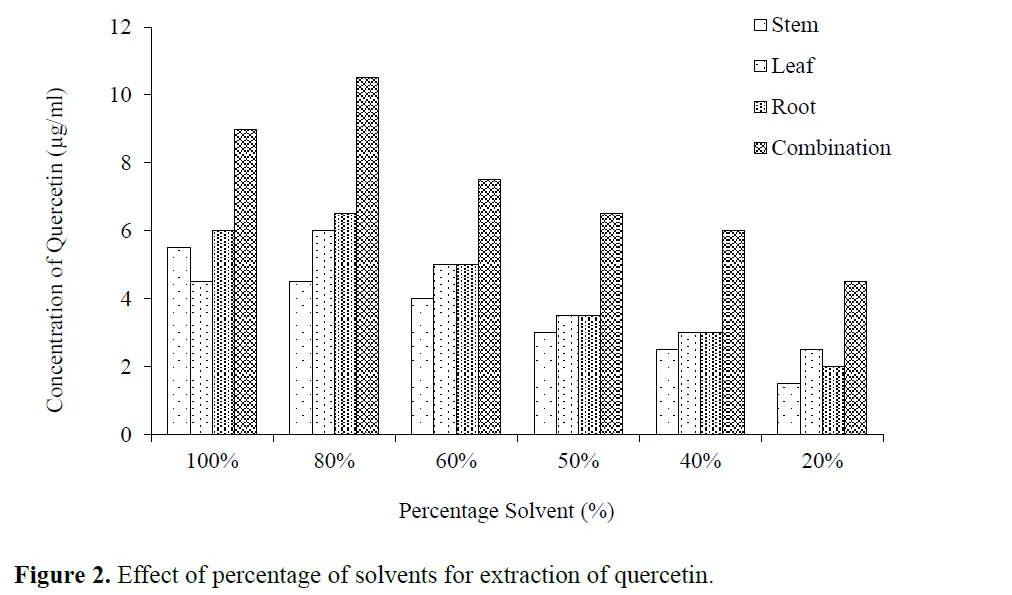
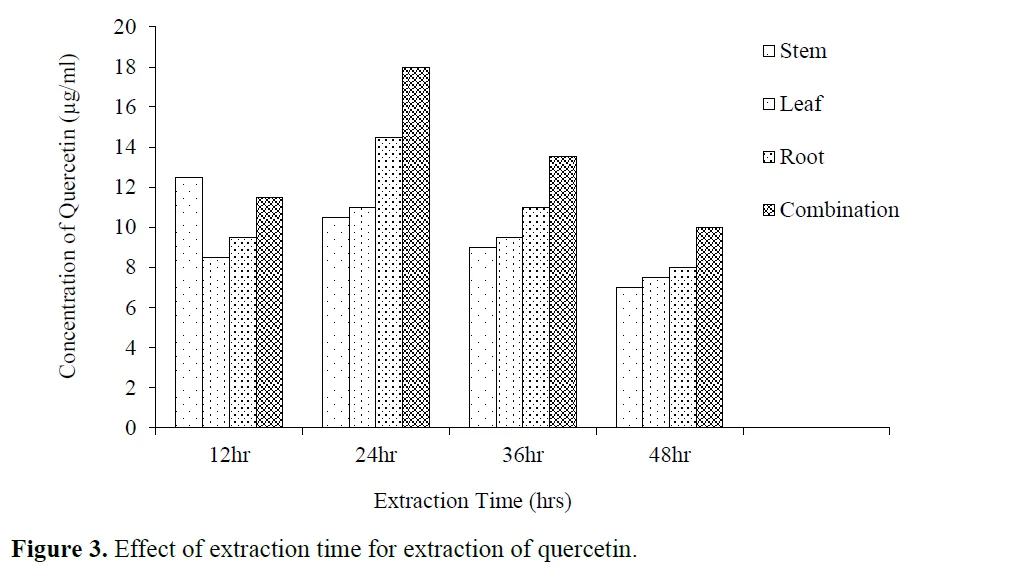
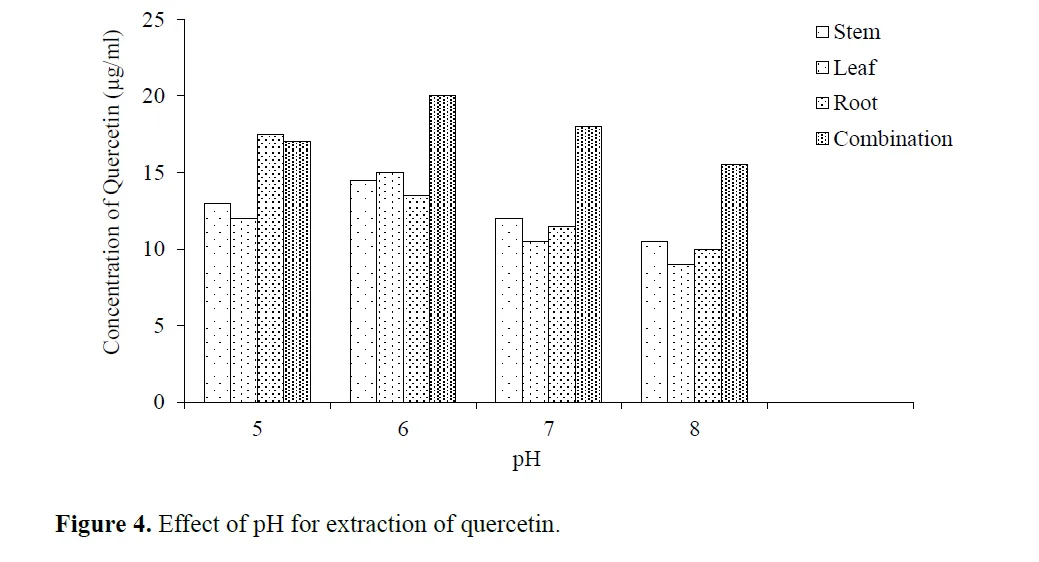
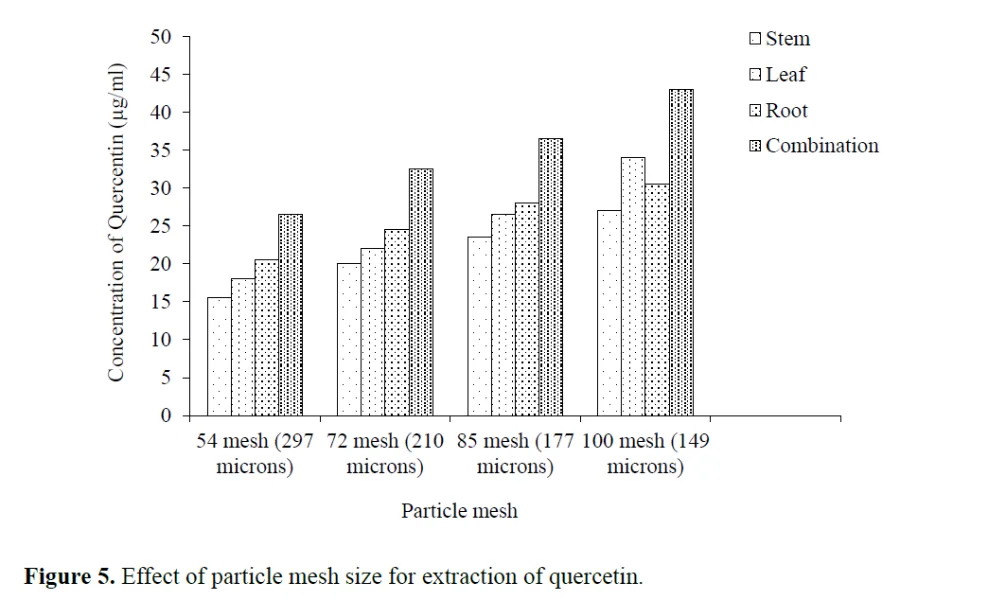
Medicinal plants constitute an essential natural resource for the treatment of chronic illness. It is possible to treat the same illness using various medicinal plants; the decision is frequently influenced by the nation in which the disorder is most frequent. Acanthus ilicifolius is an Indian mangrove and belongs to Acanthaccae family and grows in the coastal zone. It comprises of a wide range of phytochemicals and exhibits numerous biological characteristics. In this study, the quercetin flavonoid was extracted by combining different parts (root, stem, and leaf) of Acanthus ilicifolius. The extraction process, when further optimized, involved various physicochemical parameters that influenced the yield of quercetin. These parameters were different solvents and their varying concentration, extraction time, pH, and particle mesh size. The optimal conditions for extracting quercetin from this plant combination were found to be methanol as the solvent with 80% concentration, 24 hrs extraction time at pH-6, and having a particle size of 100 mesh. As a result, the concentration of the quercetin of this plant extract was found to be 43.0 µg/ml.
Keywords: Acanthus ilicifolius, Mangrove, Extraction, Quercetin, Methanol.
[This article belongs to Research & Reviews : Journal of Botany ]
References
- Mazda Y, Kobashi D, Okada S. Tidal-scale hydrodynamics within mangrove swamps. Wetlands Ecol Manage. 2005;13:647–55.
- Khare CP. Indian medicinal plants: an illustrated dictionary. New York: Springer Science & Business Media; 2008.
- Das SK, Samantaray D, Patra JK, Samanta L, Thatoi H. Antidiabetic potential of mangrove plants: a review. Front Life Sci. 2016;9(1):75–88.
- Ramanjaneyulu MVV, Battula VR, Ramanjaneyulu K, Raju PS. Phytochemical analysis of Avicennia officinalis of Krishna estuary. Phytochem Anal. 2015;3(5).
- Chowdhury R, Favas PJ, Jonathan MP, Venkatachalam P, Raja P, Sarkar SK. Bioremoval of trace metals from rhizosediment by mangrove plants in Indian Sundarban Wetland. Mar Pollut Bull. 2017;124(2):1078–88.
- Ravindran C, Naveenan T, Varatharajan GR, Rajasabapathy R, Meena RM. Antioxidants in mangrove plants and endophytic fungal associations. Botanica Marina. 2012;55(3):269–
- Shanmugapriya R, Ramanathan T, Renugadevi G. Phytochemical characterization and antimicrobial efficiency of mangrove plants Avicennia marina and Avicennia officinalis. 2012.
- Agarwal S, Chakraborty S, Mitra A. Physico-chemical variables of ambient media and astaxanthin content of mangroves in Hooghly-Matla Estuarine complex of Indian Sundarbans. Int J Pharm Biol Sci. 2019;9:53–7.
- Das SS. Qualitative determination of phytochemical constituents and antimicrobial activity of the mangrove plant Avicennia alba Blume. IJRAR-Int J Res Anal Rev. 2020;7(1):627–33.
- Sarkar SK. Trace metals in a tropical mangrove wetland. Singapore: Springer; 2018. doi: 10.1007/978-981-10-1114-7.
- Bakshi MB, Chaudhuri PC. Antimicrobial potential of leaf extracts of ten mangrove species from Indian Sundarban. 2014.
- Kanchanapoom T, Kasai R, Yamasaki K. Flavonoid glycosides from Acanthus ilicifolius L. (Natural Medicine Note). Nat Med. 2002;56(3):122.
- Kanchanapoom T, Kamel MS, Kasai R, Yamasaki K, Picheansoonthon C, Hiraga Y. Lignan glucosides from Acanthus ilicifolius. Phytochemistry. 2001;56(4):369–72.
- Kanchanapoom T, Kamel MS, Kasai R, Picheansoonthon C, Hiraga Y, Yamasaki K. Benzoxazinoid glucosides from Acanthus ilicifolius. Phytochemistry. 2001;58(4):637–40.
- Agshikar NV, Naik VR, Abraham GJ, Reddy CV, Naqvo SW, Mittal PK. Analgesic anti-inflammatory activity of Acanthus ilicifolius Linn. Indian J Exp Biol. 1979;17(11):1257–8.
Research & Reviews : Journal of Botany
| Volume | 14 | |
| Issue | 01 | |
| Received | 13/12/2024 | |
| Accepted | 16/12/2024 | |
| Published | 18/12/2024 | |
| Publication Time | Days |