
This is an unedited manuscript accepted for publication and provided as an Article in Press for early access at the author’s request. The article will undergo copyediting, typesetting, and galley proof review before final publication. Please be aware that errors may be identified during production that could affect the content. All legal disclaimers of the journal apply.
Bhushan Bhagvan Thakare,
K. P. Patil,
Neha Patil,
Mrunal D. Pendarker,
S. P. Pawar,
- Student, Department of Pharmacy, P.S.G.V.P. Mandal’s College of Pharmacy, Shahada, Maharashtra, India
- Assistant Professor, Department of Pharmaceutical Analysis, P. S. G. V. P Mandal’s College of Pharmacy, Shahada, Maharashtra, India
- Assistant Professor, Department of Pharmaceutical Analysis, P. S. G. V. P Mandal’s College of Pharmacy, Shahada, Maharashtra, India
- Assistant Professor, Department of Pharmaceutical Analysis, P. S. G. V. P Mandal’s College of Pharmacy, Shahada, Maharashtra, India
- Principal, P. S. G. V. P Mandal’s College of Pharmacy, Shahada, Maharashtra, India
Abstract
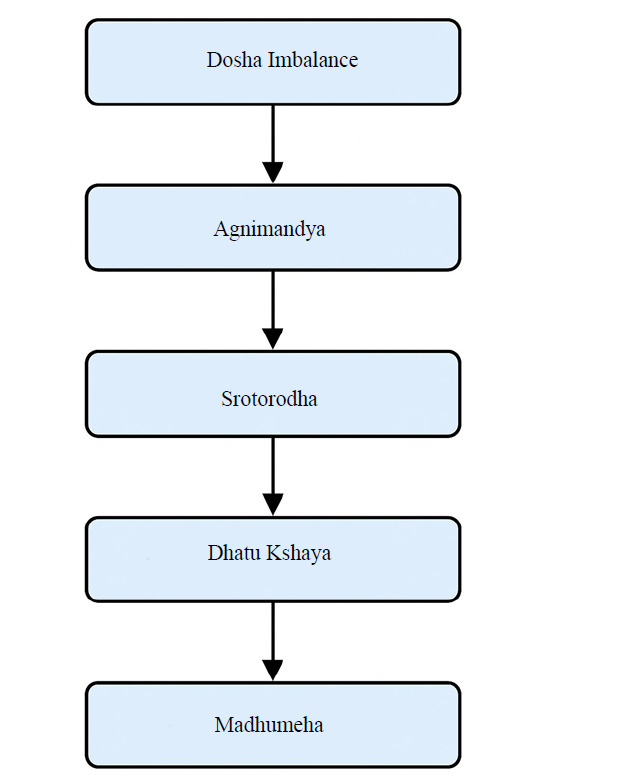
Diabetes mellitus is one of the most prevalent metabolic disorders globally, characterized by persistent hyperglycemia resulting from defects in insulin secretion, insulin action, or both. It leads to serious complications affecting the cardiovascular, renal, and nervous systems, imposing a significant health and economic burden. In Ayurveda, diabetes is described as Madhumeha, a subtype of Prameha, primarily caused by the vitiation of Kapha dosha, Meda dhatu (fat metabolism), and Agnimandya (impaired digestion). The disease develops due to improper dietary habits, a sedentary lifestyle, and disturbed metabolic fire, leading to Srotorodha (microchannel obstruction) and systemic imbalance. Ayurvedic management emphasizes restoring metabolic harmony through Ahara (diet), Vihara (lifestyle modification), and Aushadhi (herbal therapy). Several herbs, such as Trigonella foenum-graecum (Fenugreek), Gymnema sylvestre (Gurmar), Phyllanthus emblica (Amla), Curcuma longa (Turmeric), Syzygium cumini (Jamun), and Momordica charantia (Bitter Melon), possess significant hypoglycemic, antioxidant, and lipid-regulating properties. These herbs act through multiple mechanisms, including insulin secretion enhancement, beta-cell regeneration, and oxidative stress reduction. Furthermore, polyherbal formulations, such as Diabecon, Hyponidd, and BGR-34, exhibit synergistic efficacy in glycemic control and metabolic correction. This review integrates classical Ayurvedic knowledge with modern pharmacological and clinical findings, highlighting the efficacy, mechanisms, and therapeutic potential of Ayurvedic herbs and formulations in the holistic management of diabetes mellitus (Madhumeha).
Keywords: Ayurveda, Madhumeha, diabetes mellitus, antidiabetic herbs, polyherbal formulations, insulin sensitivity, β-cell regeneration, oxidative stress, Rasayana, glucose metabolism
[This article belongs to Research and Reviews : A Journal of Ayurvedic Science, Yoga and Naturopathy ]

References
- Marles RJ, Farnsworth Antidiabetic plants and their active constituents. Phy-tomedicine. 1995;2(2):137–89.
- Grover JK, Yadav S, Vats Medicinal plants of India with antidiabetic potential. J Ethnopharmacol. 2002;81(1):81–100.
- International Diabetes Federation (IDF). Diabetes Atlas, 10th Brussels: IDF; 2021.
- Modak M, Dixit P, Londhe J, Ghaskadbi S, Devasagayam TP. Indian herbs and herbal drugs used for the treatment of diabetes. J Clin Biochem Nutr. 2007;40(3):163–73.
- Patel DK, Prasad SK, Kumar R, Hemalatha S. An overview on antidiabetic medicinal plants having insulin mimetic property. Asian Pac J Trop Biomed. 2012;2(4):320–30.
- American Diabetes Association. Classification and diagnosis of diabetes: Standards of Medical Care in Diabetes. Diabetes Care. 2024;47(Suppl 1):S14–S23.
- Kahn The relative contributions of insulin resistance and -cell dysfunction to the pathophysiology of Type 2 diabetes. Diabetologia. 2003;46(1):3–19.
- Singh S, Garg V, Yadav D. Clinical efficacy of BGR-34 in Type 2 Diabetes Mellitus: A randomized controlled trial. Ayu. 2022;43(1):12–9.
- Watal G, Gupta RK. Role of herbal therapy in diabetes management. Pharmacogn Rev. 2012;6(11):1–10.
- Murudkar PH, Patil MG, Bhosale AV. Common Ayurvedic, Chinese traditional and Unani plants used in diabetes mellitus: A comparative review. Front Pharmacol. 2022;13:991083.
- Sharma Charaka Samhita. Vol. II. Varanasi: Chaukhambha Orientalia; 2001.
- Tripathi Sushruta Samhita. Vol. I. Varanasi: Chaukhambha Sanskrit Series; 2008.
- Bhavaprakasha In: Sharma PV, editor. Varanasi: Chaukhambha Bharati Academy; 2000.
- Modak M, Dixit P, Londhe J, et al. Indian herbs and herbal drugs used for the treatment of diabetes. J Clin Biochem Nutr. 2007;40(3):163–73.
- Baliga MS, Dsouza JJ. Amla (Emblica officinalis Gaertn): A wonder berry in diabetes and lipid disorders. Eur J Clin Nutr. 2011;65(9):1025–32.
- Patel DK, et al. Natural antidiabetic plant compounds and their mechanisms of action. J Ayurveda Integr Med. 2013;4(2):81–8.
- Singh KN, Srivastava B, Pandey Phytochemical and pharmacological profile of Aegle marmelos. Indian J Nat Prod Resour. 2009;8(2):27–36.
- Shastri Charaka Samhita: Ayurveda Dipika Commentary. Varanasi: Chaukhambha Publications; 2010.
- Pandey K, Sinha S, Singh Phytochemical profiling and anti-diabetic study of selected herbs. J Ethnopharmacol. 2025;(in press).
- Kumar RCS, Rao NK, Swamy Antidiabetic activity of Ayurvedic Niruryadi Gulika.
- Biomed Pharm J. 2025;18(1):1–8.
- Na LX, Li Y, Pan HZ, Zhou XL, Sun CH. Curcumin prevents hepatic insulin resistance through AMPK activation. J Nutr Biochem. 2013;24(6):1006–12.
- Manna K, Dutta S, Choudhuri S, et al. Formulation and evaluation of a novel herbal antidiabetic nutraceutical. Transl Food Sci Technol. 2024;10:100158.
- Agarwal R, Gupta SK, Agarwal SS, Srivastava S, Saxena Ocular hypotensive and an- tioxidant effects of Curcuma longa. Indian J Physiol Pharmacol. 2008;52(1):77–83.
- Godatwar P, Singh A, Rao P, et al. Evaluation of clinical efficacy and safety of “Yesaka Liquid” as add-on therapy in diabetes. J Ayurveda Integr Med. 2022;10(1):16010.
- Institutes of Recent developments in Ayurvedic approach to diabetes mellitus: A review. J Ayurveda Integr Med Sci. 2024;5(2):24–34.
- Bhishagratna KL. Sushruta Samhita (English Translation). Delhi: Motilal Banarsidass;
- Rahman IU, Afzal A, Iqbal Z, Ijaz A. Pharmacological activities of Syzygium cumini. J Pharm Sci Innov. 2014;3(5):411–5.
- Singh P, Mishra G, Srivastava Integrative approach of Ayurveda and modern medicine in diabetes management. J Tradit Complement Med. 2024;14(3):128–36.
- Murugaiyan V, Ramasamy N, Subramanian S. Integrating Ayurveda with modern medicine in diabetes management: A meta-analysis. Biotech Asia. 2024;21(4):100–12.
- Sharma RD, Raghuram TC, Rao NS. Effect of fenugreek seeds on blood glucose and serum lipids in diabetes. Eur J Clin Nutr. 1990;44(4):301–6.
- Shanmugasundaram ER, Gopinath KL, Shanmugasundaram KR, Rajendran Regen- eration of the islets of Langerhans in diabetic rats given Gymnema sylvestre. J Ethnophar- macol. 1990;30(3):265–79.
- Khosla P, Gupta DD, Nagpal Effect of Azadirachta indica (Neem) leaf extract on glu- cose and lipid profile in Type 2 diabetes. Indian J Physiol Pharmacol. 2000;44(1):69–74.
- Weisberg SP, Leibel R, Tortoriello Dietary curcumin improves obesity-associated diabetes. Endocrinology. 2008;149(7):3549–58.
- Ribes G, Sauvaire Y, Da Costa C, Baccou JC, Loubatieres-Mariani Antidiabetic ef- fects of subfractions from fenugreek seeds. Proc Soc Exp Biol Med. 1986;182(2):159–65.
- Dhaliwal KS, Dhillon SS, Singh I. Antidiabetic activity of Aegle marmelos in diabetic J Pharm Biomed Sci. 2011;11(11):1–5.
- Choudhury M, Kar Beneficial effects of Momordica charantia seed extracts in alloxan- induced diabetic rats. Pharm Biol. 2009;47(1):38–43.
- Watal G, Gupta RK. Role of herbal therapy in diabetes management. Pharmacogn Rev. 2012;6(11):1–10.

| Volume | 13 | |
| Issue | 01 | |
| Received | 15/01/2026 | |
| Accepted | 23/02/2026 | |
| Published | 25/02/2026 | |
| Publication Time | 41 Days |