
Afrin Mustafa Khicchi,
Ankita Sharma,
Rashmi Prakash Gurao,
Mahendra Prasad,
- MD Scholar, Department of Kriya Sharir, National Institute of Ayurveda, Jaipur, Rajasthan, India
- MD Scholar, Department of Kriya Sharir, National Institute of Ayurveda, Jaipur, Rajasthan, India
- Associate Professor, Department of Kriya Sharir, National Institute of Ayurveda, Jaipur, Rajasthan, India
- Assistant Professor, Department of Kriya Sharir, National Institute of Ayurveda, Jaipur, Rajasthan, India
Abstract
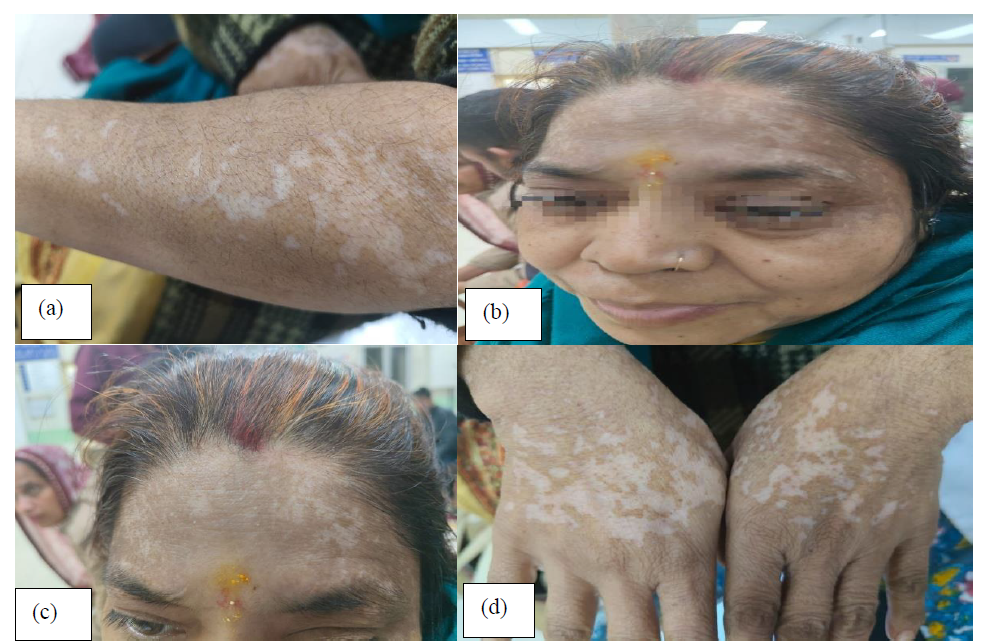
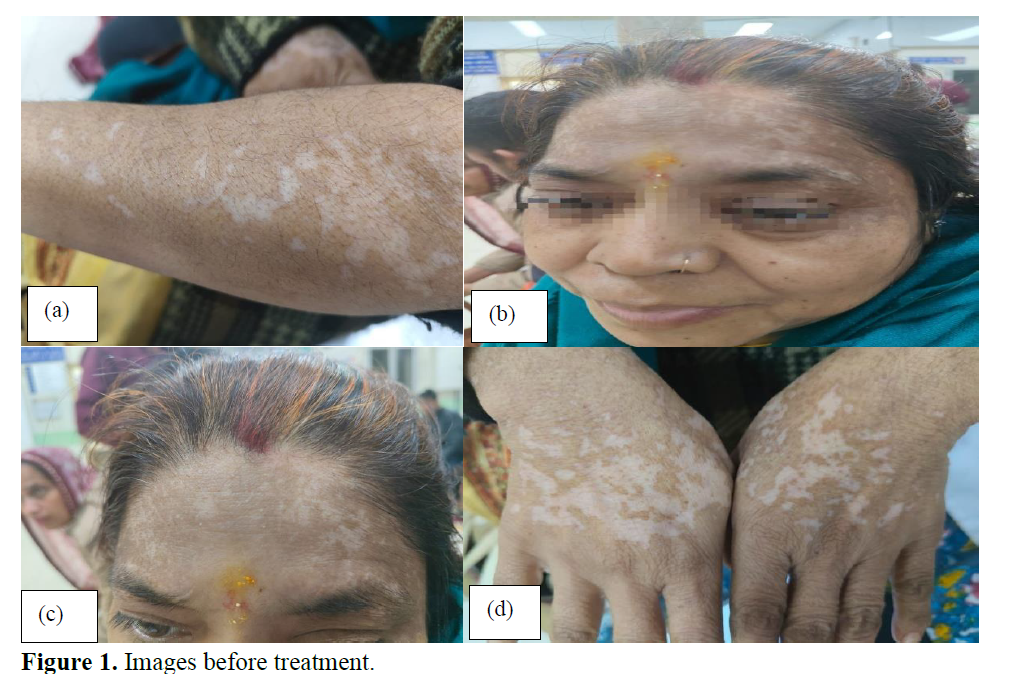
Background: Vitiligo (Shwitra), a pigmentary disorder characterized by the loss of melanocytes, the skin cells responsible for melanin production. This results in the appearance of white or depigmented patches on the skin, is interpreted in Ayurveda as a Tridoshaja condition primarily involving vitiation of Pitta and Rakta. Vitiligo poses a major psychological burden in addition to being a cosmetic issue due to its visible appearance and associated social stigma. Objective: To evaluate the efficacy of Sanshamana Chikitsa in the management of Vitiligo (Shwitra) through a single detailed case study. Case Presentation: A 49-year-old female had been presenting with depigmented patches (white spots) on the forehead, perioral region, dorsal aspects of both hands, dorsal aspect of the left forearm, and the left eyelid for a duration of six months. The patient also reported mild itching and a burning sensation over the affected areas. The patient received Ayurvedic therapy, including Rakta Shodhaka and Kushtahara Shamana Aushadis, local applications and Phototherapy (PUVA). Result: Significant improvement in the affected areas and a notable reduction in the VASI score were observed after 60 days of treatment, with a considerable decrease in the size of the patches across all affected regions. Additionally, symptoms such as itching and burning were substantially reduced within the first two months. The outcome of this study indicates that early intervention using Ayurvedic therapy, incorporating both internal and external treatment modalities, was effective in the management of vitiligo (Shwitra).
Keywords: Ayurveda, phototherapy, sanshamana chikitsa, shwitra, VASI, vitiligo
[This article belongs to Research and Reviews : A Journal of Ayurvedic Science, Yoga and Naturopathy ]

References
- Ayurveda Dipika commentary on Charaka Samhita. In: Trikamji YT, editor. Charaka Samhita. Reprint ed. Varanasi, India: Chaukhambha; 2023. p. 458.
- Nibandhasangraha commentary on Sushruta Samhita. In: Trikamji YT, editor. Sushruta Samhita. Varanasi, India: Chaukhambha Orientalia; 2021. p. 442.
- Trikamji YT, editor. Charaka Samhita of Agnivesa with Ayurveda Dipika commentary of Chakrapanidatta. 1st ed. Varanasi, India: Chaukhambha Orientalia; 2021. p. 368.
- Sharma RK, Dash B. English translation on Cakrapani Datta’s Ayurveda Dipika on Agnivesa’s Caraka Samhita. In: Sharma RK, Dash B, editors. Caraka Samhita. Reprint ed. Varanasi, India: Chowkhamba Sanskrit Series Office; 2008. p. 576.
- Tripathi HP. Harit Samhita: Hari Hindi commentary. In: Tripathi HP, editor. Harit Samhita. Reprint ed. Varanasi, India: Chaukhambha Krishnadas Academy; 2009. p. 422.
- Shastri AD. Ayurveda Tattva Sandipika: Sushruta Samhita. In: Shastri AD, editor. Sushruta Samhita. Reprint ed. Varanasi, India: Chaukhambha Sanskrit Prakashan; 2019. p. 3.
- Vriddha Jivaka Acharya. Kasyapa Samhita. In: Vriddha Jivaka Acharya, editor. Kasyapa Samhita. 1st ed. Varanasi, India: Choukhamba Viswabharati; 2002. p. 2.
- Sharma RK, Dash B. English translation on Cakrapani Datta’s Ayurveda Dipika on Agnivesa’s Caraka Samhita. In: Sharma RK, Dash B, editors. Caraka Samhita. Reprint ed. Varanasi, India: Chowkhamba Sanskrit Series Office; 2007. p. 361.
- Stuart HR, Penman ID, Strachan MWJ, Hobson RP. Davidson’s principles & practice of medicine. 23rd ed. Edinburgh, UK: Elsevier; 2018. p. 1257.
- Sharma RK, Dash B. English translation on Cakrapani Datta’s Ayurveda Dipika on Agnivesa’s Caraka Samhita. In: Sharma RK, Dash B, editors. Caraka Samhita. Reprint ed. Varanasi, India: Chowkhamba Sanskrit Series Office; 2007. p. 362.
- Hamzavi I, Jain H, McLean D, Shapiro J, Zeng H, Lui H. Parametric modeling of narrowband UV-B phototherapy for vitiligo, using a novel quantitative tool: The Vitiligo Area Scoring Index. Arch Dermatol. 2004;140(6):677-683. doi: 10.1001/archderm.140.6.677.
- Sharma RK, Dash B. English translation on Cakrapani Datta’s Ayurveda Dipika on Agnivesa’s Caraka Samhita. In: Sharma RK, Dash B, editors. Caraka Samhita. Reprint ed. Varanasi, India: Chowkhamba Sanskrit Series Office; 2008. p. 67.
- Patil S, Patil K, Narode K, Narode S, Durugkar U. Clinical evaluation of Shashilekha vati in the management of Shvitra with special reference to vitiligo. Int J Ayurveda Pharma Res. 2015;3(8):46–55.
- Government of India. The Ayurvedic Formulary of India. Part I. 2nd ed. New Delhi, India: Ministry of Health and Family Welfare; 2008. p. 91.
- Government of India. The Ayurvedic Pharmacopoeia of India. 1st ed. New Delhi, India: Department of Ayurveda, Yoga, Naturopathy, Unani, Siddha & Homeopathy; 2001. p. 32.
- Shenoi SD, Prabhu S. Photochemotherapy (PUVA) in psoriasis and vitiligo. Indian J Dermatol Venereol Leprol. 2014;80:497–504.
- Mishra S. Ayurvediya Rasashastra. 1st ed. Varanasi, India: Chaukhamba Oriental; 1997. p. 2.
- Government of India. The Ayurvedic Pharmacopoeia of India. 1st ed. New Delhi, India: Department of Ayurveda, Yoga, Naturopathy, Unani, Siddha & Homeopathy; 2001. p. 10.
- Government of India. The Ayurvedic Pharmacopoeia of India. 1st ed. New Delhi, India: Department of Ayurveda, Yoga, Naturopathy, Unani, Siddha & Homeopathy; 2001. p. 8.
- Government of India. The Ayurvedic Pharmacopoeia of India. 1st ed. New Delhi, India: Department of Ayurveda, Yoga, Naturopathy, Unani, Siddha & Homeopathy; 2001. p. 12.
- Aggarwal BB, Harikumar KB. Potential therapeutic effects of curcumin, the anti-inflammatory agent, against neurodegenerative, cardiovascular, pulmonary, metabolic, autoimmune, and neoplastic diseases. Int J Biochem Cell Biol. 2009;41(1):40-59. doi: 10.1016/j.biocel.2008.06.010.

| Volume | 13 | |
| Issue | 01 | |
| Received | 06/11/2025 | |
| Accepted | 20/12/2025 | |
| Published | 21/12/2025 | |
| Publication Time | 45 Days |