
This is an unedited manuscript accepted for publication and provided as an Article in Press for early access at the author’s request. The article will undergo copyediting, typesetting, and galley proof review before final publication. Please be aware that errors may be identified during production that could affect the content. All legal disclaimers of the journal apply.
K. Jeyapandian,
M HemaPriya,
J. Faney,
- Research Scholar, Department of Architectural Engineering, Bharath Institute of Higher Education and Research, Chennai, Tamil Nadu, India
- Associate Professor, Department of Civil Engineering, Bharath Institute of Science and Technology, Chennai, Tamil Nadu, India
- Research Scholar, Department of Civil Engineering, Bharath Institute of Higher Education and Research, Chennai, Tamil Nadu, India
Abstract
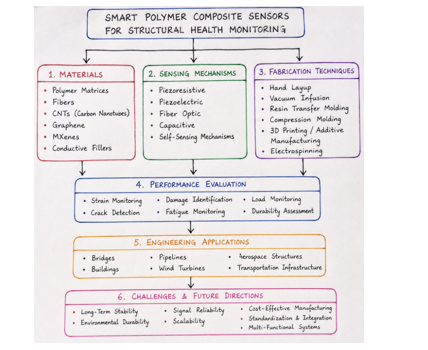
Smart polymer composite sensors have attracted attention as a possible solution for structural health monitoring (SHM) because of the capability to combine structure and sensor in one material system. The presence of conductive particles, reinforcing fibers, nanomaterials, and functional polymers leads to the creation of composite materials, which possess the ability to detect strains, deformations, cracks, vibrations, and any other kind of structural damages. This review provides a summary of the latest developments in smart polymer composite sensors with a focus on the interrelations between the properties of the polymer matrix, reinforcement, conducting filler, sensing mechanism, manufacturing technology, and sensing properties of the sensors. The main sensor types such as piezoresistive, piezoelectric, capacitive, fiber optic and self-sensing sensors are described in terms of the principles of work, strengths, weaknesses and application in SHM. In addition, the role of carbon nanotubes, graphene-based materials, carbon black, MXenes, and other functional nanomaterials is analyzed due to the significant importance of their usage.
Smart polymer composite sensors have gained interest as one potential option for structural health monitoring (SHM) thanks to the possibility to integrate structure and sensor into one system. Presence of conductive fillers, reinforcing fibers, nanomaterials and functional polymers results in the creation of composite materials with the capability of strain, deformation, crack, vibration or any other structural damage detection. This paper reviews recent progress made in smart polymer composite sensors with emphasis on correlations between the properties of polymer matrix, reinforcement, conducting filler, sensing principle, fabrication process and sensing properties of the sensors. Various types of sensors such as piezoresistive, piezoelectric, capacitive, fiber optic and self-sensing are explained according to the working principle, advantages and disadvantages as well as their application in SHM. Besides that, the importance of carbon nanotubes, graphene and its derivatives, carbon black, MXenes and other functional nanomaterials in sensor fabrication is discussed.
Keywords: Smart polymer composites, Structural health monitoring, Polymer composite sensors, Piezoresistive sensing, Carbon nanotubes, Graphene nanoplatelets, Self-sensing composites.
References
[1] Lopes C, Araújo A, Silva F, Pappas PN, Termine S, Trompeta AF, et al. Smart carbon fiber-reinforced polymer composites for damage sensing and on-line structural health monitoring applications. Polymers. 2024;16(19):2698. doi:10.3390/polym16192698.
[2] Das GS, Tripathi VK, Dwivedi J, Jangir LK, Tripathi KM. Nanocarbon-based sensors for the structural health monitoring of smart biocomposites. Nanoscale. 2024;16:1490-1525. doi:10.1039/D3NR05522A.
[3] Talluru V, Austria A, Shah S, Anekal PS, Seidel GD. Using embedded multi-walled carbon nanotube networks for damage sensing in nanocomposite polymer-bonded energetic materials subject to compression-compression cyclic loading. SSRN Electron J. 2026. doi:10.2139/ssrn.6854495.
[4] Jiang X, Lu D, Yin B, Leng Z. Advancing carbon nanomaterials-engineered self-sensing cement composites for structural health monitoring: A state-of-the-art review. J Build Eng. 2024;87:109129. doi:10.1016/j.jobe.2024.109129.
[5] Zhang Y, Wu X, Guo Q, Zhang D, Li C, Li D, et al. Advances in sensor technologies for composites structural health monitoring. Compos Struct. 2025;370:119448. doi:10.1016/j.compstruct.2025.119448.
[6] Altalbawy F, Mutar A, Jhala R, Patil N, Saed F, Shit D, et al. Advancing multifunctional carbon fibre composites: The role of nanomaterials in boosting electrochemical performance for energy storage. R Soc Open Sci. 2025;12. doi:10.1098/rsos.250606.
[7] Zhao Y, Liu Q, Li R, Lomov S, Abaimov S, Xiong K, et al. Self-sensing and self-healing smart fiber-reinforced thermoplastic composite embedded with CNT film. J Intell Mater Syst Struct. 2023;34:1561-1571. doi:10.1177/1045389X221147662.
[8] Tao Y, Zhang R, Hu X, Ou Y, Ren M, Sun J, et al. A comprehensive review on fiber-based self-sensing polymer composites for in situ structural health monitoring. Adv Compos Hybrid Mater. 2025;8. doi:10.1007/s42114-025-01413-y.
[9] Gao L, Thostenson ET, Zhang Z, Chou TW. Sensing of damage mechanisms in fiber-reinforced composites under cyclic loading using carbon nanotubes. Adv Funct Mater. 2009;19(1):123-130. doi:10.1002/adfm.200800865.
[10] Park M, Kim H, Youngblood JP. Strain-dependent electrical resistance of multi-walled carbon nanotube/polymer composite films. Nanotechnology. 2008;19(5):055705. doi:10.1088/0957-4484/19/05/055705.
[11] Thostenson ET, Chou TW. Real-time in situ sensing of damage evolution in advanced fiber composites using carbon nanotube networks. Nanotechnology. 2008;19(21):215713. doi:10.1088/0957-4484/19/21/215713.
[12] Nauman S. Piezoresistive sensing approaches for structural health monitoring of polymer composites—A review. Eng (Basel). 2021;2(2):197-226. doi:10.3390/eng2020013.
[13] Irfan MS, Khan T, Hussain T, Liao K, Umer R. Carbon coated piezoresistive fiber sensors: From process monitoring to structural health monitoring of composites—A review. Compos Part A Appl Sci Manuf. 2021;141:106236. doi:10.1016/j.compositesa.2020.106236.
[14] Aly K, Bradford PD. Real-time impact damage sensing and localization in composites through embedded aligned carbon nanotube sheets. Compos Part B Eng. 2019;162:522-531. doi:10.1016/j.compositesb.2018.12.104.
[15] Yang G, Feng X, Wang W, OuYang Q, Liu L, Wu Z. Graphene and carbon nanotube-based high-sensitive film sensors for in-situ monitoring out-of-plane shear damage of epoxy composites. Compos Part B Eng. 2021;204:108494. doi:10.1016/j.compositesb.2020.108494.
[16] Gackowski BM, Goh GD, Sharma M, Idapalapati S. Additive manufacturing of nylon composites with embedded multi-material piezoresistive strain sensors for structural health monitoring. Compos Part B Eng. 2023;261:110796. doi:10.1016/j.compositesb.2023.110796.
[17] Paredes J, et al. Experimental and theoretical study on piezoresistive properties of a structural resin reinforced with carbon nanotubes for strain sensing and damage monitoring. Compos Part B Eng. 2018;145:90-99. doi:10.1016/j.compositesb.2018.03.025.
[18] Khalid HR, Nam IW, Choudhry I, Zheng L, Lee HK. Piezoresistive characteristics of CNT fiber-incorporated GFRP composites prepared with diversified fabrication schemes. Compos Struct. 2018;203:835-843. doi:10.1016/j.compstruct.2018.08.003.
[19] Tang X, Pötschke P, Pionteck J, Li Y, Formanek P, Voit B. Tuning the piezoresistive behavior of poly(vinylidene fluoride)/carbon nanotube composites using poly(methyl methacrylate). ACS Appl Mater Interfaces. 2020;12(38):43125-43137. doi:10.1021/acsami.0c11610.
[20] Qin H, Yang Y, Sun M, Zhu J, Liu S, Sun H, et al. Monitoring of mixed failure mode in CFRP bolted joint structures based on a modular piezoresistive sensing network. Polymer Composites. 2026;47(7):6144-6157. doi:10.1002/pc.70547.Top of Form
[21] Thostenson ET, Chou TW. Carbon nanotube networks for in situ study of fatigue damage in composites. Adv Mater. 2006;18(21):2837-2841. Stassi S, Cauda V, Canavese G, Pirri CF. Flexible and stretchable piezoresistive composite sensor systems. Sensors. 2014;14(3):5296-5332.
[22] Ku-Herrera JJ, Avilés F. Cyclic tension and compression piezoresistivity of carbon nanotube/vinyl ester polymer composites. Carbon. 2012;50(2):487-492.
[23] Bautista-Quijano JR, Avilés F, Aguilar JO. Strain sensing capabilities of multiwalled carbon nanotube/polyester composite films. Sens Actuators A Phys. 2016;249:44-51.
[24] Balberg I. A comprehensive picture of the electrical phenomena in carbon black-polymer composites. Carbon. 2002;40(2):139-142.
[25] Amjadi M, Kyung KU, Park I, Sitti M. Stretchable, skin-mountable, and wearable strain sensors and their potential applications: a review. Adv Funct Mater. 2016;26(11):1678-1698.
[26] Zhang H, Bilotti E, Peijs T. The use of carbon nanotubes for damage sensing and structural health monitoring in laminated composites: a review. Nanocomposites. 2015;1(4):167-184.
[27] Hu N, Karube Y, Yan C, Masuda Z, Fukunaga H. Tunneling effect in a polymer/carbon nanotube nanocomposite strain sensor. Acta Mater. 2008;56(13):2929-2936.
[28] Gong S, Zhu ZH, Meguid SA. Anisotropic electrical conductivity of polymer composites filled with carbon nanotubes. Polymer. 2014;55(21):5488-5499.
[29] Taya M, Kim WJ, Ono K. Piezoresistivity of a short fiber or whisker reinforced metal matrix composite. Mech Mater. 1998;28(1-4):53-59.
[30] Alamusi, Hu N, Fukunaga H, Atobe S, Liu Y, Li J. Piezoresistive strain sensors made from carbon nanotubes based polymer nanocomposites. Sensors. 2011;11(11):10691-10723.
[31] Chiacchiarelli LM, Rallini M, Monti M, Puglia D, Kenny JM, Torre L. The role of dispersion on the piezoresistive behavior of multiwalled carbon nanotube/epoxy nanocomposites. Carbon. 2013;60:274-283.
[32] Bautista-Quijano JR, Avilés F. Influence of interphase on the electromechanical response of carbon nanotube/polymer composites. Comput Mater Sci. 2014;92:407-415.
[33] Li C, Chou TW. Modeling of damage sensing in fiber composites using carbon nanotube networks. Compos Sci Technol. 2008;68(15-16):3373-3379.
[34] Nofar M, Hoa SV, Pugh MD. Failure detection and monitoring in polymer matrix composites subjected to static and dynamic loads using carbon nanotube networks. Compos Sci Technol. 2009;69(10):1599-1606.
[35] Dau VT, Dinh TX, Tran CD. Printable conductive polymer composites for flexible strain sensors: optimization of sensitivity and linearity. Sens Actuators A Phys. 2020;303:111863.
[36] Moriche R, Sánchez M, Ureña A. Strain monitoring in carbon fiber reinforced polymers using graphene-nanoplatelet-doped epoxy matrices. Compos Sci Technol. 2016;136:101-108.
[37] Hassanzadeh-Aghdam MK, Ansari R, Darvizeh A. Piezoresistive behavior of hybrid carbon nanotube/graphene nanoplatelet reinforced polymer nanocomposites. Mech Mater. 2019;137:103112.
[38] Loyola BR, La Saponara V, Loh KJ. In situ health monitoring of bonded composite patch repairs using carbon nanotube sensing skins. J Intell Mater Syst Struct. 2010;21(17):1779-1790.
[39] Kang I, Schulz MJ, Kim JH, Shanov V, Shi D. A carbon nanotube strain sensor for structural health monitoring. Smart Mater Struct. 2006;15(3):737-748.
[40] Moriche R, Prolongo SG, Sánchez M, Ureña A. Thermal and moisture aging stability of graphene-coated glass fabric sensors for composite SHM. Compos A Appl Sci Manuf. 2015;78:12-18.
[41] Glavan G, Salamon P. Environmental degradation and baseline drift in piezoresistive polymer sensors under hygrothermal cycling. Sens Actuators B Chem. 2018;268:290-298.
[42] Kupke M, Schulte K, Schüler P. Non-destructive testing of failure mechanisms in FRP by electrical resistance measurements. Compos Sci Technol. 2001;61(6):837-847.
[43] Zhang R, Deng H, Fu Q. Temperature-dependent piezoresistive behavior of conductive polymer composites: mechanisms and compensation strategies. Polymer. 2014;55(16):3698-3707.
[44] Loh KJ, Kim J, Lynch JP, Kam NWS, Kotov NA. Multifunctional layer-by-layer carbon nanotube-polyelectrolyte thin films for strain and corrosion sensing. Sens Actuators A Phys. 2007;140(1):18-28.
[45] Vertuccio L, Foglia F, Pantani R, Romero-Sánchez MD, Guadagno L. Dynamic mechanical and electrical response of epoxy/CNT composites exposed to severe thermal cycles. Polym Degrad Stab. 2020;182:109369.
[46] Sanli A, Müller C, Kanoun O. Temperature effect on the piezoresistive performance of multi-walled carbon nanotube/epoxy sensors. IEEE Sens J. 2017;17(17):5408-5415.
[47] Balamurugan A, Duraisamy S. Long-term electromechanical fatigue behavior and hysteresis mitigation of conductive elastomer strain gauges. Smart Mater Struct. 2022;31(4):045019.
[48] Loh KJ, Hou TC, Lynch JP, Kotov NA. Carbon nanotube sensing skins for spatial damage detection in structural components via electrical impedance tomography. J Nondestruct Eval. 2009;28(1):9-25.
[49] Bao Y, Tang Z, Li H, Zhang Y. Computer vision and deep learning-based data anomaly detection method for structural health monitoring. Struct Health Monit. 2019;18(2):401-414.
[50] Park JB, Song MK, Hwang W. Fabrication and strain-sensing characteristics of multi-walled carbon nanotube-reinforced sensors. Smart Mater Struct. 2012;21(9):094008.

Journal of Polymer & Composites
| Volume | 14 | |
| 05 | ||
| Received | 17/08/2026 | |
| Accepted | 14/09/2026 | |
| Published | 03/11/2026 | |
| Publication Time | 78 Days |