
V. Ravi Raj,
B. Chinna Ankanna,
T. Maruthavanan,
D.Raguraman,
G.Janani,
G.Nixon Samuel Vijayakumar,
Sam Stanley S G,
D.Murali,
M.Buvana,
- Associate Professor, Department of Mechanical Engineering, Sri Sairam Engineering College, Chennai, Tamil Nadu, India
- Assistant Professor, Department of Mechanical Engineering, Rajeev Gandhi Memorial College of Engineering and Technology, Nandyal, Andhra Pradesh, India
- Associate Professor, Department of Chemistry, SONASTARCH, Sona College of Technology, Salem, Tamil Nadu, India
- Associate Professor, Department of Automobile Engineering, Bharath Institute of Science and Technology, Chennai, Tamil Nadu, India
- Assistant Professor, Department of Civil Engineering, Erode Sengunthar Engineering College, Erode, Tamil Nadu, India
- Professor, Department of Physics, R.M.K. Engineering College, Chennai, Tamil Nadu, India
- Associate Professor, Department of Mechanical Engineering, Park College of Engineering and Technology, Coimbatore, Tamil Nadu, India
- Assistant Professor, Department of Mechanical Engineering, St. Joseph’s Institute of Technology (Autonomous), Chennai, Tamil Nadu, India
- Associate Professor, Department of Computer Science and Engineering, Vel Tech Multi Tech Dr. Rangarajan Dr. Sakunthala Engineering College, Chennai, Tamil Nadu, India
Abstract
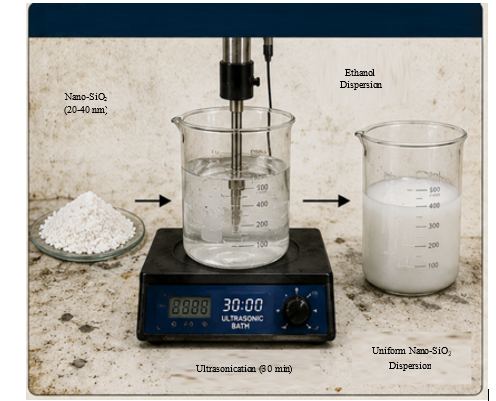
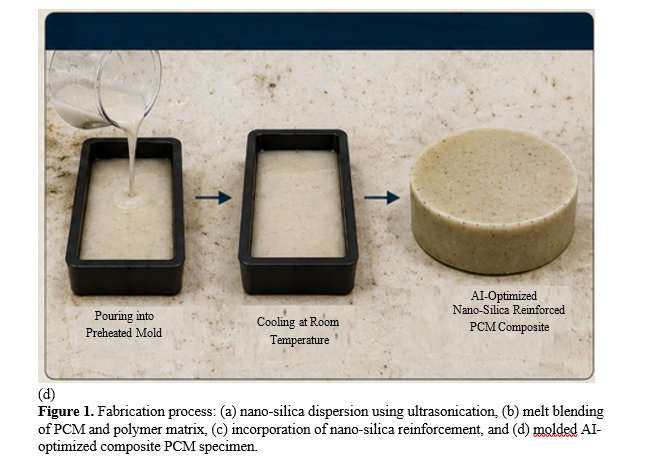
This study presents an AI-optimized nano-silica reinforced polymer composite phase change material (PCM) for predictive solar-thermal energy storage networks. The proposed composite combines paraffin wax, high-density polyethylene (HDPE), and uniformly dispersed nano-silica particles to improve thermal conductivity, structural stability, leakage resistance, and long-term cycling performance. The composite was fabricated through melt blending and ultrasonication-assisted nanoparticle dispersion, followed by comprehensive morphological, chemical, thermal, and thermophysical characterization using scanning electron microscopy (SEM), Fourier transform infrared spectroscopy (FTIR), differential scanning calorimetry (DSC), thermogravimetric analysis (TGA), and thermal conductivity measurements. Experimental results demonstrated homogeneous nano-silica distribution, strong polymer–particle interfacial adhesion, excellent chemical compatibility, enhanced latent heat storage, improved thermal stability, and significantly higher thermal conductivity compared with the unreinforced PCM. An artificial intelligence predictive optimization framework was further developed to model the nonlinear relationship between composite formulation and thermophysical performance, enabling accurate prediction of the optimum nano-silica loading while reducing experimental effort and material consumption. The synergy between polymer composite engineering and AI-driven optimization provides an efficient strategy for designing intelligent thermal energy storage materials with improved heat transfer, dimensional stability, and operational reliability. Overall, the developed nano-silica reinforced polymer composite PCM demonstrates considerable potential for next-generation solar-thermal energy storage systems, supporting sustainable renewable energy utilization, predictive thermal management, autonomous energy networks, and advanced smart materials for future clean energy applications under practical conditions.
Keywords: Nano-silica, thermogravimetric analysis, reinforced polymer composite, interfacial adhesion, nanoparticle dispersion
[This article belongs to Journal of Polymer & Composites ]
References
1. Selvakumar P, Manjunath TC, Nathsharma SK, Zahoor Khan I, Gulani M. Smart materials and nanomaterials in façade applications. In: Principles, Materials, and Applications in Facade Engineering. IGI Global Scientific Publishing; 2026. p. 1–28.
2. Madurwar K, Basem A, Nikhade A, Azher AA, Khedker S, Hadi AA, et al. SHAP-enhanced hybrid PSO-ensemble framework models for interpretable prediction of UHPC compressive strength. Asian J Civ Eng. 2026;27(2):893–910.
3. Khan MK, Mujahid Y, Alahmed N, Khan KA. A review of multifunctional hybrid fiber-reinforced polymer (HFRP) composites for aerospace applications. Adv Compos Hybrid Mater. 2026;9(2):118.
4. Lu W, Wang J, Wang M, Yan J, Mao D, Hu E. Nanoparticle-enhanced phase change materials (NPCMs) in solar thermal energy systems: A review on synthesis, performance, and future prospects. Energies. 2025;18(17):4516.
5. Yang H, Zou Y, Cui H. Advancements and challenges in enhancing salt hydrate phase change materials for building energy storage: Optimization methodologies and mechanisms. Natl Sci Open. 2024;3(3):20230056.
6. Ilyina SO, Gorbunova IY, Shutov VV, Kerber ML, Ilyin SO. Nanosilica gel-stabilized phase-change materials based on epoxy resin and Wood’s metal. Gels. 2026;12(1):79.
7. Hussain M, Labassi F, Waqas H, Khan MA, Shekar S. Artificial neural network-driven insights into nanoparticle-enhanced phase change materials melting for heat storage optimization. Nanotechnol Rev. 2025;14(1):20250231.
8. Zhou Y. Artificial neural network-based smart aerogel glazing in low-energy buildings: A state-of-the-art review. iScience. 2021;24(12).
9. Pereira J, Souza R, Oliveira J, Moita A. Phase change materials in residential buildings: Challenges, opportunities, and performance. Materials. 2025;18(9):2063.
10. An J. Mechanical-thermal synergy in phase change microcapsules: Experimental and numerical investigation of dual-shell architectures and nano-enhanced polyurea composites for efficient thermal energy storage.
11. Fabiani C, Erkizia E, Snoeck D, Rajczakowska M, Tole I, Ribeiro RR, et al. Reviewing experimental studies on latent thermal energy storage in cementitious composites: Report of the RILEM TC 299-TES. Mater Struct. 2025;58(2):58.
12. Waqas H, Hasan MJ, Naqvi SM, Liu D, Muhammad T, Eldin SM, et al. Enhancing the performance of thermal energy storage by adding nano-particles with paraffin phase change materials. Nanotechnol Rev. 2024;13(1):20230180.
13. Li L, Sun W, Gómez-Zamorano LY, Liu Z, Zhang W, Ma H. From research trend to performance prediction: Metaheuristic-driven machine learning optimization for cement pastes containing bio-based phase change materials. Polymers. 2025;17(18):2541.
14. Tan N, Ning YH, Hu P, Feng Y, Li Q, Lin CH, et al. Silica-confined composite form-stable phase change materials: A review. J Therm Anal Calorim. 2022;147(13):7077–97.
15. Zheng X, Zhao Y, Zhang C, Yang H, Liu B. Thermal performance and mechanical properties of phase change cement paste with Nano-SiO2 grafted straw-paraffin. Constr Build Mater. 2024;419:135551.
16. Dora S, Barta RB, Mini KM. Study on foam concrete incorporated with expanded vermiculite/capric acid PCM–a novel thermal storage high-performance building material. Constr Build Mater. 2023;392:131903.
17. Bora N, Joshi DP, Aulakh JS. Comparative thermal study of pristine SiO2 and SiO2-modified expanded graphite-based paraffin composite for thermal energy storage. J Mater Eng Perform. 2025;34(11):10526–36.
18. Mishra K, Singh S, Agarwal R, Balam NB, Kumar R, Srinivasarao Naik B. Silica-based microencapsulation of phase change materials for efficient thermal energy storage: A comprehensive review. Energy Storage. 2025;7(4).
19. Tolga T. Thermal performance enhancement of microencapsulated phase change material/geopolymer composites through graphite platelets and nano-additives for building energy storage applications [master’s thesis]. Ankara (Turkey): Middle East Technical University; [date unknown].
20. Tan Y, Li P, Yao Y, Li H, Zhong J, Wu J, et al. Green preparation and performance research of n-octadecane@silica phase change microcapsules for building energy conservation. Constr Build Mater. 2025;497:143847.
21. Li K, Wei Z, Qiaou H, Lu C, Theogene H. PCM-concrete interfacial tensile behavior using nano-SiO2 based on splitting-tensile test. J Adv Concr Technol. 2021;19(4):321–34.
22. Snehal K, Das BB, Barbhuiya S. Influence of aggressive exposure on the degradation of nano-silica admixed cementitious mortar integrated with phase change materials. Constr Build Mater. 2022;335:127467.

Journal of Polymer & Composites
| Volume | 14 | |
| Issue | 05 | |
| Received | 07/09/2026 | |
| Accepted | 12/09/2026 | |
| Published | 16/09/2026 | |
| Publication Time | 9 Days |