
B. Uma Maheswari,
G.Jeyaram,
Neha Choudhary,
Soundararajan Muthumani,
D. Sudha,
K.Venugopal Rao,
Muthurajan Subramoniam,
Akash Deep Kushwaha,
R.Ashok Gandhi,
- Professor, Department of Computer Science and Engineering, St. Joseph’s College of Engineering, Chennai, Tamil Nadu, India
- Assistant Professor, Department of Computer Science and Engineering (Artificial Intelligence and Machine Learning), Easwari Engineering College, Ramapuram, Chennai, Tamil Nadu, India
- Assistant Professor, Department of Electronics and Communication Engineering, Government Engineering College, Vaishali, Bihar, India
- Associate Professor, Department of Civil Engineering, Mahendra Institute of Technology, Namakkal, Tamil Nadu, India
- Associate Professor, Department of Physics, R.M.K. Engineering College, Chennai, Tamil Nadu, India
- Assistant Professor, Department of Electronics and Communication Engineering, Jyothishmathi Institute of Technology and Science, Nustulapur, Karimnagar, Telangana, India
- Assistant Professor, Department of Marine Engineering, Academy of Maritime Education and Training (AMET) Deemed to be University, Kanathur, Chennai, Tamil Nadu, India
- Assistant Professor, Department of Mechanical Engineering, School of Engineering & I.T., MATS University, Raipur, Chhattisgarh, India
- Associate Professor, Department of Mechanical Engineering, Sri Sairam Engineering College, Chennai, Tamil Nadu, India
Abstract
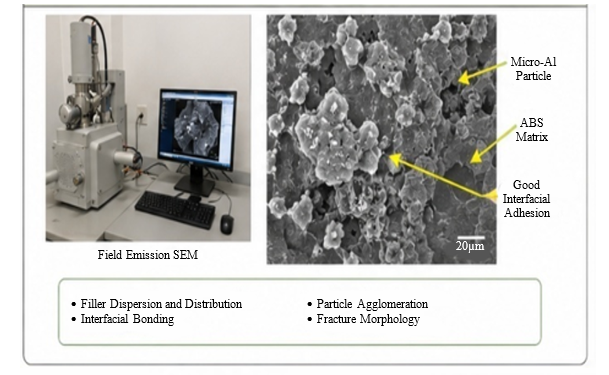
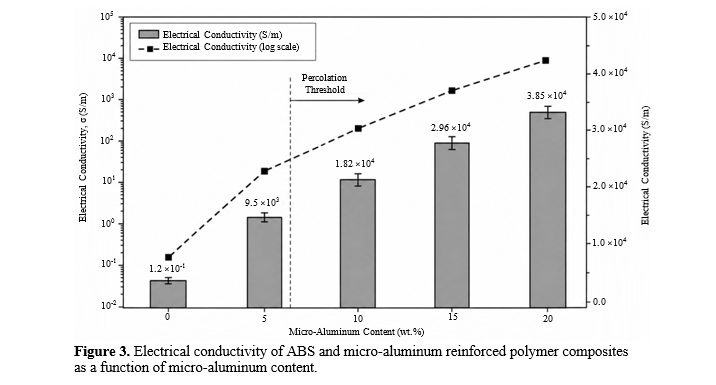
Electrically conductive polymer composites have emerged as promising multifunctional materials for lightweight antenna housings by integrating structural strength, electrical conductivity, thermal stability, and electromagnetic interference shielding. In this study, micro-aluminum reinforced Acrylonitrile Butadiene Styrene (ABS) polymer composites were fabricated using twin-screw melt compounding followed by compression molding for IoT-enabled lightweight antenna housing applications. The influence of micro-aluminum loading on microstructure, mechanical performance, electrical conductivity, EMI shielding, thermal stability, and wireless monitoring was systematically investigated. Scanning electron microscopy revealed uniform particle dispersion and strong polymer-particle interfacial bonding, promoting efficient stress transfer and continuous conductive pathways throughout the polymer matrix. Mechanical characterization demonstrated progressive improvements in tensile strength and flexural strength with increasing filler content. The optimized ABS-Al20 composite achieved an electrical conductivity of 3.85 × 10⁴ S/m and an EMI shielding effectiveness of approximately 38 dB, indicating excellent multifunctional performance. Thermogravimetric analysis confirmed enhanced thermal resistance through the barrier effect of uniformly dispersed aluminum particles. An ESP32-based IoT monitoring system enabled real-time acquisition of temperature, humidity, and vibration data with wireless cloud transmission for continuous structural health monitoring. The developed conductive polymer composite successfully combines lightweight construction, mechanical robustness, electrical functionality, EMI shielding, thermal durability, and intelligent monitoring within a single material platform. These findings demonstrate significant potential for next-generation communication infrastructure, automotive electronics, aerospace systems, smart wireless devices, and advanced IoT applications requiring durable, lightweight, electrically conductive polymer composite materials supporting sustainable high-performance antenna housings with improved reliability, durability, electromagnetic compatibility, and long-term service performance in demanding environments.
Keywords: Acrylonitrile butadiene styrene, thermogravimetric analysis, micro-aluminum, flexural strength, interfacial bonding
[This article belongs to Journal of Polymer & Composites ]
References
1. Anis A, Elnour AY, Alam MA, Al-Zahrani SM, AlFayez F, Bashir Z. Aluminum-filled amorphous-PET, a composite showing simultaneous increase in modulus and impact resistance. Polymers. 2020;12(9):2038.
2. Wang X, Li L, Liu S, Nie Z, Wang W, et al. Partially fluorinated metallic surface constructing robust, thermally conductive and electrically insulating polymer composite. Compos Sci Technol. 2023 Oct 20;243:110225. doi: doi.org.
3. Kim D, Park K, Kim K, Cho S, Hirayama Y, Takagi K, et al. Cold compaction behavior of nano and micro aluminum powder under high pressure. Compos Res. 2019;32(3):141–7.
4. Vadivelu MA, Kumar CR, Joshi GM. Polymer composites for thermal management: A review. Compos Interfaces. 2016;23(9):847–72.
5. Megahed M, Fathy A, Morsy D, Shehata F. Mechanical performance of glass/epoxy composites enhanced by micro-and nanosized aluminum particles. J Ind Text. 2021;51(1):68–92.
6. Choi S, Im H, Kim J. Flexible and high thermal conductivity thin films based on polymer: Aminated multi-walled carbon nanotubes/micro-aluminum nitride hybrid composites. Compos Part A Appl Sci Manuf. 2012;43(11):1860–8.
7. Bao L, Zhang W, Zhang X, Chen Y, Chen S, et al. Impact of MWCNT/Al on the combustion behavior of hydroxyl ammonium nitrate (HAN)-based electrically controlled solid propellant. Combust Flame. 2020 Aug 1;218:218–228.
8. Wei B, Yang S. Polymer composites with expanded graphite network with superior thermal conductivity and electromagnetic interference shielding performance. Chem Eng J. 2021 Jan 15;404:126437.
9. Gao J, Xiong H, Han X, An F, Chen T. Synergistic effect of aluminum nitride and carbon nanotube-reinforced silicon rubber nanocomposites. Molecules. 2024;29(12):2864.
10. Choi S, Kim J. Thermal conductivity of epoxy composites with a binary-particle system of aluminum oxide and aluminum nitride fillers. Compos Part B Eng. 2013 Aug 1;51:140–147.
11. Yu J, Bang J, Jin Y, et al. Design strategies for thermally conductive polymer composites based on interface and network engineering. Polym Compos. 2026.
12. Veeranaath V, Sahu RK, Priya IM. Experimental and computational studies on characteristics of indigenously produced novel Aegle marmelos micro polymer reinforced aluminum composites using powder metallurgy. J Mech Sci Technol. 2025;39(2):587–610.
13. Jasim KA, Fadhil RN. The effects of micro aluminum fillers in epoxy resin on the thermal conductivity. J Phys Conf Ser. 2018;1003(1):012082.
14. Moosa MH, Shewakh WM, Ibrahem RA, Abu-Okail M, Farouk WM. Effect of innovative hybrid nano additives of Al2O3-MWCNT-SiO2 on microstructural and tribological characteristics of carbon fiber-reinforced polymers for enhanced brake pad safety. J Mech Sci Technol. 2026;40(2):1069–80.
15. Ouyang Y, Hou G, Bai L, Li B, Yuan F. Constructing continuous networks by branched alumina for enhanced thermal conductivity of polymer composites. Compos Sci Technol. 2018 Sep 8;165:307–313.
16. Mishra P, Nazir T, Sarathi R, Paul M, Mondal M. Investigating thermal properties of electron beam irradiated silicone rubber/ATH/BN nano-micro hybrid composites. In: 2024 IEEE International Conference on High Voltage Engineering and Applications (ICHVE). 2024 Aug 18. p. 1–4. IEEE.
17. Wu H, Chiang S, Han W, Tang Y, Kang F, Yang C. Surface iodination: A simple and efficient protocol to improve the isotropically thermal conductivity of silver-epoxy pastes. Compos Sci Technol. 2014 Jul 30;99:109–116.
18. Mi YN, Liang G, Gu A, Zhao F, Yuan L. Thermally conductive aluminum nitride-multiwalled carbon nanotube/cyanate ester composites with high flame retardancy and low dielectric loss. Ind Eng Chem Res. 2013;52(9):3342–53.
19. Du FP, Li JJ, Fu P, Wu YG, Liao GY, Zhang YF, et al. Enhanced thermal conductivity of poly(L-lactide) composites with synergistic effect of aluminum nitride and modified multi-walled carbon nanotubes. Fullerenes Nanotubes Carbon Nanostruct. 2016;24(10):667–73.
20. Yu C, Zhang J, Li Z, Tian W, Wang L, et al. Enhanced through-plane thermal conductivity of boron nitride/epoxy composites. Compos Part A Appl Sci Manuf. 2017 Jul 1;98:25–31.
21. Nazir MT, Khalid A, Phung BT, Das AK, Cheetham P, Paramane A, et al. Electrical tracking, erosion and fire retardancy performance of silicone rubber insulation containing aluminum trihydrate, graphene and glass fiber additives. CSEE J Power Energy Syst. 2023;9(5):1918–25.
22. Yan W, Song X, Wang Y. Micro-aluminum simultaneously coated with metallic Cu, Ni, and Co nanoparticles: Thermal reaction and catalytic mechanism. Coatings. 2026 Jan 6;16(1):65.
23. Cao JP, Zhao J, Zhao X, You F, Yu H, et al. High thermal conductivity and high electrical resistivity of poly(vinylidene fluoride)/polystyrene blends by controlling the localization of hybrid fillers. Compos Sci Technol. 2013 Dec 13;89:142–148.

Journal of Polymer & Composites
| Volume | 14 | |
| Issue | 05 | |
| Received | 17/08/2026 | |
| Accepted | 27/08/2026 | |
| Published | 01/09/2026 | |
| Publication Time | 15 Days |