
R. Nathiya,
Deobarat Kumar Chandan,
S. Duraisivam,
K.Kannan,
J. B Veeramalini,
B. Parvathi Sangeetha,
Ashok Kumar Chaudhary,
Jayarama Pradeep,
Rajendiran M,
- Associate Professor, Department of Electronics and Communication Engineering, School of Engineering and Technology, Dhanalakshmi Srinivasan University, Trichy, Tamil Nadu, India
- Assistant Professor, Department of Electrical and Electronics Engineering, Motihari College of Engineering, Motihari, Bihar, India
- Assistant Professor, Department of Mechanical Engineering, The Kavery Engineering College, Salem, Tamil Nadu, India
- Associate Professor, Department of Electronics and Communication Engineering, RMK College of Engineering and Technology, Puduvoyal, Chennai, Tamil Nadu, India
- Professor, Department of Chemical Engineering, Vel Tech High Tech Dr. Rangarajan Dr. Sakunthala Engineering College, Chennai, Tamil Nadu, India
- Associate Professor, Department of Marine Engineering, Amet University, Kanathur, Tamil Nadu, India
- Assistant Professor, Department of Electrical and Electronics Engineering, Nalanda College of Engineering, Chandi, Bihar, India
- Professor, Department of Electrical and Electronics Engineering, St. Joseph’s College of Engineering, Chennai, Tamil Nadu, India
- Professor, Department of Computer Science and Engineering, Panimalar Engineering College, Chennai, Tamil Nadu, India
Abstract
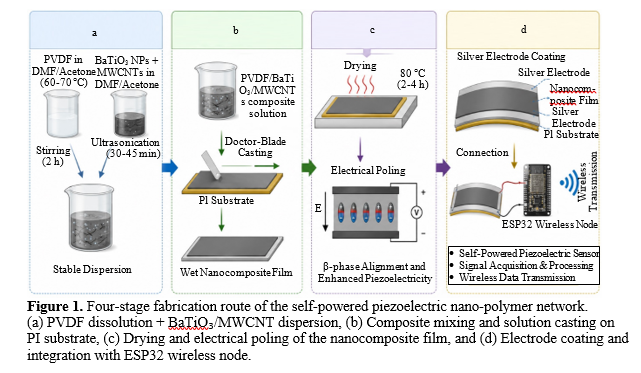
Self-powered sensing systems are emerging as a promising solution for next-generation distributed Internet of Things (IoT) platforms, where lightweight, flexible, and low-maintenance devices are required for continuous monitoring. In this work, a self-powered piezoelectric nano-polymer network based on poly-vinylidene fluoride (PVDF) reinforced with BaTiO₃ nanoparticles and multiwalled carbon nanotubes (MWCNTs) was developed for flexible wireless sensing applications. The composite was designed to combine mechanical flexibility, enhanced piezoelectric response, and real-time wireless data transmission within a single material platform. The fabricated nanocomposite film was prepared through solution casting, electrical poling, and electrode integration, followed by coupling with an ESP32 wireless node for IoT-based signal acquisition. Structural and electromechanical evaluation showed that the optimized PVDF/ BaTiO₃ / MWCNT network generated a stable open-circuit voltage of up to 8.9 V under applied mechanical loading and retained nearly 90% of its initial output after 1000 bending cycles, demonstrating good durability and flexibility. The output voltage also increased with actuation frequency, reaching 9.6 V at 5 Hz, confirming reliable dynamic sensing performance. Wireless monitoring experiments further verified that the generated voltage signals could be successfully transmitted in real time to a remote interface. Overall, the developed piezoelectric nano-polymer network provides an effective route toward flexible, self-powered, and wireless IoT sensor platforms for structural, wearable, and environmental monitoring applications
Keywords: Nano-polymer, multiwalled carbon nanotubes, electromechanical evaluation, poly-vinylidene fluoride, piezoelectric response
[This article belongs to Journal of Polymer & Composites ]
References
1. Vicente AT, Araújo A, Mendes MJ, Nunes D, Oliveira MJ, Sanchez-Sobrado O, et al. Multifunctional cellulose-paper for light harvesting and smart sensing applications. J Mater Chem C. 2018;6(13):3143–81.
2. Geertsma RE, Park MV, Puts CF, Roszek B, Van der Stijl R, De Jong WH. Nanotechnologies in medical devices.
3. Duarah R, Torné-Morató H, Zhang G, Amin Y, Pabast M, Sharma N, et al. Next-generation wearable optical sensors for personalized health and point-of-care Diagnostics—a systematic review. Adv Healthc Mater. 2026 Mar;15(10):e04419. doi: 10.1002/adhm.202604419.
4. Tian H, Han D, Wang B. A summary of wearable textiles power generation. In: IOP Conference Series: Earth and Environmental Science. 2021;772(1):012037.
5. Shekari M, Afshar Taromi A, Naderi G, Naqvi M, Khonakdar HA. Recent innovations in environmental applications of polymer gels and networks. Polym Eng Sci. 2026;66(1):43–72.
6. Loconsole D, Elia M, Conversa G, De Lucia B, Cristiano G, Elia A. Soil moisture sensing technologies: Principles, applications, and challenges in agriculture. Agronomy. 2025;15(12):2788.
7. Mustafa G, Akbar M, Sadiq N, Iqbal B, Zahid M. Nanosensor in soil-water agroecosystem. In: Nanoscience and Soil-Water Interaction in Agroecosystem. 2025 Feb 28. p. 1660.
8. Dabare S, Rajapaksha S, Munaweera I. Exploring the intersection of innovation management and nanotechnology in sustainable agriculture. Int J Innov Sci. 2025:1–37.
9. Aziz AA, Sayed MA, Mohamed AE, Ahmed MG, Saied SS, Mohammed ES, et al. Fabrication and different applications for polymer-based nanosensors. In: Smart Nanosensors. Singapore: Springer Nature Singapore; 2025 Apr 22. p. 83–141.
10. Birla S, Singh N, Shukla NK. Low-power memory design for IoT-enabled systems: Part 2. In: Electrical and Electronic Devices, Circuits and Materials. CRC Press; 2021 Mar 15. p. 63–80.
11. Saravanan M, Parthasarathy E, Ajayan J, Mohankumar P. Nanosensors for. In: Software Engineering for Automotive Systems: Principles and Applications. 2022. p. 125.
12. Pendino A, Nguyen N, Nouma SE, Wang J, Yavuz AA, Yilmaz Y, Mumcu G. Additively manufactured rf electronics with structurally integrated physically unclonable functions for wireless system security. IEEE Access. 2025 Aug 18;13:145042-59.
13. Ciliberto C. Industry 4.0, Lean Manufacturing and Circular Economy: A Novel Pathway for Circular Supply Chain Management and Sustainable Production.
14. Merino P, Mujica G, Señor J, Portilla J. A modular IoT hardware platform for distributed and secured extreme edge computing. Electronics. 2020;9(3):538.
15. Jaladi AR, Khithani K, Pawar P, Malvi K, Sahoo G. Environmental monitoring using wireless sensor networks (WSN) based on IoT. Int Res J Eng Technol. 2017;4(1):1371–8.
16. Khalifeh A, Mazunga F, Nechibvute A, Nyambo BM. Microcontroller unit-based wireless sensor network nodes: A review. Sensors. 2022;22(22):8937.
17. Pham DM, Aziz SM. FlexiS—A flexible sensor node platform for the Internet of Things. Sensors. 2021;21(15):5154.
18. Lombardo L, Corbellini S, Parvis M, Elsayed A, Angelini E, Grassini S. Wireless sensor network for distributed environmental monitoring. IEEE Trans Instrum Meas. 2018;67(5):1214–22.
19. Agre JR, Clare LP, Pottie GJ, Romanov NP. Development platform for self-organizing wireless sensor networks. In: Unattended Ground Sensor Technologies and Applications. 1999;3713:257–68.
20. Beckmann K, Dedi O. sDDS: A portable data distribution service implementation for WSN and IoT platforms. In: 2015 12th International Workshop on Intelligent Solutions in Embedded Systems (WISES). IEEE; 2015 Oct 29. p. 115–120.
21. Thaker T. ESP8266 based implementation of wireless sensor network with Linux based web-server. In: 2016 Symposium on Colossal Data Analysis and Networking (CDAN). IEEE; 2016 Mar 18. p. 1–5.
22. Zhu Q, Wang R, Chen Q, Liu Y, Qin W. IoT gateway: Bridging wireless sensor networks into Internet of Things. In: 2010 IEEE/IFIP International Conference on Embedded and Ubiquitous Computing. IEEE; 2010 Dec 11. p. 347–352.
23. Munir A, Gordon-Ross A, Ranka S. Multi-core embedded wireless sensor networks: Architecture and applications. IEEE Trans Parallel Distrib Syst. 2014;25(6):1553–62.

Journal of Polymer & Composites
| Volume | 14 | |
| Issue | 05 | |
| Received | 25/07/2026 | |
| Accepted | 08/08/2026 | |
| Published | 14/08/2026 | |
| Publication Time | 20 Days |