Anil S Pol,
Sivakumar Balu,
Gaurao S. Dharme,
S.K. Ashok,
C. Karthikeyan,
K. Anguraj,
P. Sukania,
Chitra Devi D,
K. Nithya,
- Assistant Professor, Department of Mechanical Engineering, Visvesvaraya Technological University, Belagavi, Karnataka, India
- Senior Engineer, IEEE Senior Member, San Jose, California 95134, , United States
- Workshop Superintendent, Agnel Technical College (Polytechnic), Bandra West, Mumbai, Maharashtra, India
- Associate Professor, , Department of Automobile Engineering, Dr. Mahalingam College of Engineering and Technology, Pollachi, Tamil Nadu, India
- Associate Professor, Department of Mechanical Engineering, Mohamed Sathak A. J. College of Engineering, Chennai, Tamil Nadu, India
- Associate Professor, Department of Electronics and Communication Engineering, Sona College of Technology, Salem, Tamil Nadu, India
- Assistant Professor, Department of Mathematics, R.M.K. Engineering College, Chennai, Tamil Nadu, India
- Associate Professor, Department of Computer Science and Engineering, R.M.D Engineering College, Chennai, Tamil Nadu, India
- Assistant Professor, Department of Artificial Intelligence and Machine Learning, St. Joseph’s College of Engineering, Chennai, Tamil Nadu, India
Abstract
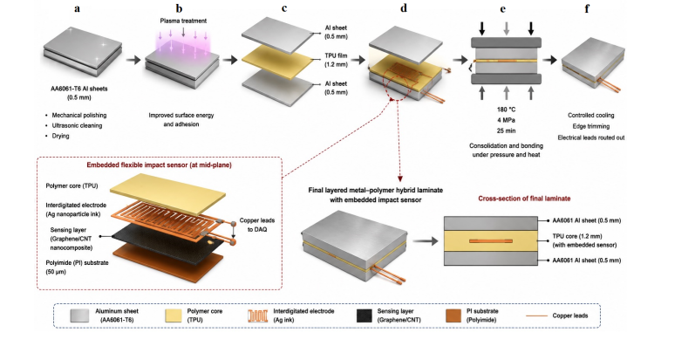
The increasing demand for lightweight, intelligent, and structurally reliable automotive components has accelerated the development of multifunctional hybrid materials capable of simultaneously providing superior mechanical performance and real-time structural health monitoring. In this study, a novel layered metal–polymer hybrid laminate incorporating an embedded flexible impact sensor was developed for connected automotive panel applications. The laminate was fabricated using AA6061-T6 aluminum alloy face sheets and a thermoplastic polyurethane interlayer through hot-press compression molding. A flexible graphene/CNT-based sensor was embedded at the neutral plane of the polymer core to monitor impact events without compromising structural integrity. Mechanical evaluation demonstrated that the TPU interlayer enhanced impact energy absorption, delayed crack propagation, and improved damage tolerance under low-velocity impact loading while maintaining high tensile and flexural performance. The sensor exhibited stable and repeatable voltage responses over impact energies ranging from 5 J to 30 J, showing excellent correlation between sensor output and impact severity. Furthermore, an ESP32-based wireless communication module established an Internet of Things enabled structural health monitoring framework capable of transmitting real-time impact data to cloud platforms for remote visualization and predictive maintenance. The proposed multifunctional hybrid laminate successfully combines lightweight structural reinforcement, impact sensing, and intelligent connectivity within a single integrated architecture, demonstrating strong potential for next-generation automotive body panels, enhanced passenger safety, and sustainable vehicle technologies for future connected mobility ecosystems and autonomous transportation worldwide.
Keywords: Thermoplastic polyurethane, graphene/ carbon nano-tube, metal–polymer hybrid laminate, remote visualization, flexural performance.
[This article belongs to Journal of Polymer & Composites ]

References
1. Schmidt R, Graf A, Decker R, Kräusel V, Hardt W, Landgrebe D, et al. Hybrid laminate for haptic input device with integrated signal processing. Appl Sci. 2018 Jul 31;8(8):1261.
2. Rizzo F, Pinto F, Meo M. Development of multifunctional hybrid metal/carbon composite structures. Compos Struct. 2019 Aug 15;222:110907.
3. Carani LB, Humphrey J, Rahman MM, Okoli OI. Advances in embedded sensor technologies for impact monitoring in composite structures. J Compos Sci. 2024 May 26;8(6):201.
4. Janeliukstis R, Mironovs D. Smart composite structures with embedded sensors for load and damage monitoring–a review. Mech Compos Mater. 2021 May;57(2):131–52.
5. Ghosh G, Bhattacharyya R, Penumadu D. Advances in multi-functional composite materials: Applications and opportunities in automotive industry. Funct Compos Struct. 2025 Dec 1;7(4):042001.
6. Moshiri H, Kamran F, Shahi F. Recent Trends in Polymeric Laminated Composites for Structural and Functional End‐Use Sectors. ChemistrySelect. 2026 Jul;11(26).
7. Wang D, Sun H, Xu W, Dong J, Lian F, Huo H. Research progress on fiber reinforced Polymer/Metal hybrid structures for automotive applications. Polym Compos. 2026 May 10;47(9):7777–99.
8. Brugo TM, Maccaferri E, Cocchi D, Mazzocchetti L, Giorgini L, Fabiani D, et al. Self-sensing hybrid composite laminate by piezoelectric nanofibers interleaving. Compos Part B Eng. 2021 May 1;212:108673.
9. Pavlovic A, Santulli C, Fragassa C. Polymer–Metal Hybrid Composites: An Overview of the Role of Metal Architecture. Materials. 2026 Apr 22;19(9):1678.
10. Xiao H, Sultan MT, Shahar FS, Gaff M, Hui D. Recent developments in the mechanical properties of hybrid fiber metal laminates in the automotive industry: A review. Rev Adv Mater Sci. 2023 Jul 24;62(1):20220328.
11. Liu Y, Xiao G, Liu E, Li X, Shu X, Hao X. Experimental investigation on the low-velocity impact responses of hybrid CFRP–elastomer–metal laminates with various rubber layer positions and impact energies. Mech Adv Mater Struct. 2026 Dec 31;33(1):2471028.
12. Mongioì F, Selleri G, Maccaferri E, Fabiani D, Zucchelli A, Brugo TM. CFRP laminate with autonomous sensing and enhanced impact resistance by P (VDF-TrFE) nanofibers interleaving. Compos Part B Eng. 2025 Mar 15;293:112143.
13. Hornig A, Winkler A, Bauerfeind E, Gude M, Modler N. Delamination behaviour of embedded polymeric sensor and actuator carrier layers in epoxy based CFRP laminates – A study of energy release rates. Polymers. 2021 Nov 13;13(22):3926.
14. Stenzler JS, Goulbourne NC. Impact mechanics of transparent multi-layered polymer composites. In: Proceedings of the SEM Annual Conference & Exposition on Experimental & Applied Mechanics; 2009 Jun 1-4; Albuquerque, NM, USA. Vol. 3. p. 1963–82.
15. Trzepieciński T, Najm SM, Sbayti M, Belhadjsalah H, Szpunar M, Lemu HG. New advances and future possibilities in forming technology of hybrid metal–polymer composites used in aerospace applications. J Compos Sci. 2021 Aug 13;5(8):217.
16. Merzkirch M, Juin E, Eman J, Pettersson J, Juntikka M, Ahlqvist F, et al. Hybrid manufacturing of a 3D-shaped fiber metal laminate. J Manuf Process. 2025 Jul 15;145:85–98.
17. Amancio-Filho ST, Blaga LA, editors. Joining of polymer-metal hybrid structures: principles and applications. Hoboken (NJ): John Wiley & Sons; 2018. doi: 10.1002/9781119429807.
18. aratharajulu M, Jagadeesh B, Hariharasakthisudhan P. Performance of hybrid composites in automotives: Case studies on side intrusion beams and other automobile components. In: Raghunathan V, Ayyappan V, Rangappa SM, Siengchin S, editors. Sustainable composites for automotive engineering. Cambridge, MA: Woodhead Publishing; 2025. p. 573–600. doi: 10.1016/B978-0-443-23669-3.00025-7.
19. Kroll L. Metal-based hybrid technologies. In: Kroll L, editor. Multifunctional lightweight structures: resource efficiency by MERGE of key enabling technologies. Berlin, Heidelberg: Springer; 2023. p. 155–293.
20. Li Z, Jackstadt A, Zhang J, Liebig WV, Kärger L. Low velocity impact resistance of hybrid CFRP‐elastomer‐metal laminates: Influence of stacking sequence and impact conditions on damage mechanisms. Polym Compos. 2025 Jan 10;46(1):817–31.
21. Klein L, Joseph Y, Kröger M. Product integration of established crash sensors for safety applications in lightweight vehicles. Sensors. 2021 Oct 21;21(21):6994.
22. Tuloup C, Harizi W, Aboura Z, Meyer Y, Khellil K, Lachat R. On the manufacturing, integration, and wiring techniques of in situ piezoelectric devices for the manufacturing and structural health monitoring of polymer–matrix composites: A literature review. J Intell Mater Syst Struct. 2019 Sep;30(16):2351–81.
23. Zhao Z, He L, Lin Z, Wang Z, Kurita H, Shi Y, et al. Self-powered multilayer impact sensor consisting of CFRP integrated with soft and hard piezoelectric layers. Compos Part B Eng. 2025 Sep 1;304:112683.
24. Pachchinavar DH, Mohammed HA, Uddin MK, Ateeq SA. Finite element analysis of corrugated sandwich panels integrated with smart hybrid materials. IUP J Mech Eng. 2025 Oct 1;18(4):60–71.
25. Ullmann F, Decker R, Graf A, Kräusel V, Heinrich M, Hardt W, et al. Continuous manufacturing of piezoceramic hybrid laminates for functionalised formed structural components. Technol Light Struct. 2017;1(1):1–13. doi: 10.21935/tls.v1i1.64.

Journal of Polymer & Composites
| Volume | 14 | |
| Issue | 05 | |
| Received | 15/07/2026 | |
| Accepted | 22/07/2026 | |
| Published | 29/07/2026 | |
| Publication Time | 14 Days |