Pijush Dutta,
Pradip Deb,
Pooja Nagpal,
Shantanu Naskar,
Anubrata Mondal,
Tan Yi Fei,
Chua Fang,
- Assistant Professor, Department of Computer Science & Engineering, Greater Kolkata College of Engineering and Management, Kolkata, West Bengal, India
- Assistant Professor, Department of Bachelor of Computer Application, Global College of Science and Technology, Krishnagar, West Bengal, India
- Associate Professor, Faculty of Management, CMS Business School, Jain (Deemed to Be University), Bangalore, Karnataka, India
- Assistant Professor, Department of Electrical Engineering, Greater Kolkata College of Engineering and Management, Kolkata, West Bengal, India
- Assistant Professor, Department of Electrical Engineering, Greater Kolkata College of Engineering and Management, Kolkata, West Bengal, India
- Associate Professor, Centre for Smart Systems and Automation, COE for Robotics and Sensing Technologies, Faculty of Artificial Intelligence and Engineering, Multimedia University, Persiaran Multimedia, 63100 Cyberjaya, Selangor, , Malaysia
- Associate Professor, Centre for Advanced Analytics, COE for Artificial Intelligence, Faculty of Computing and Informatics, Multimedia University, Persiaran Multimedia, 63100 Cyberjaya, Selangor, , Malaysia
Abstract
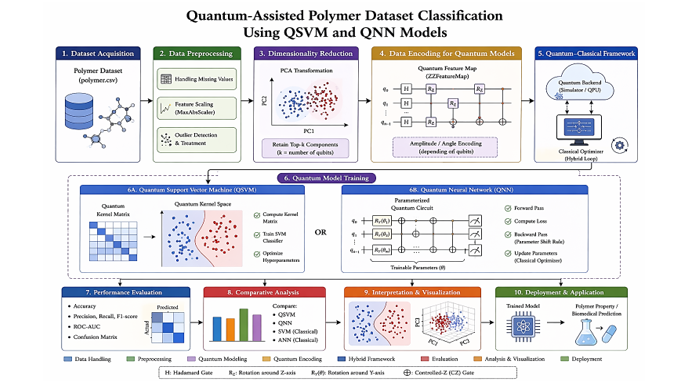
In polymer and composite materials, a major challenge lies in predicting their nonlinear rheological response, owing to complex multiscale interactions that are not captured by traditional constitutive laws or conventional machine learning approaches. In this study, a hybrid Quantum–Machine Learning (QML) model comprising Quantum Support Vector Machine (QSVM) and Quantum Neural Network (QNN) architectures is proposed for viscosity prediction without requiring any specific rheological equation. To train and test the proposed model, 420 samples, including shear rate, temperature, and composition-related parameters, were employed. Statistical metrics – like MSE, RMSE, MAE, and were used to evaluate predictive performance. The results show that both quantum models outperform the classical machine learning approaches, where the QNN has the highest prediction accuracy ( = 0.970) with RMSE = 0.0435 and MAE = 0.0324 for the testing set, and also has a very good generalization capacity. Moreover, a comparative study was also performed on this model for validation purposes. A sensitivity analysis indicated Polymer concentration and temperature as the key parameters determining the viscosity behavior. The results prove the potential of hybrid quantum–classical frameworks as powerful and data-rich tools for rheological modeling, the intelligent optimization of manufacturing processes, and future developments in materials informatics in Industry 5.0.
Keywords: Quantum–machine learning, quantum support vector machines, quantum neural networks, hybrid quantum–classical pipeline, polymer rheology.
[This article belongs to Journal of Polymer & Composites ]
References
1. Nanthakumar AJD. Rheological models for non-Newtonian fluids. In: Computational and Mathematical Techniques for Heat Transfer and Fluid Dynamics. 2025. pp.18–36
2. Jiang S, Webb MA. Generative active learning across polymer architectures and solvophobicities for targeted rheological behavior. NPJ Comput Mater. 2026;12:28. pp. 1–14.
3. Ahmad H, Boutaous MH, Xin S, Pabiou H, Siginer DA. Rheological characterization of high-molecular-weight polyethylene oxide – An extensive parametric experimental study. J Fluids Eng. 2023;145(2):021204.
4. Giuntoli A, Puosi F, Leporini D, Starr FW, Douglas JF. Predictive relation for the α-relaxation time of a coarse-grained polymer melt under steady shear. Sci Adv. 2020;6(17):eaaz0777.
5. Ling S, Wu Z, Mei J. Comparison and review of classical and machine learning-based constitutive models for polymers used in aeronautical thermoplastic composites. Rev Adv Mater Sci. 2023;62(1):20230107.
6. Yang Z, Meng Z. A review of computational modeling of polymer composites and nanocomposites. Polymers. 2026;18(4):443.
7. Almeshaal M, Palanisamy S, Murugesan TM, Palaniappan M, Santulli C. Physico-chemical characterization of Grewia monticola Sond fibers for prospective application in biocomposites. J Nat Fibers. 2022;19(17):15276–15290.
8. Palanisamy S, Mayandi K, Palaniappan M, Alavudeen A, Rajini N, Vannucchi de Camargo F, et al. Mechanical properties of Phormium tenax reinforced natural rubber composites. Fibers. 2021;9(2):11.
9. Ramasubbu R, Kayambu A, Palanisamy S, Ayrilmis N. Mechanical properties of epoxy composites reinforced with Areca catechu fibers containing silicon carbide. BioResources. 2024;19(2). pp. 2353–2370.
10. Palanisamy S, Mayandi K, Dharmalingam S, Rajini N, Santulli C, Mohammad F, et al. Tensile properties and fracture morphology of Acacia caesia bark fibers treated with different alkali concentrations. J Nat Fibers. 2022;19(15):11258–11269.
11. Ayrilmis N, Kanat G, Yildiz Avsar E, Palanisamy S, Ashori A. Utilizing waste manhole covers and fibreboard as reinforcing fillers for thermoplastic composites. J Reinf Plast Compos. 2025;44(17–18):1108–1118.
12. Ma T, Chen H, Zhang K, Shen L, Sun H. The rheological intelligent constitutive model of debris flow: A new paradigm for integrating mechanics mechanisms with data-driven approaches by combining data mapping and deep learning. Expert Syst Appl. 2025;269:126405.
13. Belkhir SA, Pakeer AA, Shakeel M, Muneer R, Alblooshi Y, Hashmet MR. Comparative assessment of machine learning models for polymer solution viscosity prediction in enhanced oil recovery. Sci Rep. 2026;16(1):10442.
14. Navaie F, Mahdaviara M, Sharifi M. Soft computing models for predicting polymer viscosity across wide thermal and ionic-strength conditions. Sci Rep. 2026;16:17724.
15. Rizvi SMA, Paracha UI, Khalid U, Lee K, Shin H. Quantum machine learning: Towards hybrid quantum-classical vision models. Mathematics. 2025;13(16):2645.
16. Mohammadisavadkoohi E, Shafiabady N, Vakilian J. A systematic review on quantum machine learning applications in classification. IEEE Trans Artif Intell. 2025;7(1):4–21.
17. Behera BK, Al-Kuwari S, Farouk A. QSVM-QNN: Quantum support vector machine-based quantum neural network learning algorithm for brain-computer interfacing systems. IEEE Trans Artif Intell. 2026;7:308–320.
18. Dutta P, Pal S, Kumar A, Cengiz K. Artificial Intelligence for Cognitive Modeling: Theory and Practice. Boca Raton (FL): Chapman and Hall/CRC; 2023. https://doi.org/10.1201/9781003216001.
19. Dutta P, Majumder M, Kumar A. Parametric optimization of liquid flow process by ANOVA optimized DE, PSO & GA algorithms. Int J Eng Manuf. 2021;11(5):14–26.
20. Dutta P, Kundu S, Paul S, Jana GG. Evaluating the performance of machine learning integrated SMOTE analysis. In: Proceedings of Third International Conference on Intelligent System (ICIS 2024). Singapore: Springer Nature; 2025. p. 343. pp.343–353, https://doi.org/10.1007/978-981-96-4093-5_30.
21. Benedetti M, Lloyd E, Sack S, Fiorentini M. Parameterized quantum circuits as machine learning models. Quantum Sci Technol. 2019;4(4):043001.
22. Amaral CA, Oliveira VL, Salazar JP, Duzzioni EI. Quantum machine learning and quantum-inspired methods applied to computational fluid dynamics: A short review. arXiv e-prints (2025): arXiv-2510, pp. 1–49.
23. Gangappa M, Manju D, Krishnna MG, Reddy MSM, Sathish M, Shahabaaz S, et al. Quantum-enhanced brain tumor detection and progression prediction using MRI imaging. J Electron Electromed Eng Med Inform. 2025;7(2):493–507.
24. Padmaja B, Maram B, Raheem AKA, Khan S, Basheti I, Abass KS, et al. Hybrid quantum classical framework for electroencephalogram-driven neurological processing in epileptic seizure taxonomy. Sci Rep. 2026;16(1):5305.
25. Nivethitha T, Venkataramanan C. A quantum-enhanced deep learning framework for precise leaf disease detection in tomato and cotton crops. Iran J Sci Technol Trans Electr Eng. 2026;50(1):323–354.

Journal of Polymer & Composites
| Volume | 14 | |
| Issue | 05 | |
| Received | 18/06/2026 | |
| Accepted | 06/07/2026 | |
| Published | 25/07/2026 | |
| Publication Time | 37 Days |