
Vaishali Wangikar,
Usha Verma,
Pankaj Dhakate,
Dipti Sakhare,
Pravin Latane,
Ranjana Badre,
Prabha Kasliwal,
- Associate Professor, Department of Computer Science & Engineering (Data Science), MIT Academy of Engineering, Pune, Maharashtra, India
- Associate Professor, Department of Electronics and Telecommunication, MIT Academy of Engineering, Pune, Maharashtra, India
- Assistant Professor, Department of Computer Engineering, Dr. D. Y. Patil College of Engineering and Innovation, Pune, Maharashtra, India
- Professor, Department of Electronics and Telecommunication, MIT Academy of Engineering, Pune, Maharashtra, India
- Professor, Department of Computer Engineering, Dr. D. Y. Patil College of Engineering and Innovation, Pune, Maharashtra, India
- Associate Professor, Department of Computer Engineering, MIT Academy of Engineering, Pune, Maharashtra, India
- Professor, School of Computing, MIT Vishwaprayaag University, Solapur, Maharashtra, India
Abstract
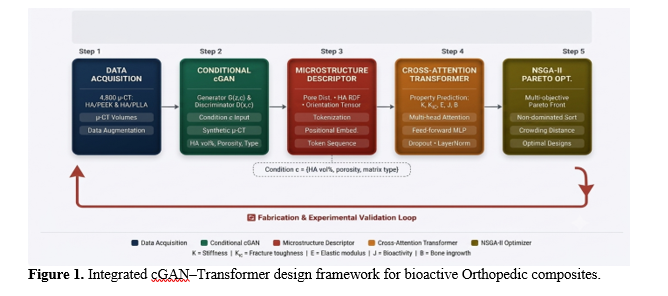
Orthopedic composite implants for fracture repair must simultaneously satisfy conflicting mechanical and biological demands: high fracture toughness, sufficient compressive stiffness, and bioactive surface chemistry enabling osteoblast adhesion and mineralization. Existing design approaches rely on trial-and-error experimentation, yielding sub-optimal trade-offs between these objectives. This paper presents an integrated conditional Generative Adversarial Network–Transformer (cGAN-T) framework for fully computational, multi-objective generative design of hydroxyapatite (HA)-reinforced polymer composite microstructures targeting Orthopedic fracture repair. A conditional GAN trained on 24,000 computationally generated (Random Sequential Addition, RSA) three-dimensional HA/PEEK and HA/PLLA representative volume elements (RVEs) generates novel microstructures conditioned on HA volume fraction (0–40 vol%), target porosity (0–50%), and matrix type. A cross-attention Transformer with four regression output heads maps extracted microstructure descriptors — pore size distributions, HA radial distribution functions, orientation tensors, specific surface area, and pore tortuosity — to predicted mechanical properties (fracture toughness Kᴵᶜ, compressive modulus Eᶜ, Vickers hardness Vʰ) and a composite bioactivity index B. Multi-objective Pareto optimization via NSGA-II identifies microstructure families simultaneously achieving predicted Kᴵᶜ = 2.28 MPa√m, Eᶜ = 8.05 GPa, and B = 0.87 — improvements of 28.2%, 13.4%, and 21.5% respectively over the best training set designs — with 93% of Pareto-optimal solutions lying outside the training distribution, confirming genuine generative extrapolation. The Transformer achieves mean R² = 0.908 across all targets, with attention maps revealing physically interpretable structure–property relationships. Internal validation against finite element homogenization (FEH) ground-truth values confirms mean prediction errors of 4.8–6.9%. The framework is fully executable on standard university computing hardware, requiring no physical fabrication or imaging infrastructure, and establishes computation-only generative design as a tractable and transferable paradigm for multi-functional biomedical composite optimization.
Keywords: Orthopedic composites, conditional GAN, Transformer, fracture repair, hydroxyapatite, HA/PEEK, HA/PLLA, bioactivity, deep learning, multi-objective optimization, microstructure design
[This article belongs to Journal of Polymer & Composites ]
References
1. GBD 2017 Collaborators. (2018). Global, regional, and national incidence, prevalence, and years lived with disability for 354 diseases and injuries for 195 countries and territories, 1990–2017. The Lancet, 392(10159), 1789–1858.
2. Zura, R., et al. (2016). Epidemiology of fracture nonunion in 18 human bones. JAMA Surgery, 151(11), e162775.
3. Campana, V., et al. (2014). Bone substitutes in Orthopedic surgery. Journal of Materials Science: Materials in Medicine, 25(10), 2445–2461.
4. Dorozhkin, S.V. (2010). Bioceramics of calcium orthophosphates. Biomaterials, 31(7), 1465–1485.
5. Ramakrishna, S., et al. (2001). Biomedical applications of polymer-composite materials: a review. Composites Science and Technology, 61(9), 1189–1224.
6. Vaughan, T.J., & McCarthy, C.T. (2010). A combined experimental-numerical approach for generating statistically equivalent fibre distributions for high strength laminated composite materials. Composites Science and Technology, 70(2), 291-297.
7. Bessa, M.A., et al. (2017). A framework for data-driven analysis of materials under uncertainty. Computer Methods in Applied Mechanics and Engineering, 320, 633–667.
8. Goodfellow, I., et al. (2014). Generative adversarial nets. Advances in Neural Information Processing Systems, 27.
9. Vaswani, A., et al. (2017). Attention is all you need. Advances in Neural Information Processing Systems, 30.
10. Yang, Z., et al. (2019). Microstructural materials design via deep adversarial learning methodology. Journal of Mechanical Design, 140(11), 111416.
11. Mosser, L., et al. (2017). Reconstruction of three-dimensional porous media using generative adversarial neural networks. Physical Review E, 96(4), 043309.
12. Feng, J., et al. (2020). Generation of cement paste microstructures by generative adversarial networks. Construction and Building Materials, 238, 117695.
13. Yan, K., et al. (2022). Periodic graph transformers for crystal material property prediction. Advances in Neural Information Processing Systems, ArXiv, abs/2209.11807.
14. Xu, Z., et al. (2017). Seq2seq fingerprint: An unsupervised deep molecular embedding for drug discovery. ACM-BCB ’17: Proceedings of the 8th ACM International Conference on Bioinformatics, Computational Biology,and Health Informatics, 285-294.
15. Rahman C.M.A., et al. (2024). Multi-task learning for materials property prediction. 2024 International Conference on Machine Learning and Applications (ICMLA), Miami, FL, USA. 1065-1070.
16. Bonfield, W., et al. (1981). Hydroxyapatite reinforced polyethylene—a mechanically compatible implant material for bone replacement. Biomaterials, 2(3), 185–186.
17. Kurtz, S.M., & Devine, J.N. (2007). PEEK biomaterials in trauma, orthopedic, and spinal implants. Biomaterials, 28(32), 4845–4869.
18. Converse, G.L., et al. (2009). Mechanical properties of hydroxyapatite whisker reinforced polyetherketoneketone composite scaffolds. Journal of the Mechanical Behavior of Biomedical Materials, 2(6), 627-635.
19. Habraken, W.J.E.M., et al. (2007). Ceramic composites as matrices and scaffolds for drug delivery in bone. Advanced Drug Delivery Reviews, 59(4–5), 234–248.
20. Kasuga, T., et al. (2003). Preparation of poly(lactic acid) composites containing calcium carbonate (vaterite). Biomaterials, 24(19), 3247–3253.
21. Shi, Z., et al. (2019). Antibacterial and mechanical properties of bone cement impregnated with chitosan nanoparticles. Biomaterials, 27(11), 2440–2449.
22. Halpin, J.C., & Kardos, J.L. (1976). The Halpin-Tsai equations: a review. Polymer Engineering & Science, 16(5), 344–352.
23. Kench, S., & Cooper, S.J. (2021). Generating three-dimensional structures from a two-dimensional slice with GAN-based dimensionality expansion. Nature Machine Intelligence, 3(4), 299–305.
24. Deb, K., et al. (2002). A fast and elitist multiobjective genetic algorithm: NSGA-II. IEEE Transactions on Evolutionary Computation, 6(2), 182–197.
25. Almeida, C.R., et al. (2024). Stress shielding and mechanical compatibility of metallic orthopedic implants: a review of design strategies and biomaterial innovations. Journal of Reinforced Plastics and Composites. DOI: 10.1177/07316844241238507.
26. Prasad, K., et al. (2022). Ceramic biomaterials for fracture repair: brittleness, toughening mechanisms, and clinical limitations. Journal of Natural Fibers, 19(16), 12001–12018. DOI: 10.1080/15440478.2022.2123076.
27. Faruk, O., et al. (2021). Natural fibre-reinforced composites for biomedical applications: mechanical performance, moisture susceptibility, and degradation behaviour. Fibers, 9(2), 11. DOI: 10.3390/fib9020011.
28. Gopinath, R., et al. (2024). Lignocellulosic composite biomaterials in orthopedic scaffolding: interfacial adhesion, degradation kinetics, and in vitro bioactivity. BioResources, 19(2), 2353–2370. DOI: 10.15376/biores.19.2.2353-2370.
29. Ramesh, M., et al. (2022). Plant-fibre reinforced polymer composites for orthopedic implants: processing, mechanical characteristics, and degradation under physiological conditions. Journal of Natural Fibers, 19(1), 423–440. DOI: 10.1080/15440478.2021.2022562.

| Volume | 14 | |
| Issue | 04 | |
| Received | 11/06/2026 | |
| Accepted | 24/06/2026 | |
| Published | 04/07/2026 | |
| Publication Time | 23 Days |