
Bingbing Pan,
Zihua Liu,
Yiyi Zhang,
Wen Li,
Hui Li,
- Graduate Student, School of Material Science and Engineering, LanZhou University of Technology, LanZhou, China
- Undergraduate Student, School of Material Science and Engineering, LanZhou University of Technology, LanZhou, China
- Graduate Student, School of Material Science and Engineering, LanZhou University of Technology, LanZhou, China
- Graduate Student, School of Material Science and Engineering, LanZhou University of Technology, LanZhou, China
- Professor, School of Material Science and Engineering, LanZhou University of Technology, LanZhou, China
Abstract
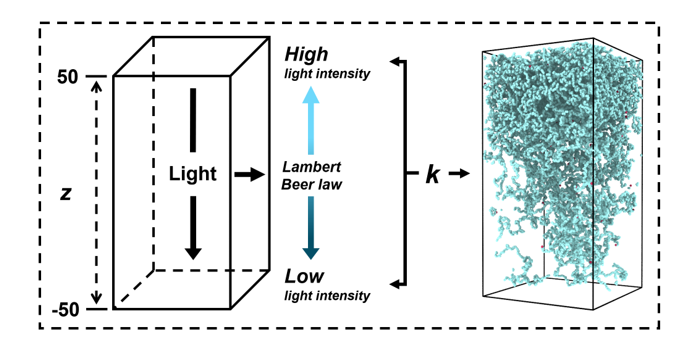
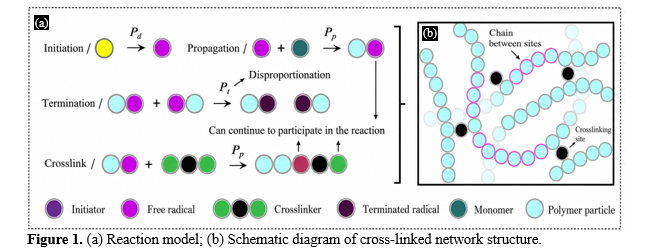
Gradient polymer materials overcome the limitations of conventional homogeneous polymers by integrating multiple distinct functionalities within a single continuous structure. Although photoinitiated free-radical polymerization offers excellent spatial and temporal control, the underlying microscopic mechanisms governing network evolution under non-uniform light fields remain poorly understood. In this study, a mesoscale dissipative particle dynamics (DPD) model was successfully developed to couple free-radical polymerization kinetics—including initiation, propagation, crosslinking, and termination—with exponential light attenuation along the z-axis via the Lambert–Beer law, characterized by a dimensionless parameter k. The simulation results systematically demonstrate that light attenuation acts as the fundamental driver of gradient structure formation by restricting local radical generation. Increasing k confines radical initiation primarily to the near-light region, thereby inducing a pronounced spatial asynchrony in monomer consumption and chain propagation. This severe kinetic heterogeneity yields a distinct topological gradient under strong attenuation: the near-light region forms a dense network characterized by short-chain, highly crosslinked domains, whereas the far-light region features longer chains and a loose morphology. Notably, strong light attenuation creates an environment where localized growing chains compete intensely for crosslinkers, significantly enhancing crosslinking site utilization efficiency. These molecular-level insights provide crucial theoretical guidance and a predictive framework for the rational design and controllable fabrication of advanced gradient polymer materials.
Keywords: Gradient polymer materials; photoinitiated radical polymerization; crosslinked network structure; competitive mechanism; mesoscale simulation
[This article belongs to Journal of Polymer & Composites ]
References
1. Gao R, Yu CC, Gao L, et al. A highly homogeneous polymer composed of tetrahedron-like monomers for high-isotropy expansion microscopy. Nat Nanotechnol. 2021;16(6):698–707. doi:10.1038/s41565-021-00875-7.
2. Yan X, Sun T, Song Y, et al. In situ thermal-responsive magnetic hydrogel for multidisciplinary therapy of hepatocellular carcinoma. Nano Lett. 2022;22(6):2251–2260. doi:10.1021/acs.nanolett.1c04413.
3. Wang L, Luo Y, Song Y, et al. Hydrogel-functionalized bandages with Janus wettability for efficient unidirectional drug delivery and wound care. ACS Nano. 2024;18(4):3468–3479. doi:10.1021/acsnano.3c10766.
4. Zhu H, Wang C, Yang Y, et al. High-strength mechanically gradient hydrogels via physical crosslinking for tendon-mimetic tissue repair. npj Flex Electron. 2025;9(1):53. doi:10.1038/s41528-025-00430-7.
5. Kosmidis PA, Chong SW, Shen Y, et al. Fabrication of gradient hydrogels using a thermophoretic approach in microfluidics. Biofabrication. 2024;16(2):025023. doi:10.1088/1758-5090/ad2b05.
6. O’Shea TC, Salem A, Schultz KM. A technique to create hydrogels with tethered concentration gradients of molecules in vitro. Soft Matter. 2026;22(3):678–691. doi:10.1039/D5SM01194A.
7. Ma Y, Wang Y, Chen D, et al. 3D bioprinting of a gradient stiffened gelatin-alginate hydrogel with adipose-derived stem cells for full-thickness skin regeneration. J Mater Chem B. 2023;11(13):2989–3000. doi:10.1039/D2TB02200A.
8. Zhang YC, Xue YQ, Ogawa T, et al. 3D printed alginate hydrogels with stiffness-gradient structure in a carbomer supporting bath by controlled Ca2+ diffusion. ACS Appl Eng Mater. 2023;1(2):802–812. doi:10.1021/acsaenm.2c00218.
9. Zhang YC, Xue YQ, Ogawa T, et al. Design and characterization of 3D printed pore gradient hydrogel scaffold for bone tissue engineering. Bioprinting. 2024;39:e00341. doi:10.1016/j.bprint.2024.e00341.
10. Wang W, Li H, Song P, et al. Photo-crosslinked integrated triphasic scaffolds with gradient composition and strength for osteochondral regeneration. J Mater Chem B. 2024;12(5):1271–1284. doi:10.1039/D3TB02031B.
11. Eckstein KN, Hergert JE, Uzcategui AC, et al. Controlled mechanical property gradients within a digital light processing printed hydrogel-composite osteochondral scaffold. Ann Biomed Eng. 2024;52(8):2162–2177. doi:10.1007/s10439-024-03516-x.
12. Liu JY, Yu JW, Chen HL, et al. Porous gradient hydrogel promotes skin regeneration by angiogenesis. J Colloid Interface Sci. 2024;671:312–324. doi:10.1016/j.jcis.2024.05.075.
13. Krishna DV, Sankar MR. Functionally graded Gelatine/PVA-based composite hydrogel for repairing the soft tissues of diarthrodial joints. Mater Today Commun. 2024;38:108070. doi:10.1016/j.mtcomm.2024.108070.
14. Gupta P, Waghmare S, Kar S, et al. Functionally gradient three-dimensional graphene foam-based polymeric scaffolds for multilayered tissue regeneration. RSC Adv. 2023;13(2):1245–1255. doi:10.1039/D2RA06018C.
15. Deng XB, Wei HX, Yang L, et al. Layered gradient-structured coating with sustained lubricating performance for the surface functionalization of implant materials. Chin J Polym Sci. 2025;43(6):1050–1058. doi:10.1007/s10118-025-3328-4.
16. Shirai Y, Sasaki A, Sato S, et al. Fabrication of an organic-inorganic hybrid hard coat with a gradient structure controlled by photoirradiation. ACS Appl Mater Interfaces. 2023;15(23):28563–28569. doi:10.1021/acsami.3c04399.
17. Yang XY, Jiang HJ, Zhong YT, et al. Hierarchically heterostructured ceramic cellular-polymer gradient coatings: Synergistic autonomous ice shedding and extreme-environment durability. J Colloid Interface Sci. 2025;695:137813. doi:10.1016/j.jcis.2025.137813.
18. Zhang WL, Yu F, Li XS, et al. Architectured gradient coupling of multiscale particles for high-performance superhydrophobic coatings. Surf Interfaces. 2026;82:108490. doi:10.1016/j.surfin.2026.108490.
19. Liu H, Chu H, Yuan H, et al. Bioinspired multifunctional self-sensing actuated gradient hydrogel for soft-hard robot remote interaction. Nano-Micro Lett. 2024;16(1):69. doi:10.1007/s40820-023-01287-z.
20. Zhu W, Wang J, Sun W, et al. Preparation of gradient hydrogel for pressure sensing by combining freezing and directional diffusion processes. Chem Eng J. 2023;451:138335. doi:10.1016/j.cej.2022.138335.
21. Zeng J, Jing X, Lin L, et al. Smart sensing hydrogel actuators conferred by MXene gradient arrangement. J Colloid Interface Sci. 2025;677:816-826. doi:10.1016/j.jcis.2024.08.117.
22. Song L, Wang Z, Chen S, et al. Phytic acid-induced gradient hydrogels for highly sensitive and broad range pressure sensing. Adv Mater. 2025;37(9):2417978. doi:10.1002/adma.202417978.
23. Ouyang K, Zhuang J, Chen C, et al. Gradient diffusion anisotropic carboxymethyl cellulose hydrogels for strain sensors. Biomacromolecules. 2021;22(12):5033–5041. doi:10.1021/acs.biomac.1c01003.
24. Huang K, Hung W, Su Y, et al. Zwitterionic gradient double-network hydrogel membranes with superior biofouling resistance for sustainable osmotic energy harvesting. Adv Funct Mater. 2023;33(19):2211316. doi:10.1002/adfm.202211316.
25. Yin J, Jia P, Ren Z, et al. Mechanically enhanced, environmentally stable, and bioinspired charge-gradient hydrogel membranes for efficient ion gradient power generation and linear self-powered sensing. Adv Mater. 2025;37(24):2417944. doi:10.1002/adma.202417944.
26. Wang Q, Huang J, Qi L, et al. A bioinspired gradient hydrogel electrolyte network with optimized interfacial chemistry toward robust aqueous zinc-ion batteries. ACS Nano. 2025;19(29):26770–26781. doi:10.1021/acsnano.5c06914.
27. Mao J, Iocozzia J, Huang J, et al. Graphene aerogels for efficient energy storage and conversion. Energy Environ Sci. 2018;11(4):772–799. doi:10.1039/C7EE03031B.
28. Li X, Sun F. An ultrastretchable gradient ionogel induced by a self-floating strategy for strain sensing. ACS Appl Mater Interfaces. 2023;15(31):37717–37727. doi:10.1021/acsami.3c06894.
29. Zhou Z, Xu Z, Zhang J, et al. An integrated capacitive pressure sensor based on gradient charge distribution with high sensitivity and fast response. ACS Appl Nano Mater. 2024;7(10):12043–12052. doi:10.1021/acsanm.4c01654.
30. Mezel M, Alsous MB, Abbas B, et al. Multimode gradient-index fiber coated with a blend of PEG and PVP as a humidity sensor. Results Opt. 2024;16:100697. doi:10.1016/j.rio.2024.100697.
31. Zinkovska N, Smilek J, Pekar M. Gradient hydrogels—the state of the art in preparation methods. Polymers. 2020;12(4):966. doi:10.3390/polym12040966.
32. Zhang Y, Wang H, Song Z, et al. Directed selective transport and enrichment of micropollutants by gradient hydrogels. J Hazard Mater. 2025;486:136929. doi:10.1016/j.jhazmat.2024.136929.
33. Jiang P, Zhang Y, Mu X, et al. Grayscale stereolithography of gradient hydrogel with site-selective shape deformation. Adv Mater Technol. 2022;7(7):2101288. doi:10.1002/admt.202101288.
34. Liu X, Liu S, Yang R, et al. Gradient chondroitin sulfate/poly(γ-glutamic acid) hydrogels inducing differentiation of stem cells for cartilage tissue engineering. Carbohydr Polym. 2021;270:118330. doi:10.1016/j.carbpol.2021.118330.
35. Tu J, Engelhardt JD, Barkow MH, et al. Additive manufacturing of polymeric gradient index optics via grayscale digital light processing vat photopolymerization technology. ACS Appl Opt Mater. 2025;3(6):1197–1207. doi:10.1021/acsaom.5c00143.
36. Wen T, Ma T, Qian J, et al. Phase-transition-induced dynamic surface wrinkle pattern on gradient photo-crosslinking liquid crystal elastomer. Nat Commun. 2024;15(1):10821. doi:10.1038/s41467-024-55180-3.
37. Shi R, Qian HJ, Lu ZY. Coarse-grained molecular dynamics simulation of polymers: Structures and dynamics. WIREs Comput Mol Sci. 2023;13(6):e1683. doi:10.1002/wcms.1683.
38. Bellussi FM, Ricci M, Fasano M, et al. Mesoscopic modeling of bio-compatible PLGA polymers with coarse-grained molecular dynamics simulations. J Phys Chem B. 2025;129(9):2598–2606. doi:10.1021/acs.jpcb.4c07518.
39. Li H, Gao K, Zhao H, et al. Dissipative particle dynamics study on the phase region of spatial gradient materials produced by photoinduced isomerization. Macromol Theory Simul. 2026;33(4):2400006. doi:10.1002/mats.202400006.
40. Deng W, Yu C, Guo H. Molecular dynamics simulation of self-assembly of one-component nanocrystals grafted with end-functionalized polymers. Soft Matter. 2026;22(8):1847–1862. doi:10.1039/D5SM01128K.
41. Groot RD, Warren PB. Dissipative particle dynamics: Bridging the gap between atomistic and mesoscopic simulation. J Chem Phys. 1997;107(11):4423–4435. doi:10.1063/1.474784.
42. Furuya T, Koga T. Molecular simulation of effects of network structure on fracture behavior of gels synthesized by radical polymerization. Macromolecules. 2025;58(7):3359–3368. doi:10.1021/acs.macromol.4c02875.
43. Zhang Z, Krajniak J, Dookhith AZ, et al. Topology and mechanical properties of polymer networks formed under free radical and atom transfer radical polymerizations. Macromolecules. 2025;58(6):3168–3187. doi:10.1021/acs.macromol.4c03138.
44. Hoogerbrugge PJ, Koelman JMVA. Simulating microscopic hydrodynamic phenomena with dissipative particle dynamics. Europhys Lett. 1992;19(3):155–160. doi:10.1209/0295-5075/19/3/001.
45. Müller M, Katsov K, Schick M. Biological and synthetic membranes: What can be learned from a coarse-grained description? Phys Rep. 2006;434(5–6):113–176. doi:10.1016/j.physrep.2006.08.003.
46. Li H, Zhao H, Gao K, et al. The conformational statistics of amphiphilic polymers with distinct topological structures at the interface between two phases. Polym Int. 2024;74: 152-162. doi: 10.1002/pi.6703.
47. Español P, Warren P. Statistical mechanics of dissipative particle dynamics. Europhys Lett. 1995;30(4):191–196. doi:10.1209/0295-5075/30/4/001.
48. Warren PB. Dissipative particle dynamics. Curr Opin Colloid Interface Sci. 1998;3(6):620–624. doi:10.1016/S1359-0294(98)80089-7.
49. Kröger M. Simple models for complex nonequilibrium fluids. Phys Rep. 2004;390(6):453–551. doi:10.1016/j.physrep.2003.10.014.
50. Groot RD, Madden TJ. Dynamic simulation of diblock copolymer microphase separation. J Chem Phys. 1998;108(20):8713–8724. doi:10.1063/1.476300.
51. Gavrilov AA, Chertovich AV. Simulation of the RAFT polymerization in 3D: Steric restrictions and incompatibility between species. Polym Chem. 2022;13(15):2143–2154. doi:10.1039/D1PY01624E.

Journal of Polymer & Composites
| Volume | 14 | |
| Issue | 04 | |
| Received | 18/06/2026 | |
| Accepted | 22/06/2026 | |
| Published | 02/07/2026 | |
| Publication Time | 14 Days |