
Rohit Katre,
Bhushan Rakhonde,
Pratik Dhabe,
Yuvraj Rathod,
Sneha Hatagale,
Rutuja Warbe,
Kalyani salunkhe,
Yogesh Mandake,
- Assistant Professor, Department of Electrical Engineering, Dr. D.Y.Patil Institute Of Technology, Pune, Maharashtra, India
- Assistant Professor, Department of Electrical Engineering, Shri Sant Gajanan Maharaj College of Engineering, Shegaon, Maharashtra, India
- Assistant Professor, Department of Electrical Engineering, Shri Sant Gajanan Maharaj College of Engineering, Shegaon, Maharashtra, India
- BE Student, Department of Electrical Engineering, Dr. D.Y.Patil Institute Of Technology, Pune, Maharashtra, India
- BE Student, Department of Electrical Engineering, Dr. D.Y.Patil Institute Of Technology, Pune, Maharashtra, India
- Assistant Professor, Department of Electrical Engineering, Dr.D.Y.Patil Institute Of Technology Pune, Maharashtra, India
- Assistant Professor, Department of Electrical Engineering, Alarad college of Engineering and management, Maharashtra, India
- Assistant Professor, Department of Electrical Engineering, Bharati Vidyapeeth University Pune, Maharashtra, India
Abstract
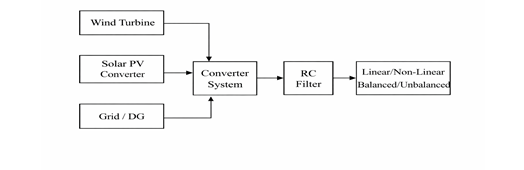
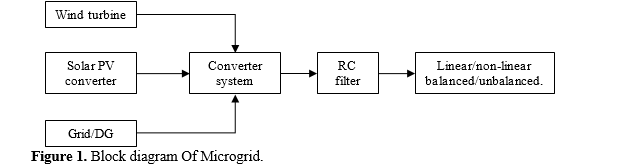
Increasing power demand and variable performance requirements in renewable-energy systems motivate integrating advanced polymeric and composite materials into microgrid components to improve reliability and performance. This paper presents a design and control framework for a standalone microgrid that couples power-electronic and energy-conversion subsystems with polymer-composite–based components to enhance durability, thermal management, and electromagnetic shielding. The microgrid uses a doubly fed induction generator (DFIG) for wind generation to enable independent active and reactive power control, and a photovoltaic (PV) array interfaced through a boost converter implementing an incremental-conductance MPPT algorithm. A common DC bus links the subsystems, while an energy management system (EMS) orchestrates power flow between generation, a battery energy storage system (BESS), and loads. Polymer-composite elements—such as composite housings for power electronics, thermally conductive polymer composites for heat-sinking, and dielectric polymer layers for DC-link insulation—are proposed and characterized via material property inputs in the simulation model. MATLAB/Simulink results demonstrate DC-link voltage regulation at 750 V and stable load voltage and frequency under source intermittency and load transients. The paper discusses how polymer-composite selection and design (mechanical, thermal, and electrical properties) affect system reliability and offers guidelines for material-property-driven system optimization.
Keywords: polymer composites, renewable-energy microgrid, photovoltaic systems, doubly fed induction generator, MPPT (incremental conductance), battery energy storage, energy management, thermal management polymers
[This article belongs to Journal of Polymer & Composites ]
References
1. Duryea S, Islam S, Lawrence W. A battery management system for stand-alone photovoltaic energy systems. In: Conference Record of the 34th IEEE IAS Annual Meeting; 1999 Oct; Phoenix, AZ, USA. Vol. 4. p. 2649–2654..
2. Duryea S, Islam S, Lawrance W. A battery management system for stand-alone photovoltaic energy systems. IEEE Ind Appl Mag. 2001 Jun;7(3):67–72.
3. Heier S. Grid integration of wind energy conversion systems. 2nd ed. Chichester (UK): Wiley; 2006.
4. Uzunoglu M, Onar OC, Alam MS. Modeling, control and simulation of a PV/FC/UC based hybrid power generation system for stand-alone applications. Renew Energy. 2009 Mar;34(3):509–520.
5. Rey-Bouë AB, García-Valverde R, Ruiz-Vila FA, Torrello-Ponce JM. An integrative approach to the design methodology for three-phase power conditioners in photovoltaic grid-connected systems. IEEE; 2010
6. Xuesong Z, Dachun S, Youjie M, Deshu C. The simulation and design for MPPT of PV system based on incremental conductance method. In: Proceedings of the International Conference on Information Engineering; 2010. p. 314–318.
7. Hirose T, Matsuo H. Standalone hybrid wind-solar power generation system applying dump power control without dump load. IEEE Trans Ind Electron. 2012 Feb;59(2):988–997.
8. Qi Z. Coordinated control for independent wind-solar hybrid power system. In: Proceedings of the Asia-Pacific Power and Energy Engineering Conference; 2012; Shanghai, China. p. 1–4.
9. Bakirtzis EA, Demoulias C. Control of a microgrid supplied by renewable energy sources and storage batteries. IEEE; 2012.
10. Orlando NA, Liserre M, Mastromauro RA, Dell’Aquila A. A survey of control issues in PMSG-based small wind turbine systems. IEEE Trans Ind Inform. 2013 Jul;9(3):1211–1221
11. Hamadi AB, Rahmani S, Al-Haddad K. Modeling and control of DFIG wind and PV solar energy source generation feeding wire isolated load. In: Proceedings of IEEE; 2013. p. 7778–7785.
12. Zhu H, Zhang D, Athab HS, Wu B, Gu Y. PV isolated three-port converter and energy-balancing control method for PV-battery power supply applications. IEEE Trans Ind Electron. 2015 Jun;62(6):3595–3606.
13. Das M, Agarwal V. Novel high-performance stand-alone solar PV system with high-gain high-efficiency DC-DC converter power stages. IEEE Trans Ind Appl. 2015 Nov-Dec;51(6):4718–4728.
14. Tiwari SK, Singh B, Goel PK. Design and control of autonomous wind-solar energy system with DFIG feeding 3-phase 4-wire network. In: 2015 Annual IEEE India Conference (INDICON); 2015; New Delhi, India. p. 1–6.
15. Das M, Agarwal V. Novel high-performance stand-alone solar PV system with high-gain high-efficiency DC-DC converter power stages. IEEE Trans Ind Appl. 2015 Nov-Dec;51(6):4718–4728.
16. Ataji AB, Miura Y, Ise T, Tanaka H. Direct voltage control with slip angle estimation to extend the range of supported asymmetric loads for stand-alone DFIG. IEEE Trans Power Electron. 2016 Feb;31(2):1015–1025.
17. Rezkallah M, Sharma S, Chandra A, Singh B. Implementation and control of small-scale hybrid standalone power generation system employing wind and solar energy. In: IEEE Industry Applications Society Annual Meeting; 2016; Portland, OR, USA. p. 1–7.
18. Young M. The technical writer’s handbook. Mill Valley (CA): University Science Books; 1989.
19. Tiwari SK, Singh B, Goel PK. Design and control of micro-grid fed by renewable energy generating sources. In: 2016 IEEE 6th International Conference on Power Systems (ICPS); 2016; New Delhi, India. p. 1–6.
20. Engelken S, Stieneker M, Soltau N, Rabiee S, Stagge H, De Doncker RW. Control and grid integration of MW-range wind and solar energy conversion systems. IEEE Trans Ind Electron. 2017 Nov;64(11):8786–8797.

Journal of Polymer & Composites
| Volume | 14 | |
| Issue | 04 | |
| Received | 15/05/2026 | |
| Accepted | 23/05/2026 | |
| Published | 08/06/2026 | |
| Publication Time | 24 Days |