
Ajai Vaidyanathan H.,
Ravikumar S.M.,
Adinarayanan A.,
Arul M.,
Yuvaraj N.,
Dinesh S.,
Ida G.,
Sharmila S.,
- Assistant Professor, Department of Electronics and Electronics Engineering, Dhanalakshmi College of Engineering, Chennai, Tamil Nadu, India
- Professor, Department of Mechanical Engineering, Vandayar Engineering College, Thanjavur, Tamil Nadu, India
- Professor, Department of Mechanical Engineering, AMET University, Chennai, Tamil Nadu, India
- Assistant Professor, Department of Mechanical Engineering, ARM College of Engineering and Technology, Tamil Nadu, India
- Associate Professor, Department of Computer Science Engineering, Adhi College of Engineering, Kanchipuram, Tamil Nadu, India
- Associate Professor, Department of Mechanical Engineering, Dhanalakshmi College of Engineering, Chennai, Tamil Nadu, India
- Assistant Professor, Department of Chemistry, New Prince Shri Bhavani College of Engineering and Technology, Chennai, Tamil Nadu, India
- Assistant Professor, Department of Computer Applications, Karpagam Academy of Higher Education, Echanaari, Coimbatore, Tamil Nadu, India
Abstract
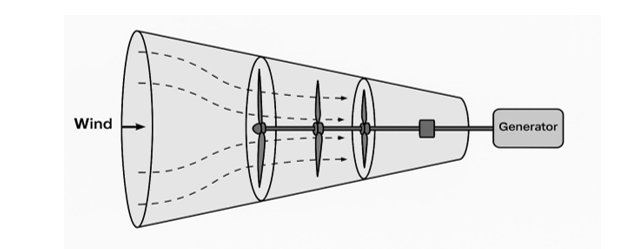
The rising demand for compact, lightweight, and high-efficiency renewable energy systems has accelerated the development of micro wind turbines capable of delivering stable performance under low wind conditions. Traditional bare-rotor micro turbines suffer from limited aerodynamic efficiency, motivating the adoption of diffuser-augmented architectures and advanced polymer-based composite materials. This study presents the AI-assisted conceptual design and theoretical aerodynamic evaluation of a multistage conical diffuser micro wind turbine fabricated using a polymer-reinforced hybrid composite structure to achieve enhanced stiffness-to-weight ratio, corrosion resistance, and structural durability. A three-stage conical diffuser integrated with co-axial rotors was developed through iterative model generation, refinement, and aerodynamic reasoning using ChatGPT as a generative design assistant. Performance assessment was conducted through analytical relations and extrapolation of validated CFD data from prior diffuser-augmented turbine studies, focusing on velocity amplification, pressure gradients, and stage-wise power enhancement. The proposed multistage configuration achieved cumulative airflow acceleration of approximately 2.38× and an estimated theoretical power improvement of nearly 13× compared to a bare rotor, outperforming conventional single-stage diffuser systems. The use of polymer hybrid composites further enables reduced mass, manufacturability, and suitability for portable, urban, and off-grid applications. Overall, the study demonstrates the aerodynamic advantages of sequential diffuser staging and highlights the promising role of generative AI in accelerating composite-based micro-wind turbine design workflows.
Keywords: Hybrid renewable energy system, multistage conical diffuser, polymer hybrid composite micro wind turbine, AI-assisted design, off-grid power generation.
[This article belongs to Special Issue under section in Journal of Polymer & Composites (jopc)]
References
- Paranjape AD, Bajaj AS, Palanganda ST, Parikh R, Nayak R, Radhakrishnan J. Computational analysis of high-lift generating airfoils for diffuser-augmented wind turbines. Wind Energy Sci. 2021;6(1):149–57. doi:10.5194/wes-6-149-2021.
- Hjort S, Larsen H. A multi-element diffuser augmented wind turbine. Energies. 2014;7(5):3256–81. doi:10.3390/en7053256.
- Hu JF, Wang WX. Upgrading a shrouded wind turbine with a self-adaptive flanged diffuser. Energies. 2015;8(6):5319–37. doi:10.3390/en8065319.
- Abe K, Ohya Y. An investigation of flow fields around flanged diffusers using CFD. J Wind EngIndAerodyn. 2004;92(3–4):315–30. doi:10.1016/j.jweia.2004.01.006.
- Mansour K, Meskinkhoda P. Computational analysis of flow fields around flanged diffusers. J Wind EngIndAerodyn. 2014;124:109–20. doi:10.1016/j.jweia.2013.12.007.
- Ohya Y, Karasudani T. A shrouded wind turbine generating high output power with wind-lens technology. Energies. 2010;3(4):634–49. doi:10.3390/en3040634.
- Maulana MI, Syuhada A, Nawawi M. Analysis of diffuser-augmented wind turbine with flange and curved interior using CFD. AIP Conf Proc. 2018;1984(1):020025. doi:10.1063/1.5046643.
- Dighe VV, Avallone F, Igra O, Van Bussel G. Multi-element ducts for ducted wind turbines: a numerical study. Wind Energy Sci. 2019;4(3):439–49. doi:10.5194/wes-4-439-2019.
- Watanabe S, Yoshikawa M, Hu C. CFD simulation of multi-rotor DAWT systems using lattice Boltzmann method. J Phys Conf Ser. 2024;2767(7):072002. doi:10.1088/1742-6596/2767/7/072002.
- Alkhabbaz A, Yang HS, Tongphong W, Lee YH. Impact of compact diffuser shroud on wind turbine aerodynamic performance. Int J Mech Sci. 2022;216:106978. doi:10.1016/j.ijmecsci.2021.106978.
- Danish SN, Almutairi Z, Alshareef M. CFD studies on the effect of holes and angles of upstream ducts of HAWTs. AIP Adv. 2023;13(3):035337. doi:10.1063/5.0138913.
- Hansen MOL, Sørensen NN, Sørensen JN, Fuglsang P. Effect of placing a diffuser around a wind turbine. Wind Energy. 2000;3(4):207–13. doi:10.1002/we.37.
- Foreman KM, Gilbert BL, Oman RA. Fluid dynamics of diffuser-augmented wind turbines. J Energy. 1978;2(6):368–74. doi:10.2514/3.62457.
- Feng WX, Li Y, Hu JF, Wang WX. Experimental influence of flanged diffusers on the dynamic behavior of CFRP turbine blades. Renew Energy. 2015;78:386–97. doi:10.1016/j.renene.2015.01.041.
- Hwang PW, Wu JH, Chang YJ. CFD-ML optimization of DAWT with inlet shrouds. Sustainability. 2024;16(9):3648. doi:10.3390/su16093648.
- Özkan R, Özkan M. Aerodynamic design optimization of diffuser-augmented micro wind turbine using ABC algorithm. Renew Energy. 2023;199:456–68. doi:10.1016/j.renene.2022.07.147.
- Dinesh S, Adinarayanan A, Selvakumar V, Paventhan R, (2024). Recent Advancements and Layering Techniques in Nanoparticle-Reinforced Hybrid Composites: A Comprehensive Analysis. J Polym Compos, 13(01), 83-89.
- Harrison-Atlas D, Glaws A, King RN, Lantz E. Artificial intelligence-aided wind plant optimization for nationwide evaluation of land use and economic benefits of wake steering. Nature Energy. 2023;8:145–56. .
- Zhang Q, Liu Q, Miao W, Zhang WF, Li C, Yue M, et al. Data-driven aerodynamic optimization for enhancing unsteady performance in wind energy systems. Energy. 2020;201:117678.
- Vita G, Hemida H, Andrianne T, Baniotopoulos C. The effect of the integral length scale of turbulence on a wind turbine aerofoil. J Wind EngIndAerodyn. 2020;201:104994.
- Zhang Y, Zhao M, Zhang MM. Research on the aerodynamic performance of the wind turbine blades with leading-edge protuberances. Ocean Eng. 2023;284:111466.
- Cheng X, Du B, He J, Long W, Su G, Liu J, et al. A review of thermoplastic composites on wind turbine blades. Compos Part B Eng. 2025;213:108739.
- Panciroli R, Giannini O. Comparing the impact resistance of flax/epoxy and glass/epoxy composites through experiments and numerical simulations. Compos Struct. 2021;267:113900.
- Shanab BH, Ashraf MM, Untaroiu A. Diffuser-type augmentation impact on dual rotor vertical axis wind turbine performance. AI for Fluids. 2022;1:45–58.
- Vaz JRP, de Lima AKF, Lins EF. Assessment of a diffuser-augmented hydrokinetic turbine designed for harnessing the flow energy downstream of dams. Sustainability. 2023;15(4):2110.
- Mortazavi B. Recent advances in machine learning-assisted multiscale design of energy materials. Adv Energy Mater. 2024;12:226629.
- Ribeiro JA, Alves D, Offshore wind turbine tower design and optimization: A review and AI-driven future directions. Appl Energy. 2025:330 12345.

Journal of Polymer & Composites
| Volume | 14 | |
| Special Issue | 02 | |
| Received | 08/12/2025 | |
| Accepted | 29/12/2025 | |
| Published | 23/04/2026 | |
| Publication Time | 136 Days |