
Digvijay B Kanase,
Arun Thorat,
Swapnil Patil,
Suraj Pawar,
Sachin P Jadhav,
Vishal Patil,
- Assistant Professor, Department of Electrical Engineering, Dr. D. Y. Patil Institute of Technology, Pune, Maharashtra, India
- Associate Professor, Department of Electrical Engineering, Kasegaon Education Society’s Rajarambapu Institute of Technology, Affiliated to Shivaji University, Sakharale, Maharashtra, India
- Assistant Professor, Department of Electrical Engineering, Walchand College of Engineering, Sangli, Maharashtra, India
- Assistant Professor, Department of Electrical Engineering, Annasaheb Dange College of Engineering and Technology, Maharashtra, India
- Assistant Professor, Department of Electrical Engineering, Kasegaon Education Society’s Rajarambapu Institute of Technology, Affiliated to Shivaji University, Sakharale, Maharashtra, India
- Assistant Professor, Department of Electrical Engineering, Kasegaon Education Society’s Rajarambapu Institute of Technology, Affiliated to Shivaji University, Sakharale, Maharashtra, India
Abstract
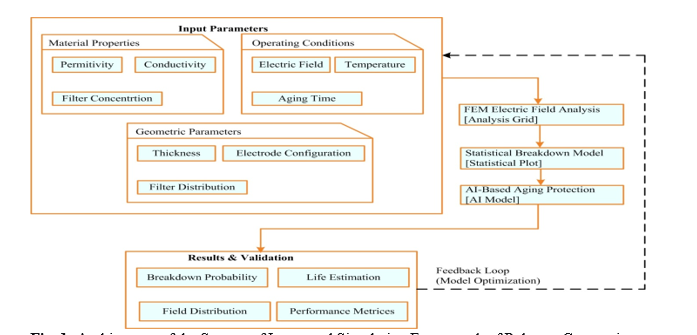
This paper provides a combined computation approach in forecasting the dielectric breakdown and electrical aging within epoxy-silica composite of insulation system. The approach will consist of a three-complementary methodology (a combination of computing electric field using the finite element analysis, estimation of the probability of failures or breakdowns using Weibull statistics, and prediction of degradation tendencies using artificial neural networks). The epoxy-silica composites are of 10-40 volumes fillers. The simulations include both electrical and thermal stresses which have field strengths of 8-25 kV/mm together with temperatures of 300-340 K keeping in mind the aging mechanisms of up to 30,000 hours. Findings indicate local field enhancement of 24.7% at filler-matrix interfaces indicating the need of field examination in designing insulation properly. The voltage endurance coefficient is 7.2 showing great sensitivity to electrical stress. Maximum filler amount of 28.6% will provide an 32.5% longer life of insulation than unfilled epoxy. The root mean square error of the artificial neural network in predicting breakdown strength is 0.047 kV/mm which is a 42% reduction over the traditional linear regression. The means and B10 of design conditions of the reliability analysis are 40.9 years and 27.7 years, respectively which can be useful in insulation optimization, conditions estimation and remaining life estimation in high voltage equipment.
Keywords: Epoxy-silica composites, dielectric breakdown, electrical aging, finite element analysis, artificial neural networks, insulation reliability, weibull statistics.
[This article belongs to Journal of Polymer & Composites ]
References
- Tanaka T, Kozako M, Fuse N and Ohki Y. Proposal of a multi-core model for polymer nanocomposite dielectrics. IEEE Trans. Dielectr. Electr. Insul.2005; 12(4): 669-81.
- Roy M, Nelson J K, MacCrone R K, Schadler L S, Reed C W and Keefe R. Polymer nanocomposite dielectrics-the role of the interface. IEEE Trans. Dielectr. Electr. Insul.2005; 12(4): 629-43.
- Montanari G C. Aging and life models for insulation systems based on PD detection. IEEE Trans. Dielectr. Electr. Insul.1995; 2(4): 667-75.
- Simoni L. A General Approach to the Endurance of Electrical Insulation under Temperature and Voltage. IEEE Trans. Electr. Insul.1981; EI-16(4): 277-89.
- Rowland S M and Wang M. Fault Development in Wet, Low Voltage, Oil-Impregnated Paper Insulated Cables. IEEE Trans. Dielectr. Electr. Insul.2008; 15(2): 484-91.
- de Santos H and Sanz-Bobi M Á. A machine learning approach for condition monitoring of high voltage insulators in polluted environments. Power Syst. Res.2023; 220: 109340.
- Dissado L A, Fothergill J C, Wolfe S V and Hill R M. Weibull Statistics in Dielectric Breakdown; Theoretical Basis, Applications and Implications. IEEE Trans. Electr. Insul.1984; EI-19(3): 227-33.
- Maraveas C, Kyrtopoulos I V, Arvanitis K G and Bartzanas T. The Aging of Polymers under Electromagnetic Radiation. Polymers2024; 16(5): 689.
- Crine J-P. A molecular model to evaluate the impact of aging on space charges in polymer dielectrics. IEEE Trans. Dielectr. Electr. Insul.1997; 4(5): 487-95.
- Reed C W and Cichanowskil S W. The fundamentals of aging in HV polymer-film capacitors. IEEE Trans. Dielectr. Electr. Insul.1994; 1(5): 904-22.
- Liu X, Wang Y, Chen Z, Li H and Zhang J. Effect of interphase on effective permittivity of composites. Phys. D: Appl. Phys.2011; 44(11): 115402.
- Gouda O, Mobarak Y A and Samir M. A simulation model for calculating the dielectric properties of nano-composite materials and comprehensive interphase approach. 14th Int. Middle East Power Syst. Conf. (MEPCON)2010; 1-6.
- Liu T, Zhang Y, Li X and Wang J. Multi-factor model for lifetime prediction of polymers used as insulation material in high frequency electrical equipment. Test.2019; 73: 193-9.
- Yeung C and Vaughan A S. On the effect of nanoparticle surface chemistry on the electrical characteristics of epoxy-based nanocomposites. Polymers2016; 8(4): 126.
- Qiu M and Ge X. Nondestructive Evaluation of Aging Failure in Insulation Coatings by Ultrasonic Guided Wave Based on Signal Processing and Machine Learning. Coatings2025; 15(3): 347.
- Emdadi K, Lee J, Kim H and Park S. Overview of monitoring, diagnostics, aging analysis, and maintenance strategies in high-voltage AC/DC XLPE cable systems. Sensors2025; 25(22): 7096.
- Sharma S, Gupta V and Kumar A. Recent trends and developments in conducting polymer nanocomposites for multifunctional applications. Polymers2021; 13(17): 2898.
- Zhou M-H, Li X and Wang Y. Recent progress on multifunctional thermally conductive epoxy composite. Polymers2023; 15(13): 2818.
- Ramadan M, Ezzat M, Abd-Allah M A, El-Gamal S M A and Said A. Synergistic impact of mesoporous Zn/Al-LDH nanorods for developing dielectric and thermal properties of epoxy as insulation in GIS/GIL. Rep.2026; 16(1): 1-12.
- Huang T-C, Yeh T-C, Huang H-Y, Ji W-F, Chou Y-C, Hung W-I, Yeh J-M and Tsai M-H. Advanced anticorrosive coatings prepared from electroactive epoxy–SiO2 hybrid nanocomposite materials. Acta2011; 56(17): 6142-9.
- Barré O and Napame B. The insulation for machines having a high lifespan expectancy, design, tests and acceptance criteria issues. Machines2017; 5(1): 7.
- Zhou X, Chen L and Zhang W. Insulation for rotating low-voltage electrical machines: Degradation, lifetime modeling, and accelerated aging tests. Energies2024; 17(9): 1987.
- Singha S and Thomas M J. Dielectric properties of epoxy nanocomposites. IEEE Trans. Dielectr. Electr. Insul.2008; 15(1): 12-23.
- Haiba A S and Gad A E. Artificial neural network analysis for classification of defected high voltage ceramic insulators. Rep.2024; 14(1): 1513.
- Haider I, Khan M A, Aziz S, Jaffery S H I, Faraz M I, Gul I H, Jung D-W, Saidani T and Shewakh W M. Exploring the Weathering and Accelerated Environmental Aging of Wave-Transparent Reinforced Composites. Polymers2025; 17(3): 357.
- Wang X, Zhang J, Li H. Electrical aging behavior of epoxy/SiC composites under high electric field stress. Polymers 2024; 16(3): 412.
- Chen L, Zhou X, Wang Y. Multi-factor electro-thermal aging modeling of polymer insulation materials. Energies 2024; 17(14): 3567.
- Zhang Y, Liu H, Chen X. Deep learning-based condition monitoring of high-voltage insulation systems. Power Syst. Res. 2024; 229: 110120.
- Ali M, Hassan T, Rehman U. Artificial intelligence-based predictive maintenance for high-voltage cable systems. IEEE Access 2025; 13: 77890-77905.
- Park J, Kim S, Lee D. Comparative analysis of HVDC and HVAC breakdown characteristics in polymeric insulation materials. IEEE Trans. Dielectr. Electr. Insul. 2024; 31(3): 987-995.
- Kokayeva G, Ivanov D, Petrov V. Effect of micro-silica filler concentration on mechanical and dielectric properties of epoxy composites. Today Commun. 2023; 35: 105689.
- Mogila A, Sharma R, Kulkarni S. Sol-gel synthesis and dielectric characterization of silica-epoxy nanocomposites. Test. 2023; 115: 107707.
- Chaudhary M, Vryonis A, Andritsch T. Core-shell nanoparticle engineered epoxy composites for enhanced dielectric performance. IEEE Trans. Dielectr. Electr. Insul. 2024; 31(5): 2103-2112.
- Wang Z, Li Q, Zhao H. Physics-informed machine learning for degradation prediction in polymer dielectrics. IEEE Access 2025; 13: 44567-44580.

Journal of Polymer & Composites
| Volume | 14 | |
| Issue | 02 | |
| Received | 05/03/2026 | |
| Accepted | 21/03/2026 | |
| Published | 07/04/2026 | |
| Publication Time | 33 Days |