
T.R. Amsica,
A. Leema Rose,
F. Janeeta Priya,
S. Vidhya,
P. Aparna,
S. S. Syed Abuthahir,
- Research Scholar, Department of Chemistry, Holy Cross College (Autonomous), Affiliated to Bharathidasan University, Tiruchirappalli, Tamil Nadu, India
- Associate Professor, Department of Chemistry, Holy Cross College (Autonomous), Affiliated to Bharathidasan University, Tiruchirappalli, Tamil Nadu, India
- Assistant Professor, Department of Chemistry, Holy Cross College (Autonomous), Affiliated to Bharathidasan University, Tiruchirappalli, Tamil Nadu, India
- Assistant Professor, Department of Chemistry, Holy Cross College (Autonomous), Affiliated to Bharathidasan University, Tiruchirappalli, Tamil Nadu, India
- Research Scholar, Department of Chemistry, Holy Cross College (Autonomous), Affiliated to Bharathidasan University, Tiruchirappalli, Tamil Nadu, India
- Assistant Professor, Department of Chemistry, Jamal Mohamed College (Autonomous), Affiliated to Bharathidasan University, Tiruchirappalli, Tamil Nadu, India
Abstract
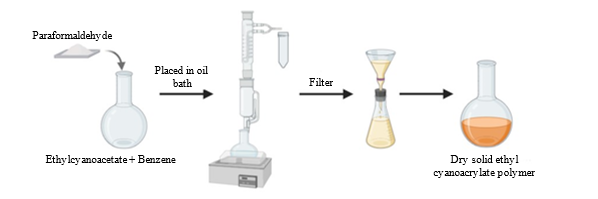
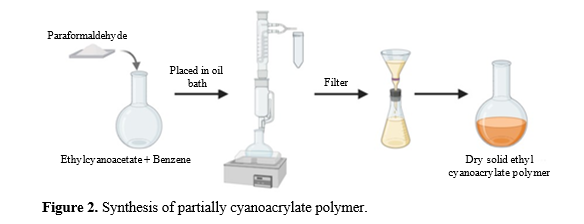
Infections caused by pathogenic microorganisms are a significant concern. Polymers, large molecules formed by chemically connecting monomers, have acquired significant interest due to their intrinsic properties. Polymers function as a matrix for the components that contain antibacterial agents. Developing polymers with antibacterial activity is a crucial research area that aims to alleviate the problem of microbe contamination. The antibacterial polymers typically exhibit prolonged effectiveness. Modification of polymers enhances their anti-microbial properties. Cyanoacrylate polymers hold notable importance because of their strong adhesive nature, rapid polymerization, and potential for structural customization. In this present investigation, the cyanoacrylate polymer can be synthesized using ethyl cyanoacetate monomer and formaldehyde via the condensation method. Further, the synthesized cyanoacrylate polymer was modified partially. The partially modified cyanoacrylate polymer was characterised by Ultraviolet-visible spectroscopy, Fourier transform infrared spectroscopy, Nuclear magnetic resonance, Thermo gravimetry analysis, Differential scanning calorimetry and Gel permeation chromatography. Spectroscopic and thermal analyses confirmed successful modification and revealed improved thermal stability and structural integrity. The antimicrobial efficacy of the partially modified cyanoacrylate polymer was assessed against selectedGram-positive, Gram-negative, and fungal strains. The antimicrobial activity of a partially modified cyanoacrylate polymer showed a superior level of inhibitory action against microorganisms. These findings emphasize the potential of modified cyanoacrylate polymers as multifunctional materials for biomedical and environmental applications, offering prolonged and reliable antibacterial performance.
Keywords: Anti-microbial property, cyanoacrylate, FTIR, NMR, polymer, UV-visible
[This article belongs to Special Issue under section in Journal of Polymer & Composites (jopc)]
References
- Szalapata K, Piet M, Kasela M, Graz M, Kapral-Piotrowska J, Mordzinska-Rak A, Samorek E, Pieniądz P, Polak J, Osinska-Jaroszuk M, Paduch R, Pawlikowska-Pawlęga B, Malm A, Jarosz-Wilkolazka A. Modified polymeric biomaterials with antimicrobial and immunostimulatory activity. In: J. Smith, editor. Scientific Reports: Bio-Material Advances. 1st edition. London, UK: Nature Publishing; 2024. pp. 58730–58745.
- Ornaghi Junior HL, Duchemin B, Azzaye S, Soares MRF, Schneider B, Romoaldo CH. Improving antimicrobial properties of biopolymer-based films for sustainable food packaging. In: L. Brown, editor. Polymer Applications in Packaging. 1st edition. Basel, Switzerland: MDPI Publishing; 2024. pp. 3086–3100.
- Degirmenci A, Sanyal R, Sanyal A. ‘Clickable’ polymeric coatings: From antibacterial surfaces to dynamic antifouling interfaces. In: M. Green, editor. Lab on a Chip Technologies. 2nd edition. Cambridge, UK: Royal Society of Chemistry; 2024. pp. 2867–2884.
- Szalapata K, Piet M, Kasela M, Grąz M, Kapral-Piotrowska J, Mordzinska-Rak A, Samorek E, Pieniądz P, Polak J, Osińska-Jaroszuk M, Paduch R, Pawlikowska-Pawlęga B, Malm A, Jarosz-Wilkolazka A. Modified polymeric biomaterials with antimicrobial and immunostimulatory activity. In: H. White, editor. Pathogens and Polymers. 1st edition. Basel, Switzerland: MDPI; 2024. pp. 296–310.
- Liu J, Wang D, Li Y, Wang H, Chen H, Wang Q, Kang W. On antimicrobial polymers: Development, mechanism of action, and application to healthcare and food industries. In: K. Wang, editor. Healthcare Polymers. 1st edition. Basel, Switzerland: MDPI; 2024. pp. 825–840.
- Castro AGB, Ferreira LP, Teixeira JA, Ferreira ICFR. Polymeric materials with antibacterial activity: A review. In: T. Silva, editor. Antibacterial Polymers. 1st edition. Basel, Switzerland: MDPI; 2021. pp. 577–590.
- Pal T, Chakraborty S, Mukherjee A, Ghosh S. Progress and prospects of synthetic antimicrobial polymers: A comprehensive review. In: J. Mukherjee, editor. Synthetic Polymers. 1st edition. Amsterdam, Netherlands: Elsevier Science; 2025. pp. 112756–112770.
- Fernandez-Barat L, Cilloniz C, Ferrer M, Torres A. Preparation and functionalization of polymers with antimicrobial peptides as efficient tools against multidrug resistance. In: G. Torres, editor. Multidrug Resistance Solutions. 1st edition. Basel, Switzerland: MDPI; 2023. pp. 3059–3075.
- Qiu H, Si Z, Luo Y, Feng P, Wu X, Hou W, Zhu Y, Chan-Park MB, Xu L, Huang D. The mechanisms and applications of antibacterial polymers in surface modification on medical devices. In: Y. Zhu, editor. Frontiers in Bioengineering. 1st edition. Lausanne, Switzerland: Frontiers Media SA; 2020. pp. 910–925.
- Lin M, Chen J, Hsu SH. Antimicrobial peptide-inspired antibacterial polymeric materials. In: S. Hsu, editor. Bioactive Materials. 1st edition. Beijing, China: KeAi Communications; 2022. pp. 118–137.
- Andersen C. Antimicrobial polymers for catheter coatings. In: C. Andersen, editor. Catheter Technologies. 1st edition. Lyngby, Denmark: Technical University of Denmark; 2020. pp. 1–182.
- Razaviamri S, Kaur R, Karimzadeh A, Hakkarainen M. Catechol-based antimicrobial polymers. In: M. Hakkarainen, editor. Polymer Science. 1st edition. Basel, Switzerland: MDPI; 2021. pp. 2182–2195.
- Kaur R, Malik P, Tyagi R, Singh N. A dual antibacterial action of soft quaternary ammonium compounds. In: R. Tyagi, editor. RSC Advances. 1st edition. London, UK: Royal Society of Chemistry; 2025. pp. 14321–14333.
- Oleszko-Torbus N, Utrata-Wesołek A, Dworak A. New trends in research on poly(2-oxazoline) with antimicrobial properties. In: A. Dworak, editor. Polymer Chemistry Trends. 1st edition. London, UK: Royal Society of Chemistry; 2025. pp. 1879–1898.
- Yu Z, Zhang X, Li J, Wang Y, Chen X. Cationic antibacterial polymers for development of anti-infective biomedical materials. In: X. Chen, editor. Colloid and Interface Science. 1st edition. Amsterdam, Netherlands: Elsevier Science; 2025. pp. 103026–103040.
- Li Y, Zhang H, Chen J, Wang L, Zhao X. Development and evaluation of antimicrobial PVC-grafted copolymers for paint applications. In: L. Wang, editor. Coating Technologies. 1st edition. London, UK: Royal Society of Chemistry; 2024. pp. 28941–28952.
- Hassan M, Khan A, Rahman S, Ali S. Antibacterial cationic polymers: A novel approach for combating multidrug-resistant bacteria. In: S. Ali, editor. Science and Research Archive. 1st edition. Mumbai, India: IJSRA; 2023. pp. 458–466.
- Wang X, Liu Y, Zhang Q, Li H, Chen Y. Advances in peptide/polymer antimicrobial assemblies. In: Y. Chen, editor. Materials Chemistry. 1st edition. London, UK: Royal Society of Chemistry; 2025. pp. 1987–2005.
- Schubert S, Delaittre G, Schmidt M, Barner-Kowollik C. Antimicrobial brushes on titanium via grafting to using phosphonic acid/pyridinium-containing block copolymers. In: C. Barner-Kowollik, editor. Macromolecular Engineering. 1st edition. Weinheim, Germany: Wiley-VCH; 2023. pp. 2200665–2200680.
- Rezic I, Kovacevic S, Ujevic D. Functionalization of polymer surface with antimicrobial microcapsules. In: D. Ujevic, editor. Textile Technology. 1st edition. Zagreb, Croatia: Faculty of Textile Technology; 2022. pp. 1–15.

Journal of Polymer & Composites
| Volume | 14 | |
| Special Issue | 01 | |
| Received | 01/11/2025 | |
| Accepted | 14/03/2026 | |
| Published | 25/03/2026 | |
| Publication Time | 144 Days |