
Venkata Narsireddy Sagili,
Mohd Hasham Ali,
Hanumatu Krishna Murty Dora,
G. Prasanna Kumar,
V. Dharam Singh,
Snehal Dewalkar,
- Assistant Professor, Department of Civil Engineering, Muffakham Jah College of Engineering and Technology, Hyderabad, Telangana, India
- Assistant Professor, Department of Mechanical Engineering, Muffakham Jah College of Engineering and Technology, Hyderabad, Telangana, India
- Assistant Professor, Department of Mechanical Engineering, Muffakham Jah College of Engineering and Technology, Hyderabad, Telangana, India
- Assistant Professor, Department of Mechanical Engineering, Muffakham Jah College of Engineering and Technology, Hyderabad, Telangana, India
- Assistant Professor, Department of Mechanical Engineering, Muffakham Jah College of Engineering and Technology, Hyderabad, Telangana, India
- Associate Professor, Department of Civil Engineering, College of Military Engineering, Pune, Maharshtra, India
Abstract
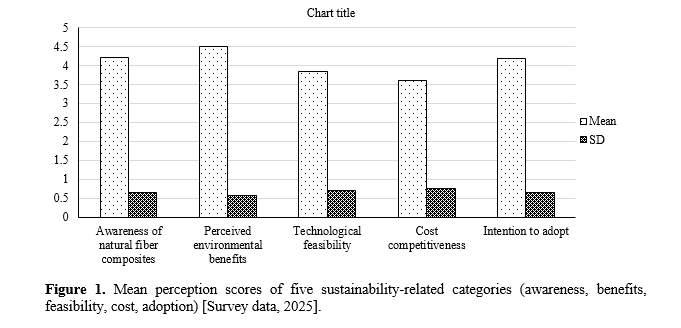
The environmental footprint of synthetic plastics has led to extensive studies of sustainable polymer composites reinforced with natural fibers like jute, sisal, hemp, flax, and coir. These biocomposites offer a greener solution to the conventional petroleum-based materials, which blends biodegradability and competitive mechanical characteristics. The present paper focuses on the processing methods, mechanical and thermal characteristics, and the possible application of natural fiber-reinforced polymer composites (NFRPCs). A survey of 50 materials engineers was conducted to determine industry perception regarding these materials. According to the findings, natural fibers have the opportunity to enhance the stiffness and impact strength and decrease the footprint on the environment by a factor of 30–60. Nevertheless, moisture uptake, low interfacial bonding, and low durability are a major problem. Discussed are strategies like surface treatments, hybridization, and biopolymer matrices. The research concludes that NFRPCs can be a solution to the next-generation materials in the automotive, construction, and packaging industries, as long as the processing and durability problems are handled. The research was also restricted to data of perception and secondary mechanical data sets; experimental research should prove these results in the future on the basis of standardized test protocols. “The survey of 50 materials engineers indicated a mean awareness score of 4.22 and an adoption intention score of 4.18, confirming positive industrial perception toward natural fiber composites.”
Keywords: Bi-based materials, mechanical properties, natural fibers, polymer composites, sustainability
[This article belongs to Special Issue under section in Journal of Polymer & Composites (jopc)]
References
1. United Nations Environment Programme. Plastics and climate change: the hidden costs of a plastic planet. In: UNEP, editor. Global Environmental Reports. 1st edition. Nairobi, Kenya: UNEP; 2023. pp. 10–120.
2. Sagili VN, Ali MH. A Review on Natural Fiber Reinforced Polymer Composites (NFRPC). In: MDPI, editor. Polymers (Basel). 1st edition. Basel, Switzerland: MDPI; 2022. pp. 3698–3710.
3. Sagili VN. Review on Natural Fiber Composites: Polymer Matrices, Fiber Surface Treatments, Fabrication Methods, Properties, and Applications. In: Wiley, editor. Polymer Engineering and Science. 1st edition. Hoboken, USA: Wiley; 2022. pp. 1271–1295.
4. Sathishkumar TP, Navaneethakrishnan P, Rajasekar R. Mechanical properties of natural fiber composites. In: SAGE, editor. Journal of Reinforced Plastics and Composites. 1st edition. Thousand Oaks, USA: SAGE; 2017. pp. 964–975.
5. Joshi SV, Drzal LT, Mohanty AK, Arora S. Are natural fiber composites environmentally superior? In: Elsevier, editor. Composites Part A Applied Science and Manufacturing. 1st edition. Amsterdam, Netherlands: Elsevier; 2022. pp. 107–125.
6. Koronis G, Silva A, Fontul M. Green composites: a review of adequate materials for automotive applications. In: Elsevier, editor. Composites Part B Engineering. 1st edition. Amsterdam, Netherlands: Elsevier; 2013. pp. 120–127.
7. John MJ, Thomas S. Biofibres and biocomposites. In: Elsevier, editor. Carbohydrate Polymers. 1st edition. Amsterdam, Netherlands: Elsevier; 2008. pp. 343–364.
8. Mohanty AK, Vivekanandhan S, Pin JM, Misra M. Composites from renewable and sustainable resources. In: AAAS, editor. Science. 1st edition. Washington, USA: AAAS; 2018. pp. 536–542.
9. Faruk O, Bledzki AK, Fink HP, Sain M. Biocomposites reinforced with natural fibers: 2000–2010. In: Elsevier, editor. Progress in Polymer Science. 1st edition. Amsterdam, Netherlands: Elsevier; 2012. pp. 1552–1596.
10. Pickering KL, Efendy MGA, Le TM. A review of recent developments in natural fibre composites and their mechanical performance. In: Elsevier, editor. Composites Part A Applied Science and Manufacturing. 1st edition. Amsterdam, Netherlands: Elsevier; 2016. pp. 98–112.
11. Bledzki AK, Gassan J. Composites reinforced with cellulose-based fibres. In: Elsevier, editor. Progress in Polymer Science. 1st edition. Amsterdam, Netherlands: Elsevier; 1999. pp. 221–274.
12. IBM Corp. IBM SPSS Statistics for Windows, Version 28.0. In: IBM, editor. Statistical Software Manuals. 28th edition. Armonk, USA: IBM Corp; 2022. pp. 1–500.
13. Yan L, Chouw N, Jayaraman K. Flax fibre and its composites – A review. In: Elsevier, editor. Composites Part B Engineering. 1st edition. Amsterdam, Netherlands: Elsevier; 2014. pp. 296–317.
14. Fiore V, Scalici T, Di Bella G, Valenza A. A review on basalt fibre and its composites. In: Elsevier, editor. Composites Part B Engineering. 1st edition. Amsterdam, Netherlands: Elsevier; 2015. pp. 74–94.
15. Baley C, Bourmaud A, Davies P, Grohens Y. Influence of drying on the mechanical behaviour of flax fibres and their unidirectional composites. In: Elsevier, editor. Composites Part A. 1st edition. Amsterdam, Netherlands: Elsevier; 2012. pp. 1226–1233.
16. Kumar GP. Review of the Thermal Characterisation of Natural and Hybrid Fibre Composites. In: MDPI, editor. Polymers (Basel). 1st edition. Basel, Switzerland: MDPI; 2022. pp. 870–890.
17. Murty HK. Critical Review of Natural Fiber Reinforced Hybrid Composites. In: MDPI, editor. Polymers (Basel). 1st edition. Basel, Switzerland: MDPI; 2021. pp. 3514–3530.

Journal of Polymer & Composites
| Volume | 14 | |
| Special Issue | 01 | |
| Received | 07/11/2025 | |
| Accepted | 19/12/2025 | |
| Published | 14/03/2026 | |
| Publication Time | 127 Days |