
G. Sunil,
Selvaraju,
T.S. Senthil,
N. Saikumari,
S. Nooray Sashmi,
Sivakumar A.,
Zakir Hussain,
J. Sharmila,
Shailendra Kumar Bohidar,
- Assistant Professor, Department of Mechanical Engineering, Visakha Institute of Engineering & Technology (Autonomous), Visakhapatnam, Andhra Pradesh, India
- Associate Professor, Department of Chemistry, Sri Sairam Engineering College, Chennai, Tamil Nadu, India
- Associate Professor, Department of Mechanical Engineering, Mahaguru Institute of Technology, Kayamkulam, Kerala, India
- Associate Professor, Department of Science and Humanities (Chemistry), R. M. K. College of Engineering and Technology, Thiruvallur, Tamil Nadu, India
- Professor, Department of Research and Innovation, Saveetha School of Engineering, SIMATS, Chennai, Tamil Nadu, India
- Professor, Department of Mechanical Engineering, Varuvan Vadivelan Institute of Technology, Dharmapuri, Tamil Nadu, India
- Assistant Professor, Department of Chemical Technology, Loyola Academy, Secunderabad, Telangana, India
- Assistant Professor, Department of Chemistry, St. Joseph’s College of Engineering, OMR, Chennai, Tamil Nadu, India
- Associate Professor, Mechanical Engineering, School of Engineering and Information Technology, MATS University, Arang, Chattisgarh, India
Abstract
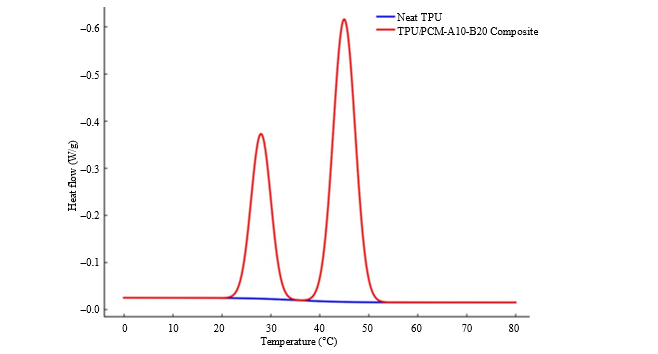
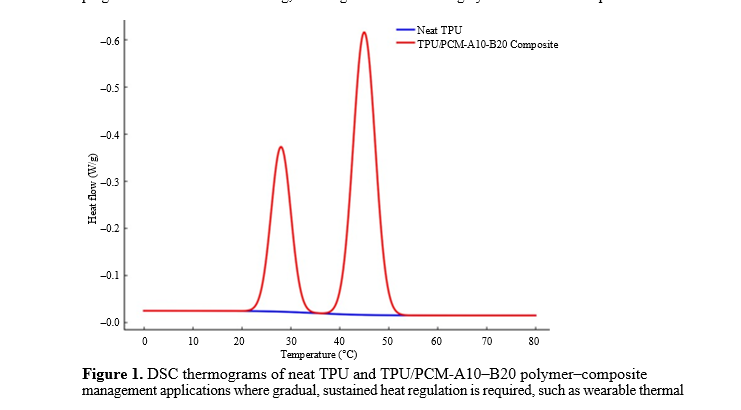
Polymer–composite based phase change systems offer an effective strategy for adaptive thermal management; however, most existing systems exhibit single-stage latent heat transitions, limiting their applicability in environments with fluctuating thermal loads. In this study, a thermoplastic polyurethane (TPU) polymer matrix was reinforced with two microencapsulated paraffin-based phase change materials (PCM-A and PCM-B) to achieve multi-level latent heat storage behavior. The fabricated TPU/PCM-A10–B20 polymer–composite demonstrated two distinct endothermic transitions at approximately 28°C and 45°C, corresponding to PCM-A and PCM-B, respectively, delivering a combined latent heat capacity of 62–68 J·g⁻¹, which represents a ~3.4-fold increase compared to neat TPU (18–20 J·g⁻¹). Thermogravimetric analysis confirmed stable PCM retention up to 150°C, while the composite exhibited only a minor reduction (~8–10°C) in onset degradation temperature relative to neat TPU, indicating preserved thermal integrity during practical use. Dynamic Mechanical Analysis showed a 17–22% higher damping capability in the composite within the PCM transition window, attributed to heat absorption-induced relaxation delay. FTIR confirmed that PCM incorporation occurred via physical embedding without chemical structural alteration. A slight reduction in bulk density (~4–6%) further validated uniform microcapsule dispersion without void formation. Overall, the engineered polymer–composite exhibits stable multi-step thermal buffering, enhanced viscoelastic damping, and structural reliability, making it suitable for applications in wearable thermal textiles, energy-efficient building panels, and passive electronic thermal regulation systems.
Keywords: Latent heat storage, phase change, polymer matrix, thermal stability
[This article belongs to Journal of Polymer & Composites ]
References
- Almeshaal M, Palanisamy S, Murugesan TM, Palaniappan M, Santulli C. Physico-chemical characterization of Grewia monticola Sond (GMS) fibers for prospective application in biocomposites. J Nat Fibers. 2022;19(17):15276–15290. doi:10.1080/15440478.2022.2123076.
- Padmanabhan RG, Rajesh S, Karthikeyan S, Palanisamy S, Ilyas RA, Ayrilmis N, Tag-eldin EM, Kchaou M. Evaluation of mechanical properties and Fick’s diffusion behaviour of aluminum-DMEM reinforced with hemp/bamboo/basalt woven fiber metal laminates under different stacking sequences. Ain Shams Eng J. 2024;15(7):102759. doi:10.1016/j.asej.2024.102759.
- Zhu N, Li S, Hu P, Wei S, Deng R, Lei F. A review on applications of shape-stabilized phase change materials embedded in building enclosure in recent ten years. Sustain Cities Soc. 2018;43:251–264.
- Souayfane F, Fardoun F, Biwole PH. Phase change materials for cooling applications in buildings: A review. Energy Build. 2016;129:396–431.
- Jamekhorshid A, Sadrameli SM, Farid M. A review of microencapsulation methods of phase change materials as a thermal energy storage medium. Renew Sustain Energy Rev. 2014;31:531–542.
- Ramasubbu R, Kayambu A, Palanisamy S. Mechanical properties of epoxy composites reinforced with Areca catechu fibers containing silicon carbide. BioResources. 2024;19(2):2353–2370. doi:10.15376/biores.19.2.2353-2370.
- Sharma A, Tyagi VV, Chen CR, Buddhi D. Review on thermal energy storage with phase change materials and applications. Renew Sustain Energy Rev. 2009;13:318–345.
- Wang X, Li W, Luo Z, Wang K, Shah SP. A critical review on phase change materials for sustainable and energy-efficient buildings: Design, characteristics, performance and application. Energy Build. 2022;260:111923.
- Palanisamy S, Kalimuthu M, Palaniappan M, et al. Characterization of Acacia caesia bark fibers. J Nat Fibers. 2022;19(15):10241–10252. doi:10.1080/15440478.2021.1993493.
- Milián YE, Gutiérrez A, Grágeda M, Ushak S. A review on encapsulation techniques for inorganic phase change materials and the influence on their thermophysical properties. Renew Sustain Energy Rev. 2017;73:983–999.
- Chandel SS, Agarwal T. Review of current state of research on energy storage, toxicity, health hazards and commercialization of phase changing materials. Renew Sustain Energy Rev. 2017;67:581–596.
- Palanisamy S, Mani T, Palaniappan M, Santulli C. Use of hemp waste for the development of mycelium-grown matrix biocomposites: A concise bibliographic review. BioResources. 2023;18(4):8771–8780. doi:10.15376/biores.18.4.8771-8780.
- Chung O, Jeong SG, Kim S. Preparation of energy efficient paraffinic PCMs/expanded vermiculite and perlite composites for energy saving in buildings. Sol Energy Mater Sol Cells. 2015;137:107–112.
- Palanisamy S, Kalimuthu M, Azeez A, Palaniappan M, Dharmalingam S, Nagarajan R, Santulli C. Wear properties and post-moisture absorption mechanical behavior of kenaf/banana-fiber-reinforced epoxy composites. Fibers. 2022;10(4):32. doi:10.3390/fib10040032.
- Vennila T, Surakasi R, Raghuram KS, Ravi G, Madhavarao S, Udagani C, Sudhakar M. Investigation on tensile behaviour of Al/Si₃N₄/sugarcane ash particle reinforced friction stir processed composites. Int J Photoenergy. 2021;2021:126670.
- Prabhu FF, Kumar KP, Shanmugam A, Kumar M, Senthil TS, Dhanraj JA. Study on wear behaviour of Al6061 metal matrix composite with nano-MoC. Mater Today Proc. 2022;69(Pt 3):1154–1158.
- Jasmin MN, Sathish S, Senthil TS, Naidu BA, Das AD, Arun KK, et al. Investigation on natural fiber reinforced polymer matrix composite. Mater Today Proc. 2023;74(Pt 1):60–63.
- Palaniappan M, Palanisamy S, Khan R, et al. Synthesis and suitability characterization of microcrystalline cellulose from Citrus × sinensis sweet orange peel fruit waste-based biomass for polymer composite applications. J Polym Res. 2024;31:105. doi:10.1007/s10965-024-03946-0.
- Goutham ERS, Hussain SS, Muthukumar C, Krishnasamy S, Kumar TSM, Santulli C, Palanisamy S, Parameswaranpillai J, Jesuarockiam N. Drilling parameters and post-drilling residual tensile properties of natural-fiber-reinforced composites: A review. J Compos Sci. 2023;7(4):136. doi:10.3390/jcs7040136.
- Srinivas J, Karthikeyan KR, Senthil TS, Yesuraj K, Aultrin KSJ. Characterization of mechanical and viscoelastic properties of ceramic nanoparticle-reinforced polymer composites. J Polym Compos. 2024;13(1):71–82.
- Mary Jasmin N, Beena T, Senthil S, Sakthi S, Ramesh Kumar M, Rahul Alex S, et al. Machinability behaviors of synthesized beryllium composite. Mater Today Proc. 2023;74(Pt 1):40–43.
- Aruchamy K, Karuppusamy M, et al. Enhancement of mechanical properties of hybrid polymer composites using palmyra palm and coconut sheath fibers: The role of tamarind shell powder. BioResources. 2024;20(1):698–724. doi:10.15376/biores.20.1.698-724.
- Kanat G, Yıldız E, Palanisamy S, Ashori A. Utilizing waste manhole covers and fibreboard as reinforcing fillers for thermoplastic composites. J Reinf Plast Compos. 2024;44(8):1108–1118. doi:10.1177/07316844241238507.
- Kanat G, Yıldız E, Palanisamy S, Ashori A. Utilizing waste manhole covers and fibreboard as reinforcing fillers for thermoplastic composites. J Reinf Plast Compos. 2024;44(8):1108–1118. doi:10.1177/07316844241238507.

Journal of Polymer & Composites
| Volume | 14 | |
| Issue | 01 | |
| Received | 04/11/2025 | |
| Accepted | 13/11/2025 | |
| Published | 05/01/2026 | |
| Publication Time | 62 Days |