
Nantha Kumar P,
Nagasrisaihari Sunkara,
Sachin S. Harak,
A. Vijayalakshmi,
DVSSSV Prasad,
Karanam Suresh Babu,
Kirubakaran D,
S.Dhivya,
Rajendiran M,
- Associate Professor, Department of Mechanical Engineering, Sri Sairam Engineering College, Chennai, Tamil Nadu, India
- Assistant Professor, Department of Mechanical Engineering, VNR Vignana Jyothi Institute of Engineering and Technology, Hyderabad, Telangana, India
- Professor, Department of Mechanical Engineering, Late GN Sapkal College of Engineering, Nashik, Maharashtra, India
- Professor, Department of Chemistry, R.M.K. Engineering College, Kavaraipettai, Tamil Nadu, India
- Professor, Department of Mechanical Engineering, Aditya University, Surampalem, Andhra Pradesh, India
- Professor, Department Mechanical Engineering, SRKR Engineering College, Bhimavaram, Andhra Pradesh, India
- Professor, Department of Electrical and Electronics Engineering, St.Joseph’s Institute of Technology, Chennai, Tamil Nadu, India
- Professor, Department of Research and Innovation, Saveetha School of Engineering, SIMATS, Chennai, Tamil Nadu, India
- Professor, Department of Computer Science and Engineering, Panimalar Engineering College, Chennai, Tamil Nadu, India
Abstract
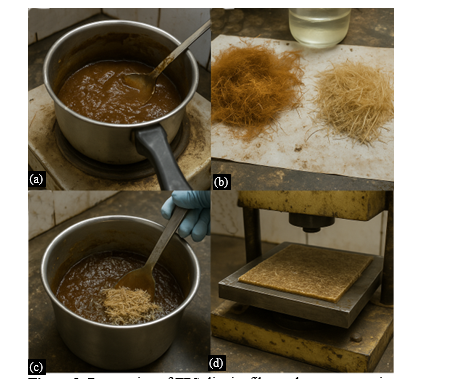
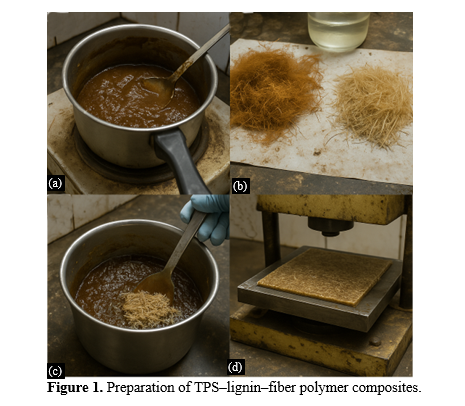
This study develops bio-derived polymer composites using a thermoplastic starch–lignin (TPS–lignin) matrix reinforced with alkali-treated coir and plantain fibers for sustainable load-bearing applications. The TPS–lignin matrix was formulated using cassava starch, glycerol, and 10 wt% lignin, while coir and plantain fibers were surface-modified using 5 wt% NaOH to enhance interfacial compatibility. Composite laminates were fabricated with varying fiber loadings (10–40 wt%) through melt-mixing and hot-press compression. Tensile, thermal, morphological, and water absorption analyses were performed to determine the influence of single-fiber and hybrid-fiber reinforcement. Tensile stress–strain results revealed substantial improvement in mechanical performance, where hybrid composites exhibited the highest tensile strength, showing a ~55–70% increase over the neat TPS–lignin matrix and outperforming single-fiber composites. SEM micrographs confirmed improved fiber–matrix adhesion, reduced pull-out, and uniform fiber dispersion, validating the enhanced stress-transfer mechanism. TGA results showed enhanced thermal stability for reinforced composites, with the hybrid system retaining the highest residual mass and displaying the slowest rate of thermal degradation. Water absorption decreased significantly with fiber addition, where hybrid composites demonstrated over 40% lower water uptake compared to the matrix due to reduced voids, improved crystallinity, and the hydrophobic influence of lignin-rich coir fibers. Overall, the combined mechanical, thermal, and moisture-resistance enhancements confirm that TPS–lignin hybrid composites reinforced with treated natural fibers offer a promising biodegradable alternative for lightweight structural and eco-efficient engineering applications.
Keywords: Fiber reinforcement, hybrid composites, thermal degradation, TPS–lignin, water absorption
[This article belongs to Journal of Polymer & Composites ]
References
- Pawłosik D, Cebrat K, Brzezicki M. Exploring advancements in bio-based composites for thermal insulation: a systematic review. Sustainability. 2025;17(3):1143.
- Quitadamo A, Massardier V, Valente M. Oil-based and bio-derived thermoplastic polymer blends and composites. In: Introduction to Renewable Biomaterials: First Principles and Concepts. 2017. p. 239–268.
- Jasmin MN, Sathish S, Senthil TS, Naidu BA, Das AD, Arun KK, et al. Investigation on natural fiber reinforced polymer matrix composite. Mater Today Proc. 2023;74(1):60–63.
- Palaniappan M, Palanisamy S, Khan R, et al. Synthesis and suitability characterization of microcrystalline cellulose from Citrus × sinensis fruit waste-based biomass for polymer composite applications. J Polym Res. 2024;31:105.
- Zhan K, Elder T, Peng Y. Enhancing polypropylene/polyethylene blend performance through compatibilization for a sustainable future: establishing bio-derived filler-based hybrid compatibilizer systems. Macromol Rapid Commun. 2025;46(11):2400724.
- Mahmud MA, Abir N, Anannya FR, Khan AN, Rahman AM, Jamine N. Coir fiber as thermal insulator and its performance as reinforcing material in biocomposite production. Heliyon. 2023;9(5):e.
- Srinivas J, Karthikeyan KR, Senthil TS, Yesuraj K, Aultrin KSJ. Characterization of mechanical and viscoelastic properties of ceramic nanoparticle-reinforced polymer composites. J Polym Compos. 2024;13(1):71–82.
- Yang H, Shi B, Xue Y, Ma Z, Liu L, Liu L, et al. Molecularly engineered lignin-derived additives enable fire-retardant, UV-shielding, and mechanically strong polylactide biocomposites. Biomacromolecules. 2021;22(4):1432–1444.
- Palanisamy S, Kalimuthu M, Azeez A, Palaniappan M, Dharmalingam S, Nagarajan R, et al. Wear properties and post-moisture absorption mechanical behavior of kenaf/banana fiber reinforced epoxy composites. Fibers. 2022;10(4):32.
- Vennila T, Surakasi R, Raghuram KS, Ravi G, Madhavarao S, Udagani C, et al. Tensile behaviour of Al/Si₃N₄/sugarcane ash particle reinforced FSP composites. Int J Photoenergy. 2021;59:1266–1270.
- Asmara YP. Green Engineering Materials: Innovations and Applications for Sustainable Construction. 1st ed. Boca Raton (FL): CRC Press; 2025. p. 1–350.
- Singh G, Sharma S, Sandhu K, Asiri AM, Khan A. Sustainable product packaging using vegetable fibers and their composites. In: Singh G, editor. Vegetable Fiber Composites and Their Technological Applications. 1st ed. Cham: Springer; 2021. p. 275–302.
- Prabhu FF, Kumar KP, Shanmugam A, Kumar M, Senthil TS, Dhanraj JA. Wear behaviour of Al6061 MMC with nano-MoC. Mater Today Proc. 2022;69(3):1154–1158.
- Goutham ERS, Hussain SS, Muthukumar C, Krishnasamy S, Kumar TSM, Santulli C, et al. Drilling parameters and post-drilling residual tensile properties of natural fiber-reinforced composites: a review. J Compos Sci. 2023;7(4):136.
- Mary Jasmin N, Beena T, Senthil S, Sakthi S, Ramesh Kumar M, Rahul Alex S, et al. Machinability behaviors of synthesized beryllium composite. Mater Today Proc. 2023;74(1):40–43.
- Chan CM, Vandi LJ, Pratt S, Halley P, Richardson D, Werker A, et al. Composites of wood and biodegradable thermoplastics: a review. Polym Rev. 2018;58(3):444–494.
- Prasant A, Aniji A, Kumar VS, Kdv P, Sumalatha S, Ranjith D. Eco-friendly composites from waste materials. Ecol Eng Environ Technol. 2022;26(11):60–82.
- Anand S, Gopalan V, Pitchumani SV. Optimization of thermal conductivity in coir fibre-reinforced PVC composites using computational techniques. Sci Rep. 2025;15(1):16675.
- Vinodh D, Lakshmaiya N, Kumar TR, Kaliappan S, Balaji V, Ross NS, et al. Sustainable hybrid biocomposites using agricultural waste fillers and natural fibers for material recycling. J Mater Cycles Waste Manag. 2025;27(6):4655–4666.
- Bavaliya KJ, Vala NS, Raj M, Raj L. Biodegradable composites based on polylactic acid with various bio fibers: a review. Chem Pap. 2024;78(5):2695–2728.
- Shah I, Li J, Yang S, Zhang Y, Anwar A. Mechanical properties of natural fiber-reinforced concrete. J Renew Mater. 2022;10(5):1307.
- Islam S, Karim FE, Islam MR, Saeed MA, Alam KA, Khatun MM. Thermoset and thermoplastic polymer composites with date palm fiber: a review. SPE Polym. 2025;6(1):e10157.
- Atalie D, Abtew MA, Zhao L. Recent advances in bio-based nonwoven materials: sustainable production, applications, and circular economy. J Nat Fibers. 2025;22(1):2565661.
- Karuppiah G, Kailasanathan CK, Palaniappan M, Santulli C, Palanisamy S. Multiobjective optimization of fabrication parameters of jute fiber/polyester composites with egg shell powder and nanoclay filler. Molecules. 2020;25:5579.
- Padhu R, Rajesh S, Karthikeyan S, Palanisamy S, Ilyas RA, Tag-eldin E, et al. Mechanical properties and Fick’s diffusion behaviour of aluminum-DMEM reinforced with hemp/bamboo/basalt woven fiber metal laminates under different stacking sequences. Ain Shams Eng J. 2024;102759.
- Kanat G, Yıldız E, Palanisamy S, Ashori A. Utilizing waste manhole covers and fibreboard as reinforcing fillers for thermoplastic composites. J Reinf Plast Compos. 2024;44:1108–1118.
- Ramasubbu R, Kayambu A, Palanisamy S. Mechanical properties of epoxy composites reinforced with Areca catechu fibers containing silicon carbide. BioResources. 2024;19:2353–2370.
- Aruchamy K, Manickaraj K, Krishnakumar S, Palanisamy S, Jayamani M, Sureshkumar K, et al. Enhancement of mechanical properties of hybrid polymer composites using palmyra palm and coconut sheath fibers: the role of tamarind shell powder. BioResources. 2024;20:698–724.
- Kar P, Palanisamy S, Pandiarajan N. Effect of fiber loading on mechanical, morphological, and dynamic mechanical characteristics of Calamus tenuis fiber-reinforced epoxy composites. J Vinyl Addit Technol. 2024;31:224–240.

Journal of Polymer & Composites
| Volume | 14 | |
| Issue | 01 | |
| Received | 21/11/2025 | |
| Accepted | 01/12/2025 | |
| Published | 08/01/2026 | |
| Publication Time | 48 Days |