
A. Chandra Vadhana,
M. Shivani,
S. Vasanthi,
M. Nageshwari,
C. Rathika Thaya Kumari,
V. Ravisankar,
V. Chithambaram,
- Professor, Department of Physics, S. A. Engineering College, Poonamallee, Chennai, Tamil Nadu, India
- Tutor, Department of Biochemistry, Sree Balaji Medical College and Hospital Chrompet, Chennai, Tamil Nadu, India
- Assistant Professor, Department of Chemistry, Easwari Engineering College, Ramapuram, Chennai, Tamil Nadu, India
- Assistant Professor, Department of Physics, Bharath Institute of Higher Education and Research, Chennai, Tamil Nadu, India
- Assistant Professor, Department of Physics, Bharath Institute of Higher Education and Research, Chennai, Tamil Nadu, India
- Assistant Professor, Department of Physics, AMET University, Kannathur, Chennai, Tamil Nadu, India
- Professor, Department of Physics, Rajalakshmi Engineering College, Thandalam, Chennai, Tamil Nadu, India
Abstract
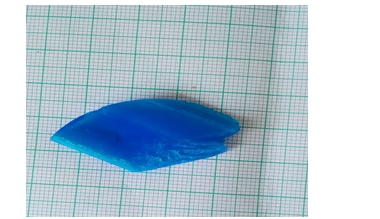
The organic material Citric Acid doped Copper Sulphate single crystals (CACS) was synthesized and single crystal was grown by slow evaporation method. The incorporation of citric acid, an organic compound, introduces polymer-like functional behavior into the crystal matrix, forming an organic-inorganic hybrid composite with enhanced optical and structural characteristics. Single crystal XRD confirmed the triclinic system with unit cell parameters: a = 5.96 Å, b = 6.11 Å, c = 10.74 Å, and angles α = 77.14°, β = 82.34°, γ = 72.64°. Powder XRD analysis displayed sharp peaks, indicating high crystallinity. FTIR spectra confirmed the presence of functional groups such as –OH and SO₄²⁻, validating the successful interaction of citric acid with the copper sulfate lattice and suggesting hydrogen bonding and molecular-level integration—features commonly seen in polymer-based systems.
Optical transparency studies using UV-Vis spectroscopy revealed a cut-off wavelength at 350 nm and a band gap of 3.55 eV, indicating excellent nonlinear optical (NLO) properties. The second harmonic generation (SHG) efficiency was tested using the Kurtz powder technique, and a high laser damage threshold (LDT) of 2.32 GW/cm² was observed—superior to that of standard materials like KDP. These results highlight the promise of CACS as a polymer-influenced hybrid composite material for photonic and optoelectronic applications, especially in environments demanding high optical clarity and laser durability. This study contributes to the growing interest in organic-inorganic composite crystals for next-generation NLO devices.
Keywords: Non-Linear optical materials, Composite materials, FTIR, nonlinear optical, CACS.
[This article belongs to Special Issue under section in Journal of Polymer & Composites (jopc)]
References
- Aravindan, P. Srinivasan, N. Vijayan, R. Gopalakrishnan, P. Ramasamy, Cryst. Res. Technol. 42, 1097 (2007).
- Prakash, D. Geetha, M. Lydia Caroline, Mater. Manuf. Pro cess. 27, 519 (2012)
- J. Rodrigues Jr., L. Misoguti, F.D. Nunes, C.R. Mendonca, S.C. Zilio, Opt. Mater. 22, 235 (2003)
- Ramya, N.T. Saraswathi, C. Ramachandra Raja, Optik 127, 2495 (2016)
- Saravanan, A. Senthil, S. Abraham Rajasekar, Optik 127, 1372 (2015)
- Priyadharshini, S. Kalainathan, J. Mater. Sci.: Mater. Electron. 28, 7401 (2017)
- Yang, Z., Mutter, L., Stillhart, M., Ruiz, B., Aravazhi, S., Jazbinsek, M., Schneider, A., Gramlich, V. and Guenter, P., 2007. Large‐size bulk and thin‐film stilbazolium‐salt single crystals for nonlinear optics and THz generation. Advanced Functional Materials, 17(13), pp.2018-2023.
- Marder, S.R., Kippelen, B., Jen, A.K.Y. and Peyghambarian, N., 1997. Design and synthesis of chromophores and polymers for electro-optic and photorefractive applications. Nature, 388(6645), pp.845-851.
- E. Tobon-Zapta, O.E. Piro, S.B. Etcheverry, E.J. Baran, Z. Anorg. Allg. Chem. 624 (1998) 721.
- E. Zacharias, J.P. Glusker, Acta Cryst. C49 (1993) 1730.
- M. Rao, C.K.N. Swamy, Indian J. Pure Appl. Phys. 10 (1972) 176.
- Nemdili, O. Koutchoukali, M. Bouhelassa, J. Seidel, F. Mameri, J. Ulrich, J. Cryst. Growth 451 (2)
- Giulietti, S. Derenzo, J. Nývlt, L. Ishida, Crystallization of copper sulphate, Crys. Res. Technol. 30 (1995) 177–183.
- Aktas, A novel purification method for copper sulfate using ethanol, Hydrometallurgy 106 (2011) 175–178.
- W. Richardson, Handbook of Copper Compounds and Applications, CRC Press, 1997.
- Saravanan, S. Santhanakrishnan, Suresh S. et al.Crystal growth and investigation of novel semi organic single crystal: l-malic acid sodium nitrate for photonic applications. J Mater Sci: Mater Electron 29, 18449–18457 (2018)
- Chithambaram, S. Jerome Das, S. Krishnan, Synthesis, Optical and dielectric studies on novel semi organic nonlinear optical crystal by solution growth technique., J. Alloys and Compounds, 509, 4543-4546 (2011)
- Rajeswari, N. Saravanan, V. Chithambaram, et al. Potential harnessing of the semi-organic single crystal of l-alanine potassium bromide (LAPB) from a structural, optical, and thermal perspective for application in optoelectronic devices. J Mater Sci: Mater Electron 35, 1886 (2024)
- C. Zumstein, R.W. Rousseau, Agglomeration of copper sulfate pentahydrate crystals within well-mixed crystallizers, Chem. Eng. Sci. 44 (1989) 2149–2155.
- Huda I. Ahemad, Ganesh E. Patil, Sarika D. Shinde, Sharad B. Patil, Synthesis and Characterization of Copper Sulfate Single Crystals, Physics of the Solid State 2025, 66(12):642-652
- Mary Anne, S. Perumal, K. Monikanda Prabu, Growth, structural and optical studies on pure and l-histidine doped single crystals of copper sulphate, International Journal of Research in Engineering and Technology, 04, 07 (2015)
- P. Ramteke , S.M. Azhar , G.G. Muley , M.I. Baig , A.M. Alshehri , H.H. Somaily , Dr. Mohd Anis, Growth and optimization of optical traits of copper sulphate crystal exploiting L-ascorbic acid for photonic device applications, Chinese Journal of Physics, 71 (2020)
- Gunasekaran, G. Anand, R. ArunBalaji, J. Dhanalakshmi, S. Kumaresan, Crystal growth and comparison of vibrational and thermal properties of semi-organic nonlinear optical materials,Indian Academy of science, Pramana journal of physics, 75 (2010) 683-690.
- K., Kurtz, & T. T. Perry. A powder technique for the evaluation of nonlinear optical materials. Journal of Applied Physics, 39(8), 3798–3813 (1968)

Journal of Polymer & Composites
| Volume | 14 | |
| Special Issue | 01 | |
| Received | 18/07/2025 | |
| Accepted | 06/08/2025 | |
| Published | 04/04/2026 | |
| Publication Time | 260 Days |