
Shaik. Nagoor Baba,
G. Diwakar,
Charan Gopi Krishna Kondapalli,
- M. Tech. Student, Department of Mechanical Engineering, Koneru Laksmaiah Education Foundation, Vaddeswaram, Guntur, Andhra Pradesh, India
- Professor, Department of Mechanical Engineering, Koneru Laksmaiah Education Foundation, Vaddeswaram, Guntur, Andhra Pradesh, India
- M. Tech. Student, Department of Mechanical Engineering, Koneru Laksmaiah Education Foundation, Vaddeswaram, Guntur, Andhra Pradesh, India
Abstract
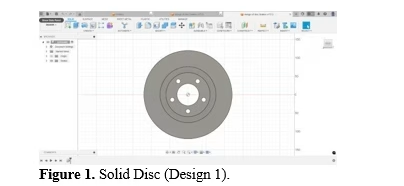
Brakes are crucial components for slowing or stopping the vehicle. Almost all vehicles use disc brakes. The working of a disc brake is simple; when the brake pedal is pressed, braking pads are forced mechanically against the rotor or disc on both surfaces. The friction generated between the rotor and brake pads slows down the vehicle. The design and materials of disc brakes play a significant role in their performance. Disc brake may fail due to various mechanical and thermal stresses. This problem can be overcome by choosing the right material and design. The primary aim of this research paper is to develop and examine the stresses on the disc brake by selecting environmentally friendly materials and design. Here, we have designed different models of disc brakes to reduce the weight of the disc and ensure good strength and stiffness. Gray cast iron is a conventional material used for making disc brakes. Though it has good thermal conductivity and strength, there are certain drawbacks, such as high weight and corrosion susceptibility. So, we have chosen Fly Ash & Aluminium as an alternative material for the disc brake. Three different models-Solid disc, Straight Vented, and Curved Vented were designed using Fusion 360 software. Structural and thermal analyses were performed on each design using ANSYS software. Total deformation, equivalent stress, and total heat flux were found in the analysis. After reviewing the outcomes, the optimal design and material for the disc brake have been selected. The findings suggest that disc brakes with Fly Ash Aluminium are the most viable and sustainable alternatives to gray cast iron.
Keywords: Disc brake, Gray Cast Iron, Fly Ash Aluminium Composites, Fusion 360, ANSYS
[This article belongs to Special Issue under section in Journal of Polymer & Composites (jopc)]
References
1. Pohane RK, Kongare SC, Daf SP. Mechanical Property Which Affect the Performance of Disk Brake Material. Int J Eng Res Technol. 2016;4(30):1–5.
2. Chand GG, Vinay M, Rao SS, Vamsi P, Kumar NV, Kumar MS. A Review on Analysis of Disc Brake in Automobiles. Int J Adv Eng Manag. 2022 Sep;4(9):449–54.
3. Szymański P, Czarnecka-Komorowska D, Gawdzińska K, Trubas A, Kostecka E. A review of composite materials used in brake disc pad manufacturing process. Compos Theory Pract. 2020;20(2):60–66.
4. Cho MH, Kim SJ, Basch RH, Fash JW, Jang H. Tribological study of gray cast iron with automotive brake linings: The effect of rotor microstructure. Tribol Int. 2003;36(8):537–545. doi:10.1016/S0301-679X(02)00260-8.
5. Maluf O, Angeloni M, Milan MT, Spinelli D, Bose Filho WW. Development of materials for automotive disc brakes. Minerva. 2007;4(2):149–158.
6. Barik N, Khadari SAR. Analysis of disc brake. IOP Conf Ser Mater Sci Eng. 2021;1123:012004. doi:10.1088/1757-899X/1123/1/012004.
7. Patel SH, Prajapati JM, Prajapati JM. Thermal analysis of disc brake using MMC and GCI materials. Int J Sci Eng Res. 2013;4(6):1336–13
8. Porlekar SB, Bhatwadekar SG, Kulkarni GR. Design, analysis and optimization of brake disc made of composite material for a motorcycle. Int J Res Publ Eng Technol. 2017;3(3):63–69.
9. Hari Vignesh S, Kannan GR, Prabakaran MP, Ganesamoorthy R. Investigation of brake disc using metal matrix composites. IOP Conf Ser Mater Sci Eng. 2020;988:012119. doi:10.1088/1757-899X/988/1/012119.
10. Srinivas M, Suresh P. Design and analysis of brake disc with different materials. Int J Eng Res Appl. 2016;6(7):21–27.
11. Reddy LS, Kumar KA, Rao KR. Application of fly ash in the design of automotive disc brakes. Int J Mech Eng Technol. 2019;10(3):537–544.
12. Wasekar MK, Khond MP. A Composite Material an alternative for manufacturing of Automotive Disc Brake: A Review. IOP Conf Ser Mater Sci Eng. 2021;1126:012067.
13. Mishra A, Solanki P. A Review Paper on Disc Brake. Int J Res Publ Rev. 2022;3(10):1126–9.
14. Barik N, Khadari SAR. Analysis Of Disc Brake. IOP Conf Ser Mater Sci Eng. 2021;1123:012004.
15. Rashid A. Overview of Disc Brakes and Related Phenomena – a review. Int J Vehicle Noise Vib. 2014;10(4):257–301.
16. Jafari R, Akyüz R. Optimization and thermal analysis of radial ventilated brake disc to enhance the cooling performance. Case Stud Them Eng. 2022;30:101731.

Journal of Polymer & Composites
| Volume | 13 | |
| Special Issue | 06 | |
| Received | 16/08/2025 | |
| Accepted | 15/09/2025 | |
| Published | 25/09/2025 | |
| Publication Time | 40 Days |