
Jhunjhun Kumar Mishra,
Vishal Francis,
- PhD Research Scholar, School of Mechanical Engineering, Lovely Professional University, Phagwara, Punjab, India
- Associate Professor, School of Mechanical Engineering, Lovely Professional University, Phagwara, Punjab, India
Abstract
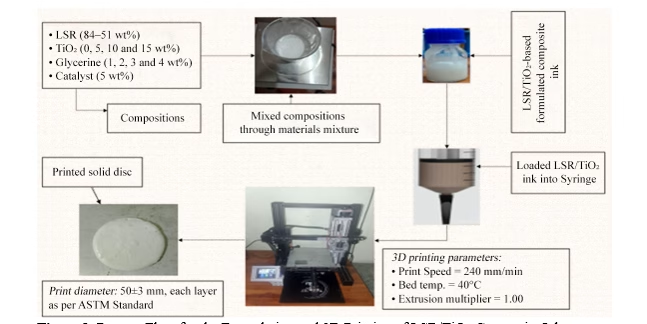
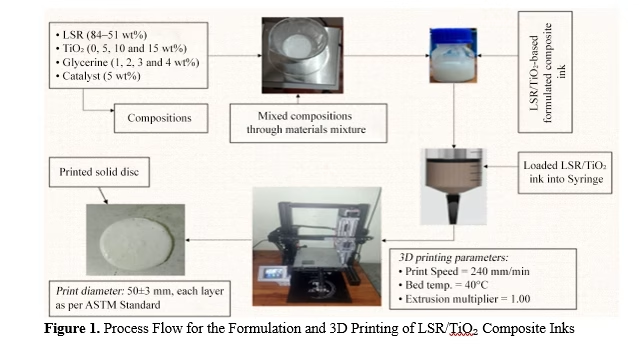
The purpose of this research is to develop and optimize the Liquid Silicone Rubber (LSR)/Titanium Dioxide (TiO₂) composite inks in Direct Ink Writing (DIW)-based 3D printing systems. The primary research objective was to use enhancement of mechanical, rheological, and dielectric characteristics of LSR using TiO₂ reinforcement but still retain extrusion stability and dimensional consistency. TiO₂ content (0, 5, 10, and 15 wt%) and catalyst and glycerol ratios were regulated and were used to prepare four ink formulations. To determine the structure-property relationships, the materials have been and were characterized through rotational rheometry, FTIR spectroscopy, X-ray diffraction (XRD), and scanning electron microscopy (SEM). From the analysis, it was found out that the 5 wt% TiO₂ composition displayed the best rheological characteristics with shear-thinning viscosity, which allowed DIW extrusion, good dispersion of the nanoparticle, and good adhesion of the particles to the silicone matrix. SEM analysis proved to be homogenous and possessing low agglomeration at this concentration, and XRD and FTIR confirmed stability of the phases and chemical compatibility of TiO₂ and LSR. Part fabrication experiments further confirmed rapid extrusion, smooth deposition, and high dimensional fidelity at 390 mm/min print speed and 60° substrate temperature. The overall results of the research identify the LSR/TiO₂ (5 wt%) as the best formulation in the functional elastomeric 3D printing with better print quality, mechanical strength, and printability reliability in flexible electronics and biomedical applications.
Keywords: Direct Ink Writing, Liquid Silicone Rubber, Titanium Dioxide, Dielectric Properties, SEM
[This article belongs to Journal of Polymer & Composites ]
References
- Foerster A, Annarasa V, Terry A, et al. UV-curable silicone materials with tuneable mechanical properties for 3D printing. Mater Des. 2021;205:109681.
- Liu B, Ma B. 3D printing molding of UV-curing liquid silicone rubber by UV follow curing. J Appl Polym Sci. 2025;142:e56453.
- Fay CD, Wu L. Cost-effective 3D printing of silicone structures using an advanced intra-layer curing approach. Technologies. 2023;11:179.
- Young CA, O’Bannon M, Thomson SL. Three-Dimensional Printing of Ultrasoft Silicone with a Functional Stiffness Gradient. 3D Print Addit Manuf. 2024;11(2).
- Senderoff DM. Biceps augmentation using solid silicone implants. Aesthet Surg J. 2018;38:
401–8. - McCoul D, Rosset S, Schlatter S, Shea H. Inkjet 3D printing of UV and thermal cure silicone elastomers for dielectric elastomer actuators. Smart Mater Struct. 2017;26:125022.
- Davoodi E, Fayazfar H, Liravi F, et al. Drop-on-demand high-speed 3D printing of flexible milled carbon fiber/silicone composite sensors for wearable biomonitoring devices. Addit Manuf. 2020;32.
- Luis E, Pan HM, Sing SL, et al. 3D Direct Printing of Silicone Meniscus Implant Using a Novel Heat-Cured Extrusion-Based Printer. Polymers (Basel). 2020;12:1031.
- Liravi F, Toyserkani E. Additive manufacturing of silicone structures: A review and prospective. Addit Manuf. 2018;24:232–42.
- Elizalde-Herrera FJ, Flores-Soto PA, Mora-Cortes LF, et al. Recent Development of Graphene-Based Composites for Electronics, Energy Storage, and Biomedical Applications: A Review. J Compos Sci. 2024;8:481.
- Nieva-Esteve G, Agulló N, Grande-Molina M, et al. Developing tuneable viscoelastic silicone gel-based inks for precise 3D printing of clinical phantoms. Mater Adv. 2024;5:3706–20.
- Yang G, Sun Y, Qin L, et al. Direct-ink-writing (DIW) 3D printing functional composite materials based on supra-molecular interaction. Compos Sci Technol. 2021;215:109013.
- Qiao H, et al. Preparation and performance of Silica/epoxy group-functionalized biobased Elastomer nanocomposite. Ind Eng Chem Res. 2017;56:881–9.
- Kim H, Kim J, Ryu K-H, et al. Embedded Direct Ink Writing 3D Printing of UV Curable Resin/Sepiolite Composites with Nano Orientation. ACS Omega. 2023;8:23554–65.
- Ulfah IM, Raistuti Fidyaningsih, Sri Rahayu et al. Influence of carbon black and Silica Filler on the rheological and mechanical Properties of natural rubber compound. Procedia Chem. 2015;16:258–64.
- Rius-Bartra JM, Ferrer-Serrano N, Agull N, et al. High-consistency silicone rubber with reduced Young’s modulus. An industrial option to dielectric silicone rubber. J Appl Polym Sci. 2023;140:e54405.
- Li J, Wu S, Zhang W, Ma K, Jin G. 3D printing of silicone elastomers for soft actuators. Actuators. 2022;11:200.
- Neethirajan J, Parathodika AR, Hu G-H, et al. Functional rubber composites based on silica-silane reinforcement for green tire application: the state of the art. Funct Compos Mater. 2022;3:7.
- Ortega JM, Golobic M, Sain JD, et al. Active Mixing of Disparate Inks for Multimaterial 3D Printing. Adv Mater Technol. 2019 Apr.
- Duran MM, Moro G, Zhang Y, Islam A. 3D printing of silicone and polyurethane elastomers for medical device application: A review. Adv Ind Manuf Eng. 2023;7:100125.
- Śliwiak M, Bui R, Brook MA, et al. 3D printing of highly reactive silicones using inkjet type droplet ejection and free space droplet merging and reaction. Addit Manuf. 2021;46:102099.
- Bhattacharjee N, Urrios A, Kang S, et al. The upcoming 3D-printing revolution in microfluidics. Lab Chip. 2016;16:1720–42.
- Koushki P, Kwok TH, Hof L, et al. Reinforcing silicone with hemp fiber for additive manufacturing. Compos Sci Technol. 2020;194:108139.
- Amert RSA, Kellar JJ, Whites KW. Rheological Optimization and Stability Study of Silver Nano-Ink for InkJet Printing of Solar Electrodes Using Industrial Printhead. Cleantech. 2012.
- Lee SJ, Yoon SJ, Jeon IY. Graphene/Polymer Nanocomposites: Preparation, Mechanical Properties, and Application. Polymers (Basel). 2022;14:4733.
- Roh S, Parekh DP, Bharti B, et al. 3D Printing by Multiphase Silicone/Water Capillary Inks. Adv Mater. 2017;29(26):1701554.
- Greenwood TE, Hatch SE, Colton MB, Thomson SL. 3D printing low-stiffness silicone within a curable support matrix. Addit Manuf. 2021;37:101681.
- Miron VM, Lämmermann S, Çakmak U, et al. Material Characterization of 3D-printed Silicone Elastomers. Procedia Struct Integr. 2021;34:65–70.
- Wang Y, Liu SY, Meng JS. Advanced materials for additive manufacturing. IOP Conf Ser Mater Sci Eng. 2019;479:012088.
- Chen Y, Zhou L, Wei J, et al. Direct Ink Writing of Flexible Electronics on Paper Substrate with Graphene/Polypyrrole/Carbon Black Ink. J Electron Mater. 2019;48(9):5514–23.
- Ahmed EM, Mostafa NY. Thermal stability, mechanical strength, and ionic conductivity of hematite nanoparticle/CS nanocomposites. Polym Polym Compos. 2025;33. doi:10.1177/09673911251327811.
- Liu M, Zhao Y, Wang Y, et al. Design, simulations, and experiments of tube-making pultrusion process with glass fabric/PP composites. Polym Polym Compos. 2025;33. doi:10.1177/09673911251321020.
- Aldakheel FM, Wickramasinghe R, Thamaraiselvan C, et al. Green silver nanoparticle-embedded chitosan-alginate hydrogel: A novel antibacterial approach for potential wound healing. Polym Polym Compos. 2025;33. doi:10.1177/09673911251320463.
- Gahramanli L, Muradov M, Eyvazova G, et al. Comparison of the physical properties of CdxZn1-xS-based nanocomposite materials produced via sonochemical and SILAR approaches. Polym Polym Compos. 2025;33. doi:10.1177/09673911251318543.
- Pandey R, Shrivastava AK, Mohan R, et al. A Review on Additive Manufacturing Processes. J Polym Compos. 2025;13(03):13–24.
- Srividya DV, Vali SK, Hadya B, Sadaq SI. Failure Analysis of Hybrid Natural/Synthetic Fiber Composite Laminates in The Application of Hybrid Composite Pressure Vessel. J Polym Compos. 2025;13(03):85–98.
- Venkatesh K, Rama Krishna LS, Kumar AS. Optimization of Process Parameters for FDM Printed Tensile Test Specimens to Reduce Energy Consumption and CO2 Emission for Sustainable Manufacturing. J Polym Compos. 2025;13(03):63–71.
- Kumawat S, Yashpal, Jain NL. Fabrication of Belt for Backpack for Students to Reduce the Musculoskeletal Disorders using ABS material 3D Printing. J Polym Compos. 2024;13(01):1110–7.
- Ananda MN, Reddy JS, Kumar SV, et al. Evaluation of Mechanical Properties of Carbon Reinforced Composite for Different Process Parameters Using FDM. J Polym Compos. 2024;11(13):218–28.
- George M, George PP. Dielectric Properties of Reduced Graphene Oxide with Nickel Cobalt Ferrite and Nickel Zinc Ferrite Epoxy Nanocomposites. J Polym Compos. 2024;11(11):28–37.
- Palanisamy S, Kalimuthu M, Palaniappan M, Alavudeen A, Rajini N, Santulli C, Al-Lohedan H. Characterization of Acacia caesia bark fibers (ACBFs). J Nat Fibers. 2021;19(15):10241–52. doi:10.1080/15440478.2021.1993493
- Palanisamy S, Murugesan TM, Palaniappan M, Santulli C, Ayrilmis N. Use of hemp waste for the development of mycelium-grown matrix biocomposites: a concise bibliographic review. BioResources. 2023;18(4):8771–80. doi:10.15376/biores.18.4.Palanisamy
- Padmanabhan RG, Rajesh S, Karthikeyan S, Palanisamy S, Ilyas RA, Ayrilmis N, Tag-eldin EM, Kchaou M. Evaluation of mechanical properties and Fick’s diffusion behaviour of aluminum-DMEM reinforced with hemp/bamboo/basalt woven fiber metal laminates (WFML) under different stacking sequences. Ain Shams Eng J. 2024;15(7):102759. doi:10.1016/j.asej.2024.102759
- Aruchamy K, Karuppusamy M, Krishnakumar S, Palanisamy S, Jayamani M, Sureshkumar K, Ali SK, Al-Farraj SA. Enhancement of mechanical properties of hybrid polymer composites using Palmyra palm and coconut sheath fibers: the role of tamarind shell powder. BioResources. 2025;20(1):698–724. doi:10.15376/biores.20.1.698-724
- Ayrilmis N, Kanat G, Yildiz Avsar E, Palanisamy S, Ashori A. Utilizing waste manhole covers and fibreboard as reinforcing fillers for thermoplastic composites. J Reinf Plast Compos. 2024;44(17–18):1108–18. doi:10.1177/07316844241238507
- Ramasubbu R, Kayambu A, Palanisamy S, Ayrilmis N. Mechanical properties of epoxy composites reinforced with Areca catechu fibers containing silicon carbide. BioResources. 2024;19(2):2353–70. doi:10.15376/biores.19.2.2353-2370

Journal of Polymer & Composites
| Volume | 13 | |
| Issue | 06 | |
| Received | 04/11/2025 | |
| Accepted | 12/11/2025 | |
| Published | 22/11/2025 | |
| Publication Time | 18 Days |