
Mukesh Chand,
Ashish Raj,
Garima Mathur,
Sushil Kumar Jain,
- Research Scholar, Department of Electrical and Electronics Engineering, Poornima University, Jaipur, Rajasthan, India
- Associate Professor, Department of Electrical and Electronics Engineering, Poornima University, Jaipur, Rajasthan, India
- Professor, Department of Electronics and Communication Engineering, Poornima College of Engineering, Jaipur, Rajasthan, India
- Assistant Professor, Department of Electronics and Communication Engineering, SRM University, Andhra Pradesh, India
Abstract
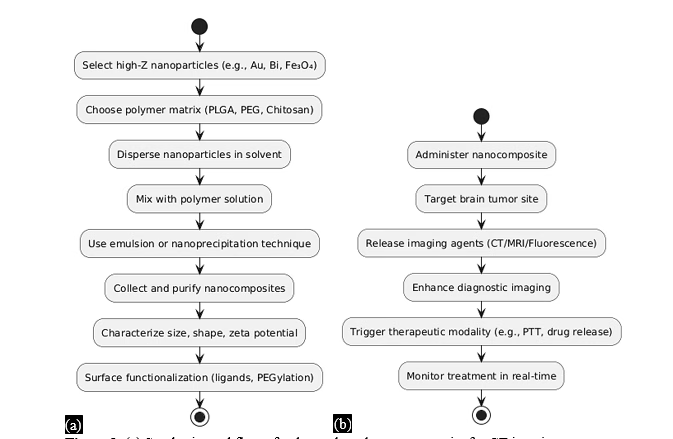
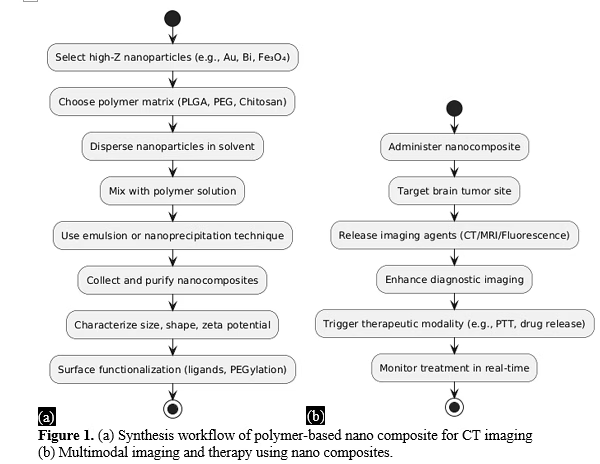
The detection and characterization of brain tumors require high-resolution and non-invasive imaging modalities that have the ability of differentiating tumorous tissues and healthy brain tissues. Computed tomography (CT) can be included in this number because, in addition to providing speedy scans and penetration to deep tissue, the diagnostic capability in soft tissue organ such as the brain is poor despite low natural contrast. The review is dedicated to the emerging area of research of nanostructured polymer composites that can be engineered to improve the CT contrast of the brain tumor diagnosis. Contrast enhancement Conjunction of high atomic number (Z) nanoparticles, e.g., gold (Au), bismuth (Bi), tantalum (Ta), and tungsten (W) with biocompatible polymer matrices (e.g. poly ethylene glycol (PEG), poly (lactic-co-glycolic acid) (PLGA) and chitosan) represents a promising method to achieve targeted and efficient contrast enhancement. By using polymeric encapsulation, stability and bio-distribution of the nanoparticle can be enhanced but also allows the specific tumor-targeting by functionalizing the surface with ligands, peptides or antibodies. However, this review is a critically appraising review of the up-to-date accounts of modulation of some techniques of synthesis, physicochemical characterization, bio- performance, and imaging results of such Nano composites. Special consideration is directed to the role of size, shape, surface charge and the chemistry of the polymers of imaging efficacy and translocation across the blood-brain barrier. Also issues such as toxicity, clearance mechanisms and regulatory issues are discussed. The review takes a conclusion about the direction of future research, which will involve the development of hybrid imaging systems, stimuli-responsive composites, and prospects of integration with theranostic platforms. On aggregate, nanostructured polymer composites have the potential to transform the current approach to CT-based brain tumor diagnostics as the imaging contrast agents they make available are safer because they are more natural and precise and can be customized to meet various requirements imposed by the present state and future developments of real-life application.
Keywords: Nanostructured Polymer Composites, Brain Tumor Diagnosis, Computed Tomography, CT Contrast Agents, High Atomic Number Nanoparticles
[This article belongs to Journal of Polymer & Composites ]
References
- Rabha B, Bharadwaj KK, Pati S, Choudhury BK, et al. Development of polymer-based nanoformulations for glioblastoma brain cancer therapy and diagnosis: an update. Polymers. 2021; 13(14).
- Ziai Y, Zargarian SS, Rinoldi C, et al. conducting polymer-based nanostructured materials for brain-machine interfaces. Wiley Interdiscip Rev Nanomed Nanobiotechnol. 2023; 15(1).
- Atiqah A, Ansari MNM. Nanostructure-polymer composites for soft-tissue engineering. In: Thomas S, editor. Nanostructured polymer composites for biomedical applications. Elsevier; 2019.
- Ahmed T, Saleem A, Ramyakrishna P, Thomas S. Nanostructured polymer composites for bio-applications. In: Thomas S, editor. Nanostructured polymer composites for biomedical applications. Elsevier; 2019.
- Imran M, Ahmed AAA, Kateb B, Kaushik A. Inorganic nanostructures for brain tumor management. In: Kaushik A, editor. Nanotherapy for brain tumor drug delivery. Springer; 2020.
- Renkler NZ, Scialla S, Russo T, D’Amora U, et al. Micro- and nanostructured fibrous composites via electro-fluid dynamics: design and applications for brain. Pharmaceutics. 2024; 16(1).
- Xu T, Zhang N, Nichols HL, Shi D, Wen X. Modification of nanostructured materials for biomedical applications. Mater Sci Eng C. 2007; 27(3).
- Arias-Ramos N, Ibarra LE, Serrano-Torres M, Yagüe B, et al. Iron oxide incorporated conjugated polymer nanoparticles for simultaneous use in magnetic resonance and fluorescent imaging of brain tumors. Pharmaceutics. 2021; 13(8).
- Basso J, Miranda A, Nunes S, Cova T, Sousa J, et al. Hydrogel-based drug delivery nanosystems for the treatment of brain tumors. Gels. 2018; 4(3).
- Ansari MA, Yadav MK, Rathore D, Svedberg A, Chhipa Z. Applications of nanostructured polymer composites for gene delivery. In: Thomas S, editor. Nanostructured polymer composites for biomedical applications. Elsevier; 2019.
- Mujokoro B, Adabi M, Sadroddiny E, Adabi M, Osanloo M. Nano-structures mediated co-delivery of therapeutic agents for glioblastoma treatment: a review. Mater Sci Eng C. 2016; 69.
- Yasri S, Wiwanitkit V. Application of chitosan nanostructures embedded composite materials in cancer therapy. In: Varaprasad KM, editor. Chitosan nanocomposites: bionanomechanical applications. Springer; 2023.
- Khan MJ, Svedberg A, Singh AA, Ansari MS, Thomas S. Use of nanostructured polymer in the delivery of drugs for cancer therapy. In: Thomas S, editor. Nanostructured polymer composites for biomedical applications. Elsevier; 2019.
- Duan Y, Hu D, Guo B, Shi Q, Wu M, et al. Nanostructural control enables optimized photoacoustic-fluorescence-magnetic resonance multimodal imaging and photothermal therapy of brain tumor. Adv Funct Mater. 2020; 30(39).
- Vidu R, Rahman M, Mahmoudi M, Enachescu M, et al. Nanostructures: a platform for brain repair and augmentation. Front Syst Neurosci. 2014; 8.
- Ni D, Bu W, Zhang S, Zheng X, Li M, et al. Single Ho3+-doped upconversion nanoparticles for high-performance T2-weighted brain tumor diagnosis and MR/UCL/CT multimodal imaging. Adv Funct Mater. 2014; 24(42).
- Venugopal J, Prabhakaran MP, Low S, Choon AT, et al. Continuous nanostructures for the controlled release of drugs. Curr Pharm Des. 2009; 15(15).
- Muñoz R, Singh DP, Kumar R, Matsuda A. Graphene oxide for drug delivery and cancer therapy. In: Thomas S, editor. Nanostructured polymer composites for biomedical applications. Elsevier; 2019.
- Abdelmaoula AE, Du L, Xu L, Cheng Y, Mahdy AA, et al. Biomimetic brain-like nanostructures for solid polymer electrolytes with fast ion transport. Sci China Mater. 2022; 65(3).
- Zare EN, Jamaledin R, Naserzadeh P, Afjeh-Dana E, et al. Metal-based nanostructures/PLGA nanocomposites: antimicrobial activity, cytotoxicity, and their biomedical applications. ACS Appl Mater Interfaces. 2020; 12(3).
- Aberoumandi SM, Mohammadhosseini M, Nilforoushzadeh MA, et al. An update on applications of nanostructured drug delivery systems in cancer therapy: a review. Artif Cells Nanomed Biotechnol. 2017; 45(6).
- Martin-Banderas L, Holgado MA, Sayalero MJ, Gañán-Calvo AM. Nanostructures for drug delivery to the brain. Curr Med Chem. 2011; 18(35).
- Mostafavi E, Medina-Cruz D, Vernet-Crua P, Cholula-Díaz JL, et al. Green nanomedicine: the path to the next generation of nanomaterials for diagnosing brain tumors and therapeutics? Expert Opin Drug Deliv. 2021; 18(6).
- Prusty K, Swain SK. Nanostructured chitosan composites for cancer therapy: a review. Int J Polym Mater Polym Biomater. 2018; 67(15).
- Mir M, Ahmed N, ur Rehman A. Recent applications of PLGA based nanostructures in drug delivery. Colloids Surf B Biointerfaces. 2017; 159.
- Invernici G, Cristini S, Alessandri G, Parati EA. Nanotechnology advances in brain tumors: the state of the art. Recent Pat Anticancer Drug Discov. 2011; 6(1).
- Pryjmaková J, Kaimlová M, Hubáček T, Švorčík M, Švorčík V. Nanostructured materials for artificial tissue replacements. Int J Mol Sci. 2020; 21(7).
- Ostovar S, Pourmadadi M, Zaker MA. Carboxymethyl cellulose hydrogel improved by zinc oxide and graphene quantum dots nanoparticles as pH-sensitive nanocomposite for quercetin delivery to brain cancer treatment. Int J Biol Macromol. 2023; 242(1).
- Anand R, Kumar L, Mohan L, Bharadvaja N. Nano-inspired smart medicines targeting brain cancer: diagnosis and treatment. J Biol Inorg Chem. 2023; 28(3).
- Liu T, Liu Z. 2D MoS2 nanostructures for biomedical applications. Adv Healthc Mater. 2018; 7(8).
- Almeshaal M, Palanisamy S, Murugesan TM, Palaniappan M, Santulli C. Physico-chemical characterization of Grewia monticola Sond (GMS) fibers for prospective application in biocomposites. J Nat Fibers. 2022; 19(17).
- Padmanabhan RG, Rajesh S, Karthikeyan S, Palanisamy S, Ilyas RA, Ayrilmis N, Tag-eldin EM, Kchaou M. Evaluation of mechanical properties and Fick’s diffusion behaviour of aluminum-DMEM reinforced with hemp/bamboo/basalt woven fiber metal laminates (WFML) under different stacking sequences. Ain Shams Eng J. 2024; 15(7).
- Palanisamy S, Kalimuthu M, Azeez A, Palaniappan M, Dharmalingam S, Nagarajan R, Santulli C. Wear properties and post-moisture absorption mechanical behavior of kenaf/banana-fiber-reinforced epoxy composites. Fibers. 2022; 10(4).
- Muthukumar R, Prakash SM, Kumar P N, Dinesh V, Meena RS, Sivakumar R, Deshmukh RG, Pratheep VG, Hussain Z. Polymer-nanowire hybrid composites based on PEDOT: PSS and AgNWs for high-performance conductive films in flexible devices. Polymers. 2025;13(5).
- Goutham ER, Hussain SS, Muthukumar C, Krishnasamy S, Kumar TS, Santulli C, Palanisamy S, Parameswaranpillai J, Jesuarockiam N. Drilling parameters and post-drilling residual tensile properties of natural-fiber-reinforced composites: a review. J Compos Sci. 2023; 7(4).

Journal of Polymer & Composites
| Volume | 13 | |
| Issue | 06 | |
| Received | 26/07/2025 | |
| Accepted | 15/09/2025 | |
| Published | 07/11/2025 | |
| Publication Time | 104 Days |