
Alok Kumar,
Shiv Kumar Ray,
Rashique Arif,
Sunny Chandra,
Ashish Kumar Aman,
Rajesh Kumar,
- Assistant Professor, Department of Mechanical Engineering, Nalanda College of Engineering, Chandi (Nalanda), Bihar Engineering University, Patna, Bihar, India
- Assistant Professor, Department of Mechanical Engineering, Bihar Engineering University, Patna, Bihar, India
- Assistant Professor, Department of Mechanical Engineering, Government Engineering College, Jehanabad, Bihar Engineering University, Patna, Bihar, India
- Assistant Professor, Department of Mechanical Engineering, Bihar Engineering University, Patna, Bihar, India
- Assistant Professor, Department of Mechanical Engineering, Government Engineering College, Baxar, Bihar Engineering University, Patna, Bihar, India
- Assistant Professor, Department of Mechanical Engineering, Sandip University, Sijoul, Madhubani, Bihar, India
Abstract
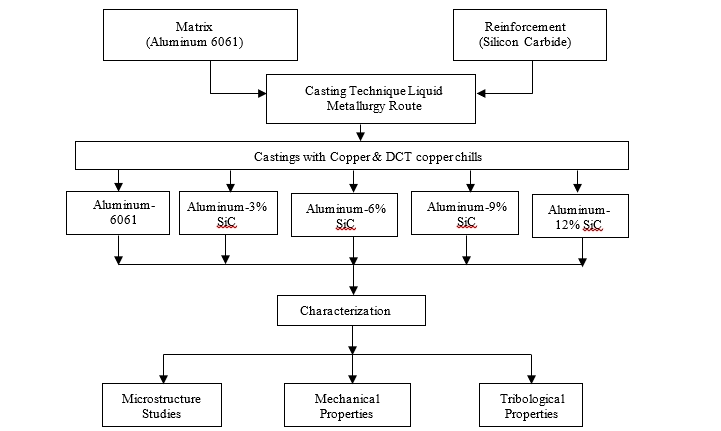
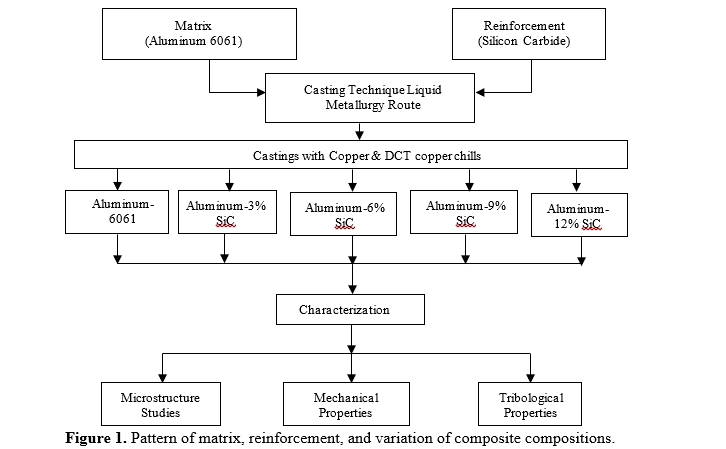
Aluminum-Silicon Carbide Metal Matrix Composites (Al/SiC MMCs) represent advanced materials created through the integration of aluminum matrices with silicon carbide particle reinforcement. These composites demonstrate superior characteristics compared to conventional aluminum alloys, establishing their relevance across diverse engineering applications. This experimental investigation focuses on developing composites using aluminum as the base matrix while incorporating SiC particles (40-50μm particle size) as reinforcing agents. The reinforcement content was systematically varied from 3 to 12 weight percent in incremental steps of 3 weight percent. Composite fabrication utilized sand mold casting techniques incorporating specialized chill blocks, including Deep Cryogenic Treatment (DCT) processed copper and standard copper alternatives, with subsequent evaluation of resulting material characteristics. Experimental findings revealed that Al/SiC composites achieved maximum tensile strength when produced using DCT copper chill blocks, whereas specimens manufactured with conventional copper chills exhibited reduced strength values. Enhanced thermal conductivity properties of the chill plates directly correlate with improved strength characteristics. Additionally, increased composite hardness contributes to superior tensile strength through the development of refined grain structures during rapid solidification processes. Microstructural analysis conclusively demonstrated that specimens produced using DCT-copper chill plates exhibited significantly refined grain structures, while those manufactured with conventional copper chills displayed notably coarser grain formations. Comparative microstructural examination confirmed that DCT-copper chills produce substantially finer grain sizes compared to conventional copper chills, which generate coarser grain structures.
Keywords: Aluminum-silicon carbide composites, deep cryogenic treatment, copper chill plates, enhanced cooling rates, thermal conductivity.
[This article belongs to Journal of Polymer & Composites ]
References
- Abba AlhajiHammajam, A. M.-J. (2019). The Green Composites: Millet Husk Fiber (MHF) Filled Poly Lactic Acid (PLA) and Degradability Effects on Environment. Open Journal of Composite Materials, 9, 300-311. doi: 10.4236/ojcm.2019.93018.
- Alagarsamy, S. S. (2015). Investigating the Mechanical Behaviour of Coconut Coir—Chicken Feather Reinforced Hybrid Composite. International Journal of Science, Engineering and Technology Research, 4, 4215-4221.
- Ali Alavi Nia, S. A. (2022). Investigating the effects of alumina nanoparticles on the impact resistance of polycarbonate nano-composites. Archive of Mechanical Engineering, 69(3), 411-429. doi:10.24425/ame.2022.140424.
- Amulah, C. E.-J. (2019). Development and Characterization of a Composite Material Based on the Mixture of Gypsum Plaster and Rice Husk Ash. Continental Journal of Engineering Sciences, 14, 15-33.
- BadyankalPramod V, M. T. (2020). Compression and water absorption behaviour of banana and sisal hybrid fiber polymer composites. Material Today: Proceedings, 35(3), 383-386. doi:10.1016/j.matpr.2020.02.695.
- Bazan, P., Nosal, P., Kozub, B., &Kuciel, S. (2020). Biobased Polyethylene Hybrid Composites with Natural Fiber: Mechanical, Thermal Properties, and Micromechanics. Materials, 2020, 2967. doi:10.3390/ma13132967.
- BeleteAmbachewMekonen, T. M. (2023). Experimental investigation of tensile, flexural and hardness properties of polyester resin echinatusfiber reinforced composite material. Engineering Solid Mechanics, 11(2), 151-162. doi:10.5267/j.esm.2023.1.001.
- Bhongade, A., Thakur, K. K., &Radkar, D. (2021). Effect of fillers in glass matrix composite material suitable for light weight and high thermal strength applications. Materials Today: Proceedings, 38(5), 2217-2221. doi:10.1016/j.matpr.2020.06.265.
- BK Sriranga, L. K. (2021). The mechanical properties of hybrid laminates composites on epoxy resin with natural jute fiber and S-glass fibers. Materials Today: Proceedings, 46(18), 8927-8933. doi:10.1016/j.matpr.2021.05.363.
- BN Ravi Kumar, G. A. (2013). Effect of Fillers on Thermal and Fire Resistance Properties of E-Glass Epoxy Composites. International Journal of Mechanical Engineering Research & Applications, 1(4), 122-127.
- Boopathi L, S. P. (2012). Investigation of physical, chemical and mechanical properties of raw and alkali treated Borassus fruit fiber. Compos Part B, 43(8), 3044–3052. doi:10.1016/j.compositesb.2012.05.002.
- Byström, J., Jekabsons, N., & Varna, J. (2000). Evaluation of different models for prediction of elastic properties of woven composites. Composites Part B Engineering, 30(1), 7-20. doi:10.1016/S1359-8368(99)00061-X.
- D Shivappa, G. A. (2013). Mechanical characterization of rice husk flour reinforced vinylester polymer composite. Int. J. Innovat. Res. Sci., Eng. and Technol, 2(11), 6271-6278.
14. Almeshaal, M., Palanisamy,S., Murugesan, T.M., Palaniappan M. & Santulli C. (2022) Physico-chemical characterization of Grewia Monticola Sond (GMS) fibers for prospective application in biocomposites, Journal of natural fibers, Vol.-19, Issue-17.
15. Padmanabhan, R.G. , Rajesh, S., Karthikeyan S., Palanisamy, S., Ayrilmis N., Tageldin E. M.& Kchaou M. (2024), Evaluation of mechanical properties and Fick’s diffusion behaviour of aluminum-DMEM reinforced with hemp/bamboo/basalt woven fiber metal laminates (WFML) under different stacking sequences, Ain shams engineering journal, Volume 15, Issue 7.
- Palaniappan, Palanisamy S., Khan R., Alrasheedi N.H., Tadepalli S., Mani T. & Santulli C. (2024) Synthesis and suitability characterization of microcrystalline cellulose from Citrus x sinensis sweet orange peel fruit waste-based biomass for polymer composite applications, Journal of Polymer Research, 31(4).
- Palanisamy, Mayandi K., Azeez A., Palaniappan M., Dharmalingam S., Rajini N. & Santulli C., (2022), Wear Properties and Post-Moisture Absorption Mechanical Behavior of Kenaf/Banana-Fiber-Reinforced Epoxy Composites, Fibers, 10(4):32.
- Goutham E.R.S., Hussain S.S., Muthukumar C., Krishnasamy S., Kumar T.S.M., Santulli, Palanisamy S., Parameswaranpillai J. & Naveen Jesuarockiam N., (2023), Drilling Parameters and Post-Drilling Residual Tensile Properties of Natural-Fiber-Reinforced Composites: A Review, Journal of composite science, Vol.-7, issue-4.
- Eberemu, A. O. (2011). Consolidation Properties of Compacted Lateritic Soil Treated with Rice Husk Ash. Geomaterials, 1(3), 87-94. doi:10.4236/gm.2011.13011.
- Essabir, H., Bensalah, M., Rodrigue, D., Bouhfid, R., &Qaiss, A. (2016). Structural, mechanical and thermal properties of bio-based hybrid composites from waste coir residues: Fibers and shell particles. Mechanics of Materials, 93, 134-144. doi:10.1016/j.mechmat.2015.10.018.
- Federico Bosia, M. F. (2004). Through-the-thickness distribution of strains in laminated composite plates subjected to bending. Composites Science and Technology, 64(1), 71-82. doi:10.1016/S0266-3538(03)00201-X.
- Filho, R. D., Scrivener, K., England, G. L., &Ghavami, K. (2000). Durability of alkali-sensitive sisal and coconut fibres in cement mortar composites. Cement and Concrete Composites, 22(2), 127-143. doi:10.1016/S0958-9465(99)00039-6.
- L. Easwara Prasad, B. K. (2017). A Study on Impact Strength Characteristics of Coir Polyester Composites. Procedia Engineering, 173, 771-777. doi:10.1016/j.proeng.2016.12.091.
- Gaikwad, V. (2020). High Performance Fiber- Kevlar the Super Tough Fiber. Journal of Textile Science & Engineering, 7, 1-4. doi:10.37421/jtese.2020.10.426.
- Gopalan, S. L. (2023). Investigations on mechanical properties of jute fibre reinforced with aluminium oxide fortified epoxy composite. Advances in Materials and Processing Technologies, 9(3), 779-804. doi:10.1080/2374068X.2022.2096836.
- Ashby M.F. & Jones R.H. (2013). Engineering Materials 2. An Introduction to Microstructures and Processing.
- Kagzi, S. A., &Raval, H. K. (2023). Mathematical modelling to predict spring back in bimetallic material including material anisotropy during bending. Advances in Materials and Processing Technologies, 9(4), 1381-1393. doi:10.1080/2374068X.2022.2118905.
- Jawaid, H. A. (2010). Hybrid composites made from oil palm empty fruit bunches/jute fibres: water absorption, thickness swelling and density behaviours. J Polym Environ, 19, 106-109. doi:10.1007/s10924-010-0203-2.
- McWilliam, B., Yu, J., Pankow, M., & Yen, C.-F. (2015). Ballistic impact behavior of woven ceramic fabric reinforced metal matrix composites. International Journal of Impact Engineering, 86, 57-66. doi:10.1016/j.ijimpeng.2015.07.005.
- Mohammed Bukar, A. ,.-J. (2022). Development and Evaluation of the Mechanical Properties of Coconut Fibre Reinforced Low Density Polyethylene Composite. Open Journal of Composite Materials, 12, 83-97. doi:10.4236/ojcm.2022.123007.
- H. Padmaraj, G. L. (2018). Mechanical characterization of areca husk-coir fiber reinforced hybrid composites. Mater Today: Proc, 5(1), 1292-1297. doi:10.1016/j.matpr.2017.11.214.
- O. Hagstrand, F. B.-A. (2005). The influence of void content on the structural flexural performance of unidirectional glass fibre reinforced polypropylene composites. Compos Part AApplSciManuf, 36, 705-714. doi:10.1016/j.compositesa.2004.03.007.
- Prasad H. Nayak, M. R. (2022). Processing and Characterization of Cu–10Sn/ZrO2 Alloys Processed Via Stir Casting Technique: Mechanical Properties and Wear Behavior Studies. Journal of Metalcasting, 17, 1266–1276. doi:10.1007/s40962-022-00812-x.
34. Garg P., Jamwal A., Kumar D., Sadasivuni K. K., Hussain C.M., Gupta P. (2019) Advance research progresses in aluminium matrix composites: manufacturing & applications. Journal of Materials Research and Technology, 8(5), 4924-4939, doi.org/10.1016/j.jmrt.2019.06.028.
- Rajak, D., Pagar, D., Menezes, P., &Linul, E. (2019). Fiber-Reinforced Polymer Composites: Manufacturing, Properties, and Applications. Polymers, 11, 1667. doi:10.3390/polym11101667.
- Ronald Krueger, M. K. (2000). Testing and Analysis of Composite Skin/Stringer Debonding under Multi-Axial Loading. Journal of Composite Materials, 34(15), 1263-1300. doi:10.1177/002199830003401502.
- Ronga MZ, Z. M. (2001). The effect offiber treatment on the mechanical properties of unidirectional sisal-reinforced epoxy composites. Composites Science and Technology, 61(10), 1437-1447. doi:10.1016/S0266-3538(01)00046-X.
- Seong Ok Han, S. M. (2006). Mechanical and thermal properties of waste silk fiber-reinforced poly (butylene succinate) biocomposites. Journal of applied polymer science, 100, 4972–4980. doi:10.1002/app.23300.
- Shubhra, Q. T., Alam, A. K., Gafur, M. A., Shamsuddin, S. M., Khan, M. A., Saha, M. S., Ashaduzzaman, M. (2010). Characterization of plant and animal based natural fibers reinforced polypropylene composites and their comparative study. Fibers and Polymers, 11, 725–731. doi:10.1007/s12221-010-0725-1.
- G. Yashas., Gowda, M. R. (2018). Polymer matrix-natural fiber composites: An overview. Cogent Engineering, 5(1). doi:10.1080/23311916.2018.1446667.
- Totla, S. K., Pillai, A. M., Chetan, M., Warad, C., Vinodkumar, S., &Patil, A. Y. (2020). Analysis of helmet with coconut shell as the outer layer. Journal of Material Today: Proceedings , 32(3), 365-373. doi:10.1016/j.matpr.2020.02.047.

Journal of Polymer & Composites
| Volume | 13 | |
| Issue | 06 | |
| Received | 17/09/2025 | |
| Accepted | 29/09/2025 | |
| Published | 09/10/2025 | |
| Publication Time | 22 Days |