
Pankaj S. Shirsath,
Srikant Prasad,
Vishal Sulakhe,
- Research Scholar, Department of Mechanical Engineering, SOET, Sandip University, Nashik, Maharashtra, India
- Assistant Professor, Department of Mechanical Engineering, SOET, Sandip University, Nashik, Maharashtra, India
- Associate Professor, Department of Mechanical Engineering, SOET, Sandip University, Nashik, Maharashtra, India
Abstract
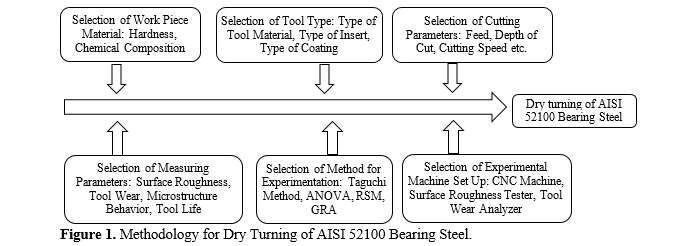
Bearing steel like AISI 52100 is one of the most widely used high cutting steel in industry for manufacturing of bearing. A large amount of coolant is used for machining at high speed due to which increase there has been a significant increase in environmental hazards. So Green or Dry manufacturing with optimize cutting parameters and its effect on tool material & work piece quality need to be studied to get the best possible combination. Parameters like machining, cutting power, surface quality and tool wear influence metal cutting friction. Nowadays dry turning of high speed steel with improved machinability and developed cutting tool are being studied. Herein dry turning of AISI bearing steel material 52100 are reviewed using coated & uncoated carbide insert for cutting wear analysis and tool material. A good understanding of the metal cutting parameters affecting the machinability of AISI 52100 bearing steel is required along with proper selection of tool geometry, coating & experimentation. A comparative study is required of coated & uncoated carbide tool for analysis of proper cutting condition. Consistent surface integrity & dimensional accuracy is also assured of the finished product. Dry machining with zero use of cutting fluid during hard turning material like AISI 52100 is needed for eliminating environmental hazards and reduction in production cost. The increasing emphasis on environmental protection and worker health is driving industries to adopt sustainable manufacturing practices, and dry machining is a key component of this shift.
Keywords: AISI 52100 Bearing Steel, dry Machining, Carbide Tool, cutting parameters, Surface Roughness, Tool Wear Analysis, Taguchi Method, ANOVA, RSM, GRA
[This article belongs to Special Issue under section in Journal of Polymer & Composites (jopc)]

References
- Li Q, Ma C, Wang C, et al. Analysis of the cutting performance of coated micro-textured bionic tools for dry cutting AISI 52100 machines. 2023; 11:886.
- Rajarajan SS, Kannan CR, Dennison MS. A comparative study on the machining characteristics on turning AISI 52100 alloy steel in dry and micro lubrication condition. Aust. J Mech. Eng. 2020.
- Evangelista G, Peruchi RS, Brito TG, et al. A multivariate statistical quality control of AISI 52100 hardened steel turning. IEEE Access. 2020; 8.
- Pradeep AV, Suryam LV, Prasad SVS, et al. Optimization for machining parameters in turning of AISI 52100 steel for manufacturing services genetic algorithm method. Int J Innov Techno Explore Eng. 2020; 9(3).
- Rafighi M. Effect of cutting parameters on machinability of hardened AISI 52100 bearing steel. In: Proceedings of the 8th International Symposium on Innovative Technologies in Engineering and Science; 2020 Oct 23-25; Bursa, Turkey. Academic Platform; 2020; 474–81.
- Peruchi RS, Junior PR, Brito TG, et al. Integrating multivariate statistical analysis into Six Sigma DMAIC projects: a case study on AISI 52100 hardened steel turning. IEEE Access. 2020;8:34246–55
- Chauhan S, Kumar R. Comparative study on cutting performance of plain and coated carbide inserts in CNC turning of EN9 steel. Eng. Res Express. 2020; 2:045009.
- Panda A, Sahoo AK, Kumar R, et al. A review on machinability aspects for AISI 52100 bearing steel. Mater Today Proc. 2019.
- Umamaheswarrao P, Ranga Raju D, Suman KN, et al. Hybrid optimal scheme for minimizing machining force and surface roughness in hard turning of AISI 52100 steel. Int. J Eng. Sci. Technol. 2019; 11(3):19–29.
- Umamaheswarrao P, Ranga Raju D, Suman KN, et al. TOPSIS-based optimization of process parameters while hard turning of AISI 52100 steel. Acta. Mech. Malaysia. 2019; 2(2):28–31.
- Panda A, Sahoo AK, Panigrahi I, Rout AK. Investigating machinability in hard turning of AISI 52100 bearing steel through performance measurement: QR, ANN and GRA study. 2018; 15(1):4935–61.
- Erameh AA, Achebo JI, Osarenmwinda JO. Optimization and prediction of effect of turning parameters on tool wear rate and surface roughness using response surface methodology. Int. J Sci. Eng. Res. 2018; 9(9):1218–26.
- Sateesh Kumar C, Patel SK, Mujumdar H, et al. Numerical analysis of hard machining of AISI 52100 steel using uncoated and coated Al₂O₃-TiCN based mixed ceramic inserts. Int. J Eng. Technol. Res Manag. 2018; 2(4).
- Kulkarni A, Sargad V, More C. Machinability investigation of AISI 304 austenitic stainless steels using multilayer AlTiN/TiAlN coated carbide inserts. Procedia Manuf. 2018; 20:549–51.
- Prakash S, Rao PS. Performance of coated carbide tools during CNC machining – a review. Int. J Res Sci. Innov. 2018; V (XII):78–80.
- Keblouti O, Boulanouar L, Azizi MW, et al. Modeling and multi-objective optimization of surface roughness and productivity in dry turning of AISI 52100 steel using (TiCN-TiN) coating cermet tools. Int. J Ind. Eng. Comput. 2017; 8:71–84.
- Cakan A. Wear behavior of multilayer coated carbide tools in finish dry hard turning. Mater Test. 2016; 58:772–7.
- Qehaja N, Jakupi K, Bunjaku A, et al. Effect of machining parameters and machining time on surface roughness in dry turning process. Procedia Eng. 2015; 100:135–40.
- Shihab SK, Khan ZA, Siddiquee AN. RSM based investigations on the effects of cutting parameters on surface integrity during cryogenic hard turning of AISI 52100. J Manuf. Sci. Prod. 2015; 15(3):309–18.
- Vijaykumar HK, Siddiq A, Sinan M. Optimization of turning parameters using Taguchi technique for MRR and surface roughness of hardened AISI 52100 steel. Int. J Eng. Res Appl. 2014; 4(5):39–44.
- Shihab SK, Khan ZA, Mohammad A, et al. Investigations on the effect of CNC dry hard turning process parameters on surface integrity: a multi-performance characteristics optimization. J Manuf. Sci. Prod. 2014; 14(1):23–30.
- Palakudtewar RK, Gaikwad SV. Dry machining of super alloys: difficulties and remedies. Int. J Sci. Res. 2014; 3(7):277–82.
- Rotella G, Umbrello D, Dillon OW, et al. Evaluation of process performance for sustainable hard machining. J Adv. Mech. Des Syst. Manuf. 2012;6(6).
- Caruso S, Umbrello D, Outeiro JC, et al. An experimental investigation of residual stresses in hard machining of AISI 52100 steel. Procedia Eng. 2011; 19:67–72.
- Saini P, Ali M. New generation coatings for high speed cutting tools. In: Proceedings of the 9th International Conference on Manufacturing Excellence (ICME); 2003; Australia. Institution of Engineers; 2003. 1–2.

Journal of Polymer & Composites
| Volume | 13 | |
| Special Issue | 06 | |
| Received | 16/01/2025 | |
| Accepted | 11/07/2025 | |
| Published | 01/09/2025 | |
| Publication Time | 228 Days |