
Hari Krishnan G,
Umashankar G,
Sheeba Santhosh,
Ram Prasad Reddy M,
Venkata Prasanth B,
- Associate Professor, Department of Electrical and Electronics Engineering, School of Engineering, Mohan Babu University, Tirupati, Andhra Pradesh, India
- Assistant Professor, Department of Biomedical Engineering, GRT Institute of Engineering and Technology, Tiruvallur, Tamil Nadu, India
- Associate Professor, Department of Electronics and Communication Engineering, Panimalar Engineering College, Chennai, Tamil Nadu, India
- Professor, Department of Electrical and Electronics Engineering, Aditya College of Engineering, Madanapalle, Andhra Pradesh, India
- Professor, Department of Electrical and Electronics Engineering, QIS College of Engineering & Technology, Ongole, Andhra Pradesh, India
Abstract
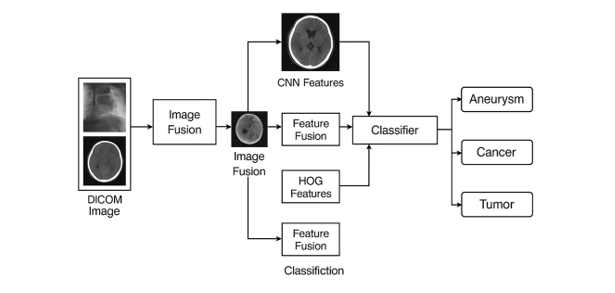
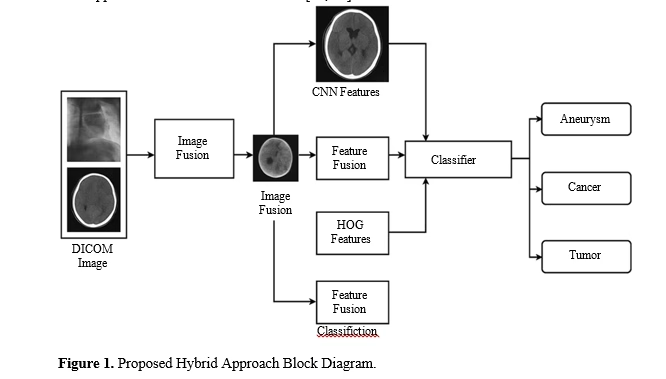
Early and accurate classification of brain CT images is critical for diagnosing conditions such as aneurysms, tumors, and related lesions. We present a dual-stream image-classification framework that fuses convolutional neural network (CNN) features with handcrafted Histogram of Oriented Gradients (HOG) descriptors to jointly capture global semantics and local textural cues. The pipeline begins with modality unification via pixel-wise averaging to form a fused input, which is then processed in parallel by the CNN and HOG branches. Their outputs are concatenated at the feature level and passed to a compact classifier. Training uses standard cross-entropy with Adam and early stopping, and performance is reported using accuracy, precision, recall, F1-score, and confusion matrix analysis. Evaluated on 270 grayscale CT scans, the proposed model delivers uniformly high precision, recall, and F1 across aneurysm, cancer, and tumor classes (0.991–0.995), reflecting balanced detection and discrimination among visually similar pathologies; the confusion matrix shows strong class separation. Beyond neurodiagnostics, the same dual-stream fusion strategy is pertinent to imaging-based assessment of polymer composite neuroimplants (e.g., cranial plates and scaffolds): the CNN pathway encodes global structural context while HOG emphasizes boundary/texture signatures of material interfaces, supporting postoperative integrity checks and positioning verification. Overall, this hybrid CNN–HOG approach advances efficient, accurate CT-based classification while establishing a practical foundation for non-invasive evaluation of polymer composite biomedical implants, thereby bridging clinical imaging and materials engineering within a single automated framework.
Keywords: Brain CT Image Classification, Hybrid CNN–HOG Model, Feature‑Level Fusion, Polymer Composite Neuro‑Implants, Biomedical Imaging Applications, Deep Learning in Neurodiagnostic
[This article belongs to Special Issue under section in Journal of Polymer & Composites (jopc)]
References
- Pereira, A. Pinto, V. Alves and C. A. Silva, Brain Tumor Segmentation Using Convolutional Neural Networks in MRI Images, IEEE Transactions on Medical Imaging, vol. 35, no. 5, pp. 1240-1251, May 2016, doi: 10.1109/TMI.2016.2538465.
- Deepak S, Ameer PM. Brain tumor classification using deep CNN features via transfer learning. Comput Biol Med. 2019;111:103345. doi:10.1016/j.compbiomed.2019.103345.
- Mao, Y., Kim, J., Podina, L. et al. Dilated SE-DenseNet for brain tumor MRI classification. Sci Rep 15, 3596 (2025). https://doi.org/10.1038/s41598-025-86752-y
- Afshar, A. Mohammadi and K. N. Plataniotis, Brain Tumor Type Classification via Capsule Networks, 2018 25th IEEE International Conference on Image Processing (ICIP), Athens, Greece, 2018, pp. 3129-3133, doi: 10.1109/ICIP.2018.8451379.
- Ali, M. Sharif, C. Muhammad Shahzad Faisal, A. Rizwan, G. Atteia and M. Alabdulhafith, Brain Tumor Segmentation Using Generative Adversarial Networks, in IEEE Access, vol. 12, pp. 183525-183541, 2024, doi: 10.1109/ACCESS.2024.3450593.
- Islam MT, et al. Ensemble learning for hemorrhage classification in CT brain scans. Comput Biol Med. 2021;129:104148. doi:10.1016/j.compbiomed.2020.104148.
- Abdusalomov AB, Mukhiddinov M, Whangbo TK. Brain Tumor Detection Based on Deep Learning Approaches and Magnetic Resonance Imaging. Cancers (Basel). 2023 Aug 18;15(16):4172. doi: 10.3390/cancers15164172.
- Luo M, He Z, Cui H, Ward P, Chen YPP. Dual attention-based fusion network for MCI conversion prediction. Comput Biol Med. 2024;182:109039. doi:10.1016/j.compbiomed.2024.109039.
- Naser MA, Deen MJ. A deep learning framework for COVID-19 detection using CT images. Sensors (Basel). 2021;21(17):5921. doi:10.3390/s21175921.
- Hamed Jabbari, Nooshin Bigdeli, A new hierarchical algorithm based on CapsGAN for imbalanced image classification, IET Image Processing, 10.1049/ipr2.12942, 18, 1, (194-210), (2024).
- Mohandass G, Krishnan GH, Sridhathan C, et al. Lung cancer classification using optimized attention-based CNN with DenseNet-201 transfer learning on CT. Biomed Signal Process Control. 2024;95:106351. doi:10.1016/j.bspc.2024.106351.
- Krishnan GH, Umashankar G, Abraham S. Cerebrovascular disorder diagnosis using MR angiography. Biomed Res (India). 2016;27(3):773-775.
- Mohandass G, Natarajan RA, Krishnan GH. Comparative analysis of optical coherence tomography retinal images using multidimensional and cluster methods. Biomed Res (India). 2015;26(2):273-285.
- Sabarivani A, Krishnan GH. Home health assistive system for critical care patients. Res J Pharm Biol Chem Sci. 2015;6(2):629-633.
- Jindal S, Manzoor F, Haslam N, et al. 3D printed composite materials for craniofacial implants: current concepts, challenges and future directions. Int J Adv Manuf Technol. 2021;112:635-653. doi:10.1007/s00170-020-06397-1.
- Aslam Khan MU, Abd Razak SI, Al Arjan WS, Nazir S, Sahaya Anand TJ, Mehboob H, et al. Recent advances in biopolymeric composite materials for tissue engineering and regenerative medicines: a review. 2021;26(3):619. doi:10.3390/molecules26030619.
- Santhosh S, Juliet AV, Krishnan GH. Predictive analysis of identification and disease condition monitoring using bioimpedance data. J Ambient Intell Humaniz Comput. 2021;12(2):2955-2963. doi:10.1007/s12652-020-01988-3.
- Santhosh S, Juliet AV, Krishnan GH. Simulation of signal generation and measuring circuit and real-time IoT-based electrical bio-impedance cardiac monitoring system. In: Intelligent Computing, Information and Control Systems (ICICCS 2019). 2020;1039:701-706. doi:10.1007/978-981-32-9817-0_74.
- Reddy AN, Krishnan GH, Raghuram D. Real time patient health monitoring using Raspberry PI. Res J Pharm Biol Chem Sci. 2016;7(6):570-575.
- Krishnan GH, Natarajan RA, Nanda A. Impact of upper limb joint fluid variation on inflammatory diseases diagnosis. J Electr Eng Technol. 2014;9(6):2114-2117. doi:10.5370/JEET.2014.9.6.2114.
- Krishnan GH, Natarajan RA, Nanda A. Microcontroller-based non-invasive diagnosis of knee joint diseases. In: 2014 Int Conf on Information Communication and Embedded Systems (ICICES). 2014:1-5. doi:10.1109/ICICES.2014.7033973.
- Almeshaal, M., Palanisamy, S., Murugesan, T. M., Palaniappan, M., & Santulli, C. (2022). Physico-chemical characterization of Grewia Monticola Sond (GMS) fibers for prospective application in biocomposites. Journal of Natural Fibers, 19(17), 15276–15290.
- Palanisamy, S.; Kalimuthu, M.; Azeez, A.; Palaniappan, M.; Dharmalingam, S.; Nagarajan, R.; Santulli, C. Wear Properties and Post-Moisture Absorption Mechanical Behavior of Kenaf/Banana-Fiber-Reinforced Epoxy Composites. Fibers 2022, 10, 32. https://doi.org/10.3390/fib10040032.
- Palaniappan, M., Palanisamy, S., Murugesan, T.M. et al. Novel Ficus retusa L. aerial root fiber: a sustainable alternative for synthetic fibres in polymer composites reinforcement. Biomass Conv. Bioref. 15, 7585–7601 (2025). https://doi.org/10.1007/s13399-024-05495-4,
- Palaniappan, M., Palanisamy, S., Khan, R. et al. Synthesis and suitability characterization of microcrystalline cellulose from Citrus x sinensis sweet orange peel fruit waste-based biomass for polymer composite applications. J Polym Res 31, 105 (2024). https://doi.org/10.1007/s10965-024-03946-0.
- Palanisamy, S., Kalimuthu, M., Palaniappan, M., Alavudeen, A., Rajini, N., Santulli, C., … Al-Lohedan, H. (2021). Characterization of Acacia caesia Bark Fibers (ACBFs). Journal of Natural Fibers, 19(15), 10241–10252. https://doi.org/10.1080/15440478.2021.1993493.

Journal of Polymer & Composites
| Volume | 13 | |
| Special Issue | 06 | |
| Received | 26/08/2025 | |
| Accepted | 05/09/2025 | |
| Published | 15/09/2025 | |
| Publication Time | 20 Days |