
Manikandan Kannan,
Ramesh Velumayil,
Suresh Dharman,
- Research Scholar, Department of Mechanical Engineering, Vel Tech Rangarajan Dr. Sagunthala R&D Institute of Science and Technology, Chennai, Tamil Nadu, India
- Assistant Professor, Department of Mechanical Engineering, Vel Tech Rangarajan Dr. Sagunthala R&D Institute of Science and Technology, Chennai, Tamil Nadu, India
- Assistant Professor, Department of Electronics and Communication Engineering, St. Joseph’s Institute of Technology, Chennai, Tamil Nadu, India
Abstract
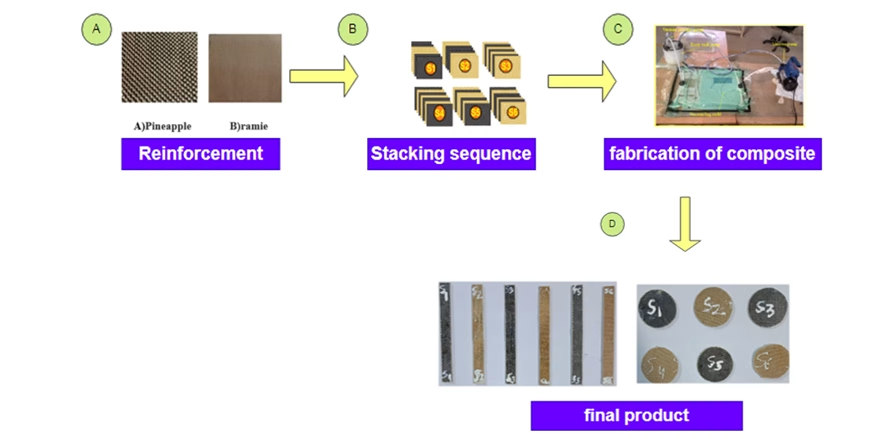
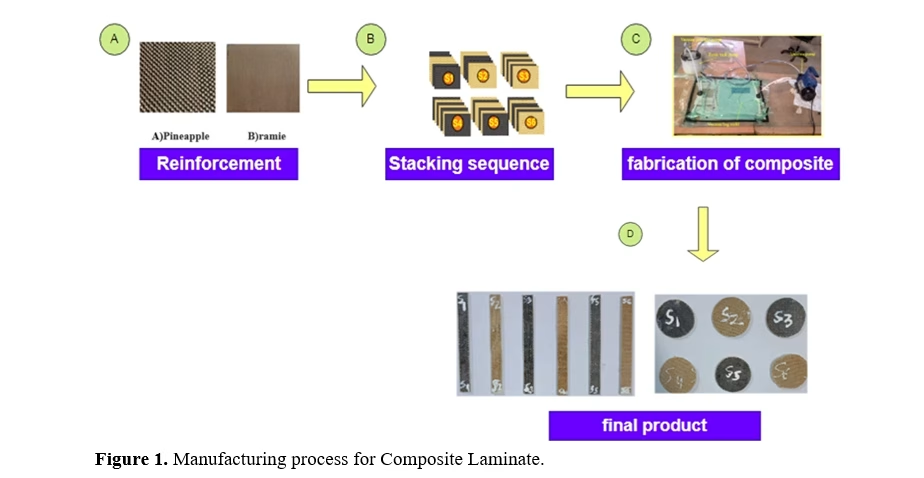
The increasing demand for sustainable and environmentally responsible materials has driven the exploration of natural fiber-reinforced polymer composites as potential alternatives to conventional synthetic materials. Among various natural fibers, pineapple leaf fiber (PALF) and ramie fiber are notable for their complementary characteristics—PALF offers excellent insulating behavior and lightweight structure, while ramie provides high thermal stability and strength. In the field of Eco-friendly composite product manufacturing, the processing temperature holds significant relevance in influencing overall performance. Therefore, the relevant aspects of the thermal properties of composites must be considered, and accurate thermal measurements using composite test methods are necessary. In this study investigates the thermal properties of six composite specimens with different stacking sequences. The specimens were evaluated based on thermal conductivity (CT), heat deflection temperature (HDT), and coefficient of thermal expansion (CTE). Results indicate that stacking sequences PRRPRRP exhibits the highest thermal conductivity (0.345 W/mK), while RPRPRPR has the lowest (0.205 W/mK). The highest HDT (250°C) was observed in stacking sequences PPRRRPP and RPRPRPR, suggesting superior thermal stability. Conversely, stacking sequences RPPRPPR demonstrated the lowest HDT (87.8°C). The coefficient of thermal expansion varied significantly, with stacking sequences RPPRPPR having the lowest CTE (1×10⁻⁶ /°C), indicating minimal dimensional changes under thermal stress, while RPRPRPR showed the highest CTE (2×10⁻⁵ /°C). Overall, the study emphasizes that static stacking sequence plays a crucial role in determining the thermal characteristics of natural fiber composites. These findings highlight the influence of stacking sequence on thermal behavior, providing insights for optimizing composite materials in high-temperature applications, particularly eco-friendly composites for use in construction, automotive, and thermal barrier systems.
Keywords: ramie fiber; Pineapple fiber; ply; thermal expansion; heat, epoxy.
[This article belongs to Special Issue under section in Journal of Polymer & Composites (jopc)]
References
- Behzad, T., & Sain, M. (2007). Measurement and prediction of thermal conductivity for hemp fiber reinforced composites. Polymer Engineering & Science, 47(7), 977–983. https://doi.org/10.1002/pen.20632
- Barouni, A., Lupton, C., Jiang, C., Saifullah, A., Giasin, K., Zhang, Z., & Dhakal, H. N. (2022). Investigation into the fatigue properties of flax fibre epoxy composites and hybrid composites based on flax and glass fibres. Composite Structures, 281(115046), 115046. https://doi.org/10.1016/j.compstruct.2021.115046
- da Silva, T. T., Silveira, P. H. P. M. da, Figueiredo, A. B.-H. da S., Monteiro, S. N., Ribeiro, M. P., Neuba, L. de M., Simonassi, N. T., Garcia Filho, F. da C., & Nascimento, L. F. C. (2022). Dynamic mechanical analysis and ballistic performance of Kenaf fiber-reinforced epoxy composites. Polymers, 14(17), 3629. https://doi.org/10.3390/polym14173629
- Hamidon, M. H., Sultan, M. T. H., Ariffin, A. H., & Shah, A. U. M. (2019). Effects of fibre treatment on mechanical properties of kenaf fibre reinforced composites: a review. Journal of Materials Research and Technology, 8(3), 3327–3337. https://doi.org/10.1016/j.jmrt.2019.04.012
- Deng, E.-F., Zhang, Z., Zhang, C.-X., Tang, Y., Wang, W., Du, Z.-J., & Gao, J.-P. (2023). Experimental study on flexural behavior of UHPC wet joint in prefabricated multi-girder bridge. Engineering Structures, 275(115314), 115314. https://doi.org/10.1016/j.engstruct.2022.115314
- Fiore, V., Scalici, T., Di Bella, G., & Valenza, A. (2015). A review on basalt fibre and its composites. Composites. Part B, Engineering, 74, 74–94. https://doi.org/10.1016/j.compositesb.2014.12.034
- Goda, K., Sreekala, M. S., Gomes, A., Kaji, T., & Ohgi, J. (2006). Improvement of plant based natural fibers for toughening green composites—Effect of load application during mercerization of ramie fibers. Composites. Part A, Applied Science and Manufacturing, 37(12), 2213–2220. https://doi.org/10.1016/j.compositesa.2005.12.014
- Gopinath, R., Poopathi, R., & Saravanakumar, S. S. (2019). Characterization and structural performance of hybrid fiber-reinforced composite deck panels. Advanced Composites and Hybrid Materials, 2(1), 115–124. https://doi.org/10.1007/s42114-019-00076-w
- Hamad, S. F., Stehling, N., Holland, C., Foreman, J. P., & Rodenburg, C. (200 C.E.). Low-Voltage SEM of Natural Plant Fibres: Microstructure Properties (Surface and Cross-Section) and Their Link to the Tensile Properties. Procedia Eng, 295–302.
- Kalita, K., Mallick, P. K., Bhoi, A. K., & Ghadai, K. R. (2018). Optimizing drilling induced delamination in GFRP composites using genetic Algorithm& particle swarm optimisation. Advanced Composites Letters, 27(1), 096369351802700. https://doi.org/10.1177/096369351802700101
- Karthik Babu, N. B., Muthukumaran, S., Arokiasamy, S., & Ramesh, T. (2020). Thermal and mechanical behavior of the coir powder filled polyester micro-composites. Journal of Natural Fibers, 17(7), 1058–1068. https://doi.org/10.1080/15440478.2018.1555503
- Mittal, G., Rhee, K. Y., Mišković-Stanković, V., & Hui, D. (2018). Reinforcements in multi-scale polymer composites: Processing, properties, and applications. Composites. Part B, Engineering, 138, 122–139. https://doi.org/10.1016/j.compositesb.2017.11.028
- Nagamadhu, M., Jeyaraj, P., & Mohan Kumar, G. C. (2020). Influence of textile properties on dynamic mechanical behavior of epoxy composite reinforced with woven sisal fabrics. Sadhana, 45(1). https://doi.org/10.1007/s12046-019-1249-z
- Petrucci, R., Santulli, C., Puglia, D., Sarasini, F., Torre, L., & Kenny, J. M. (2013). Mechanical characterisation of hybrid composite laminates based on basalt fibres in combination with flax, hemp and glass fibres manufactured by vacuum infusion. Materials in Engineering, 49, 728–735. https://doi.org/10.1016/j.matdes.2013.02.014
- Rahman, M. T., Asadul Hoque, M., Rahman, G. T., Gafur, M. A., Khan, R. A., & Hossain, M. K. (2019). Study on the mechanical, electrical and optical properties of metal-oxide nanoparticles dispersed unsaturated polyester resin nanocomposites. Results in Physics, 13(102264), 102264. https://doi.org/10.1016/j.rinp.2019.102264
- Ramesh, V., & Anand, P. (2021a). Evaluation of mechanical properties on Kevlar/Basalt fiber reinforced hybrid composites. Materials Today: Proceedings, 39, 1494–1496. https://doi.org/10.1016/j.matpr.2020.05.406
- Ramesh, V., & Anand, P. (2021b). Thermal analysis of Kevlar/basalt reinforced hybrid polymer composite. Materials Research Express, 8(11), 115302. https://doi.org/10.1088/2053-1591/ac3aa6
- Ramesh, Velumayil, Karthik, K., Cep, R., & Elangovan, M. (2023). Influence of stacking sequence on mechanical properties of basalt/ramie biodegradable hybrid polymer composites. Polymers, 15(4). https://doi.org/10.3390/polym15040985
- Rajesh, D., Lenin, N., Cep, R., Anand, P., & Elangovan, M. (2022). Experimental investigation of bi-directional flax with ramie fibre-reinforced phenol-formaldehyde hybrid composites. Polymers, 14(22), 4887. https://doi.org/10.3390/polym14224887
- Sayyidmousavi, A., Bougherara, H., Falahatgar, S. R., & Fawaz, Z. (2019). Prediction of the effective thermal conductivity of fiber reinforced composites using a micromechanical approach. Journal of Mechanics, 35(02), 179–185. https://doi.org/10.1017/jmech.2017.88
- Vieille, B., Chabchoub, M., Bouscarrat, D., & Gautrelet, C. (2017). A fracture mechanics approach using Acoustic Emission Technique to investigate damage evolution in woven-ply thermoplastic structures at temperatures higher than glass transition temperature. Composites. Part B, Engineering, 116, 340–351. https://doi.org/10.1016/j.compositesb.2016.10.074
- Yaacoubi, S., Dahmene, F., Bouzenad, A., El Mountassir, M., & Aouini, M. (2018). Modal acoustic emission for composite structures health monitoring: Issues to save computing time and algorithmic implementation. Composite Structures, 183, 338–346. https://doi.org/10.1016/j.compstruct.2017.03.081
- Narayana, V. L., & Rao, L. B. (2023). Influence of alkali treatment and stacking sequence on mechanical, physical, and thermal characteristics of hemp and Palmyra-reinforced hybrid composites. Journal of Natural Fibers, 20(2). https://doi.org/10.1080/15440478.2023.2213908
- Karthik, A., Bhuvaneshwaran, M., Senthil Kumar, M. S., Palanisamy, S., Palaniappan, M., & Ayrilmis, N. (2024). A review on surface modification of plant fibers for enhancing properties of biocomposites. ChemistrySelect, 9(21), e202400650. https://doi.org/10.1002/slct.202400650
- Palaniappan, M., Palanisamy, S., Khan, R., H. Alrasheedi, N., Tadepalli, S., Murugesan, T. M., & Santulli, C. (2024). Synthesis and suitability characterization of microcrystalline cellulose from Citrus x sinensis sweet orange peel fruit waste-based biomass for polymer composite applications. Journal of Polymer Research, 31(4), 105. https://doi.org/10.1007/s10965-024-03946-0
- Palanisamy, S., Mayandi, K., Palaniappan, M., Alavudeen, A., Rajini, N., de Camargo, F. V., & Santulli, C. (2021). Mechanical properties of phormium tenax reinforced natural rubber composites” Fibers 9, 11. https://doi.org/10.3390/fib9020011
- Palanisamy, S., Kalimuthu, M., Santulli, C., Palaniappan, M., Nagarajan, R., & Fragassa, C. (2023). Tailoring epoxy composites with Acacia caesia bark fibers: Evaluating the effects of fiber amount and length on material characteristics. Fibers, 11(7), 63. https://doi.org/10.3390/fib11070063
- Sumesh, K. R., Palanisamy, S., Khan, T., Ajithram, A., & Ahmed, O. S. (2024). Mechanical, morphological and wear resistance of natural fiber/glass fiber-based polymer composites. BioResources, 19(2), 3271-3289. https://orcid.org/0000-0003-1926-4949
- Neves, P. P., Costa, U. O., Bezerra, W. B. A., Figueiredo, A. B.-H. da S., Monteiro, S. N., & Nascimento, L. F. C. (2022). Dynamic and ballistic performance of uni- and bidirectional pineapple leaf fibers (PALF)-reinforced epoxy composites functionalized with graphene oxide. Polymers, 14(16), 3249. https://doi.org/10.3390/polym14163249
- Nikmatin, S., Syafiuddin, A., Hong Kueh, A. B., & Maddu, A. (2017). Physical, thermal, and mechanical properties of polypropylene composites filled with rattan nanoparticles. Journal of Applied Research and Technology, 15(4), 386–395. https://doi.org/10.1016/j.jart.2017.03.008
- Pereira, A. L., Banea, M. D., Neto, J. S. S., & Cavalcanti, D. K. K. (2020). Mechanical and thermal characterization of natural intralaminar hybrid composites based on sisal. Polymers, 12(4), 866. https://doi.org/10.3390/polym12040866

Journal of Polymer & Composites
| Volume | 13 | |
| Special Issue | 05 | |
| Received | 22/03/2025 | |
| Accepted | 09/05/2025 | |
| Published | 28/07/2025 | |
| Publication Time | 128 Days |