
Balaji A.N.,
Karthikeyan M.K.V.,
Pradeep R.,
Kumaresan A.,
Mothilal A.,
- Professor, Department of Mechanical Engineering, SRM Madurai College for Engineering and Technology, Tamil Nadu, India
- Professor, Department of Mechanical Engineering, Vaigai College of Engineering, Tamil Nadu, India
- Assistant Professor, Department of Mechanical Engineering, Sethu Institute of Technology, Tamil Nadu, India
- Assistant Professor, Department of Chemistry, SRM Madurai College for Engineering and Technology, Tamil Nadu, India
- Professor, Department of Mechanical Engineering, Velammal College of Engineering and Technology, Tamil Nadu, India
Abstract
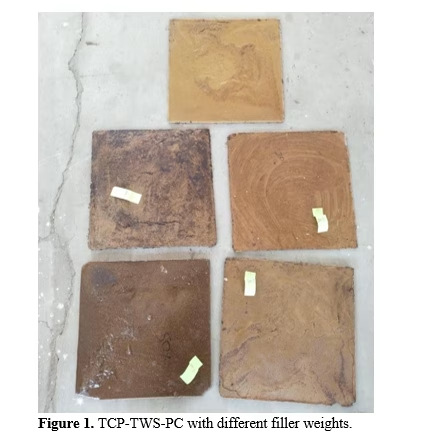
This study examines the mechanical characteristics of polymer hybrid composites augmented with sawdust from teak wood and Terminalia chebula (Kadukkai). To examine their effects on mechanical performance, the composites were made with different percentages of biofiller (10%, 20%, 30%, 40%, and 50%) while keeping the proportions of the two reinforcements same. Tensile, flexural, and impact tests were performed to assess their strength properties. The findings showed that flexural strength varied between 16.11 MPa and 82.78 MPa, while tensile strength values ranged from 6.42 MPa to 28.5 MPa. Furthermore, the range of impact strength was 4.3 KJ/m² to 18.4 KJ/m². The composites with 40% filler content showed the best mechanical performance among the various filler compositions, indicating the ideal concentration of reinforcement. The study highlights the potential of sawdust from teak and kadukkai powder as effective bio fillers in polymer composites. These organic reinforcements preserve the material’s lightweight qualities while greatly enhancing its strength features. According to the results, these hybrid composites can be used as ecologically friendly substitutes for traditional synthetic materials in a range of industrial and building applications. This study advances the creation of green composites that support environmental sustainability objectives by employing renewable resources. These composites’ encouraging mechanical qualities demonstrate their potential for usage in furniture, automotive applications, and lightweight structural components, hence lowering reliance on non-biodegradable materials. The study’s overall findings highlight the viability of adding natural fillers to polymer matrices to produce long-lasting and eco-friendly composite materials.
Keywords: Terminalia chebula, Teak Wood Sawdust, Hybrid Composites, Mechanical Properties, bio fillers.
[This article belongs to Special Issue under section in Journal of Polymer & Composites (jopc)]
References
- Mohammed L, Ansari MN, Pua G, et al. A review on natural fiber reinforced polymer composite and its applications. International Journal of Polymer Science. 2015;2015(1):243947.
- Jariwala H, Jain P. A review on mechanical behavior of natural fiber reinforced polymer composites and its applications. Journal of Reinforced Plastics and Composites. 2019;38(10):441-53.
- Kamarudin SH, Mohd Basri MS, Rayung M, et al. A review on natural fiber reinforced polymer composites (NFRPC) for sustainable industrial applications. Polymers. 2022;14(17):3698.
- Singh MK, Tewari R, Zafar S, et al. A comprehensive review of various factors for application feasibility of natural fiber-reinforced polymer composites. Results in Materials. 2023;17:100355.
- Periyasamy R, Hemanth Kumar M, Rangappa SM, et al. A comprehensive review on natural fillers reinforced polymer composites using fused deposition modeling. Polymer Composites. 2023;44(7):3715-47.
- Kuan HTN, Tan MY, Shen Y, et al. Mechanical properties of particulate organic natural filler-reinforced polymer composite: A review. Composites and Advanced Materials. 2021;30:26349833211007502.
- Zaghloul MYM, Zaghloul MMY, Zaghloul MMY. Developments in polyester composite materials–An in-depth review on natural fibres and nano fillers. Composite Structures. 2021;278:114698.
- Theja KK, Bharathiraja G, Murugan VS, et al. Evaluation of mechanical properties of tea dust filler reinforced polymer composite. Materials Today: Proceedings. 2023;80:3208-11.
- Murugapoopathi S, Ashwin Prabhu G, Chandrasekar G, et al. Fabrication and Characterisation of Saw Dust Polymer Composite. Journal of the Institution of Engineers (India): Series D. 2023;1-6.
- Ayswarya EP, Francis KV, Renju VS, et al. Rice husk ash–A valuable reinforcement for high-density polyethylene. Materials & Design. 2012;41:1-7.
- Li HY, Tan YQ, Zhang L, et al. Bio-filler from waste shellfish shell: preparation, characterization, and its effect on the mechanical properties on polypropylene composites. Journal of Hazardous Materials. 2012;217:256-62.
- Prabhakar MN, Shah AUR, Rao KC, et al. Mechanical and thermal properties of epoxy composites reinforced with waste peanut shell powder as a bio-filler. Fibers and Polymers. 2015;16:1119-24.
- Khuntia T, Biswas S. Characterization of a novel natural filler from sirisha bark. Journal of Natural Fibers. 2022;19(8):3083-92.
- Karunakaran K, Pugazhenthi R, Anbuchezhiyan G, et al. Experimental investigations on synthesis and characterization of tamarind seed powder reinforced bio-composites. Materials Today: Proceedings. 2022;64:760-4.
- Abd-El Salam MH. Mechanical properties of bamboo powder reinforced ethylene propylene diene monomer (EPDM) composites: Effect of filler loading and particle size. Journal of Advances in Physics. 2014;6(2):1122-34.
- Le Digabel F, Boquillon N, Dole P, et al. Properties of thermoplastic composites based on wheat-straw lignocellulosic fillers. Journal of Applied Polymer Science. 2004;93(1):428-36.
- Dattu VSC, Lokesh M, Kumar A, et al. Mechanical characterization of polymer composite reinforced with bio-fillers. Materials Today: Proceedings. 2022;69:695-9.
- Kiran MD, Govindaraju HK, Jayaraju T, et al. Effect of fillers on mechanical properties of polymer matrix composites. Materials Today: Proceedings. 2018;5(10):22421-4.
- Zaaba NF, Ismail H. A review on peanut shell powder reinforced polymer composites. Polymer-Plastics Technology and Materials. 2019;58(4):349-65.
- Ojha S, Raghavendra G, Acharya SK. A comparative investigation of bio waste filler (wood apple‐coconut) reinforced polymer composites. Polymer Composites. 2014;35(1):180-5.
- Abhishek S, Sanjay MR, George R, et al. Development of new hybrid Phoenix pusilla/carbon/fish bone filler reinforced polymer composites. Journal of the Chinese Advanced Materials Society. 2018;6(4):553-60.
- Rajan STK, Nagarajan KJ, Balasubramani V, et al. Investigation of mechanical and thermo-mechanical characteristics of silane-treated cellulose nanofibers from agricultural waste reinforced epoxy adhesive composites. International Journal of Adhesion and Adhesives. 2023;126:103492.
- Nagarajan KJ, Balaji AN, Rajan STK, et al. Effect of sulfuric acid reaction time on the properties and behavior of cellulose nanocrystals from Cocos nucifera var-Aurantiaca peduncle’s cellulose microfibers. Materials Research Express. 2019;6(12):125333.
- Vignesh V, Balaji AN, Rabi BRM, et al. Cellulosic fiber based hybrid composites: A comparative investigation into their structurally influencing mechanical properties. Construction and Building Materials. 2021;271:121587.
- Stalin B, Nagaprasad N, Vignesh V, et al. Evaluation of mechanical and thermal properties of tamarind seed filler reinforced vinyl ester composites. Journal of Vinyl and Additive Technology. 2019;25(s2):E114-E28.

Journal of Polymer & Composites
| Volume | 13 | |
| Special Issue | 05 | |
| Received | 18/02/2025 | |
| Accepted | 10/05/2025 | |
| Published | 04/08/2025 | |
| Publication Time | 167 Days |