
Trupti P. Durgawale,
Veerendra C Yeligar,
- Assistant Professor, Department of Pharmaceutical Chemistry, Krishna Institute of Pharmacy, Krishna Vishwa Vidyapeeth (Deemed to be University), Karad, Maharashtra, India
- Professor, Department of Pharmaceutical Chemistry, Krishna Institute of Pharmacy, Krishna Vishwa Vidyapeeth (Deemed to be University), Karad, Maharashtra, India
Abstract
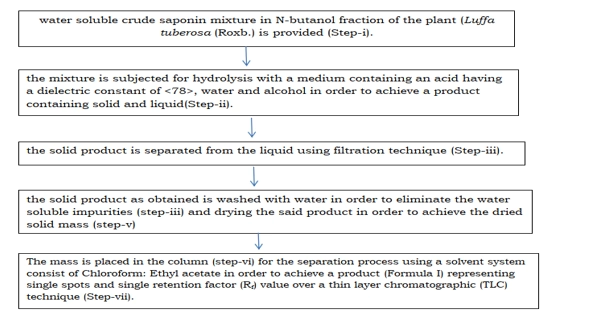
This study explores the isolation process of glucuronide compounds from Luffa tuberosa (Roxb.) using an efficient and cost-effective method. The extracted compound, Gypsogenin-3β-O-β-D-Methyl glucuronide, is characterized using spectroscopic techniques such as IR, NMR, and Mass Spectrometry. The polymeric nature of glucuronide-based compounds and their potential applications in polymer and composite materials are discussed. The findings highlight the suitability of glucuronide derivatives in biomedical, pharmaceutical, and polymeric drug delivery systems. Additionally, the study examines the structural integrity of the isolated compound, confirming its potential as a bioactive polymer precursor.The study further investigates the biocompatibility and stability of the extracted glucuronide compound under physiological conditions, making it a viable candidate for biomedical applications. The chemical stability of Gypsogenin-3β-O-β-D-Methyl glucuronide enables its incorporation into polymeric matrices, enhancing mechanical strength and biodegradability. Furthermore, this research delves into the feasibility of using the isolated compound in composite formulations, where it exhibits promising compatibility with natural and synthetic polymers. The findings underscore its potential in drug delivery systems, where controlled release mechanisms are critical for therapeutic efficacy. With its hydrophilic nature, glucuronide-based materials can enhance bioavailability and targeted delivery, making them suitable for next-generation polymer composites. Overall, the study highlights the significance of glucuronide derivatives in advancing polymer science, particularly in the development of biocompatible and sustainable materials. Future research should explore its integration with nanomaterials and its role in multifunctional polymer composites, paving the way for innovative applications in healthcare and industrial sectors.
Keywords: Glucuronide, Polymer Chemistry, Biopolymer, Spectroscopy, Biodegradable Composites.
[This article belongs to Special Issue under section in Journal of Polymer & Composites (jopc)]
References
- Li C, Luo Z, Feng H, Li Z. Polymers Facilitating Therapeutic Efficacy and Applications for Traditional Chinese Medicine. Journal of Polymer Science. 2024.
- Maji B, Maiti S. Chemical modification of xanthan gum through graft copolymerization: Tailored properties and potential applications in drug delivery and wastewater treatment. Carbohydrate Polymers. 2021 Jan 1;251:117095.
- Shivarajaiah NK, Nair SP, Rathi CS, Solanki V, Koneri R. Evaluation of Momordica cymbalaria Fenzl (MC) In Healing Burn Wounds. International Journal of Pharmaceutical Investigation. 2023 Oct 1;13(4).
- Gathungu RM, Kautz R, Kristal BS, Bird SS, Vouros P. The integration of LC‐MS and NMR for the analysis of low molecular weight trace analytes in complex matrices. Mass spectrometry reviews. 2020 Mar;39(1-2):35–54.
- Osunde OM, Atere CT, Adesanwo OO, Taiwo LB, Olayinka A. FTIR Characterization of Bioactive Functional Groups Present in Crude Extract of Mycoherbicides Produced from Consortium Culture of Rhizosphere Fungal Isolates. Communications in Soil Science and Plant Analysis. 2024 Oct 27;55(19):2858–67.
- Tan XF, Zhu SS, Wang RP, Chen YD, Show PL, Zhang FF, Ho SH. Role of biochar surface characteristics in the adsorption of aromatic compounds: Pore structure and functional groups. Chinese Chemical Letters. 2021 Oct 1;32(10):2939–46.
- Dieckmann S, Maurer S, Kleigrewe K, Klingenspor M. Spatial recruitment of cardiolipins in inguinal white adipose tissue after cold stimulation is independent of UCP1. European Journal of Lipid Science and Technology. 2022 Mar;124(3):2100090.
- Wang K, Wang R, Shan W, Yang Z, Chen Y, Wang L, Zhang Y. Unravel the in-Source Fragmentation Patterns of Per-and Polyfluoroalkyl Substances during Analysis by LC-ESI-HRMS. Environmental Science & Technology. 2024 Dec 13;58(51):22766–76.
- Kamel EM, Alkhayl FF, Alqhtani HA, Bin-Jumah M, Rudayni HA, Lamsabhi AM. Dissecting molecular mechanisms underlying the inhibition of β-glucuronidase by alkaloids from Hibiscus trionum: Integrating in vitro and in silico perspectives. Computers in biology and medicine. 2024 Sep 1;180:108969.
- Perez S, Makshakova O, Angulo J, Bedini E, Bisio A, de Paz JL, Fadda E, Guerrini M, Hricovini M, Hricovini M, Lisacek F. Glycosaminoglycans: what remains to be deciphered?. Jacs Au. 2023 Mar 2;3(3):628–56.
- Speciale I, Notaro A, Garcia-Vello P, Di Lorenzo F, Armiento S, Molinaro A, Marchetti R, Silipo A, De Castro C. Liquid-state NMR spectroscopy for complex carbohydrate structural analysis: A hitchhiker’s guide. Carbohydrate Polymers. 2022 Feb 1;277:118885.
- Sonia K, Lakshmi KS. HPTLC method development and validation: An overview. Journal of Pharmaceutical Sciences and Research. 2017 May 1;9(5):652.
- Arnuar AZ, Nordin N, Tajuddin HA, Abdullah Z. Current Methods for Peroxide Detection in Food and the Emerging Role of Heteroaromatic Dyes as an Efficient Alternative. Journal of Food Composition and Analysis. 2024 Mar 22:106191.
- Flores A, Cañamares D, Ticona LA, Pablos JL, Peña J, Hernáiz MJ. Highly efficient functionalization of hydroxypropyl cellulose with glucuronic acid through click chemistry under microwave irradiation as potential biomaterial with therapeutic properties. Catalysis Today. 2024 Mar 1;429:114495.
- West AR. Solid state chemistry and its applications. John Wiley & Sons; 2022 Apr 6.
- Ali Z, Yaqoob S, Yu J, D’Amore A. Critical review on the characterization, preparation, and enhanced mechanical, thermal, and electrical properties of carbon nanotubes and their hybrid filler polymer composites for various applications. Composites Part C: Open Access. 2024 Jan 6:100434.
- Aishwarya Digvijay Mohite, G.R. Pathade. Polymer Use in Soilless Farming Systems with A Comparative Study on Hydroponics and Aquaponics. Journal of Polymer and Composites. 2024; 13(01):868–874.
- Yan Y, Liu Z, Wan T, Li W, Qiu Z, Chi C, Huangfu C, Wang G, Qi B, Yan Y, Wei T. Bioinspired design of Na-ion conduction channels in covalent organic frameworks for quasi-solid-state sodium batteries. Nature Communications. 2023 May 27;14(1):3066.
- Kubicki DJ, Stranks SD, Grey CP, Emsley L. NMR spectroscopy probes microstructure, dynamics and doping of metal halide perovskites. Nature Reviews Chemistry. 2021 Sep;5(9):624–45.
- Shivani S. kadam, Randhir B. Lad, Shilpa S. Ruikar, Girish R. Pathade. Evaluation of Bio-Based Polymer Composites Containing Guava Leaf Extract for Antimicrobial Functionality. Journal of Polymer and Composites. 2024; 13(01):875–880.
- Chis AA, Dobrea CM, Arseniu AM, Frum A, Rus LL, Cormos G, Georgescu C, Morgovan C, Butuca A, Gligor FG, Vonica-Tincu AL. Antibody–Drug Conjugates—Evolution and Perspectives. International Journal of Molecular Sciences. 2024 Jun 26;25(13):6969.
- Singh M, Manik G. Bio-Based Adhesives from Plant Oils. In Encyclopedia of Green Materials 2024 Dec 27 (pp. 123–134). Singapore: Springer Nature Singapore.
- Palaniappan M, Palanisamy S, Khan R, H. Alrasheedi N, Tadepalli S, Murugesan TM, Santulli C. Synthesis and suitability characterization of microcrystalline cellulose from Citrus x sinensis sweet orange peel fruit waste-based biomass for polymer composite applications. Journal of Polymer Research. 2024 Apr;31(4):105.
- Palanisamy S, Mayandi K, Palaniappan M, Alavudeen A, Rajini N, Vannucchi de Camargo F, Santulli C. Mechanical properties of phormium tenax reinforced natural rubber composites. Fibers. 2021 Feb 1;9(2):11.
- Karuppiah G, Kuttalam KC, Palaniappan M, Santulli C, Palanisamy S. Multiobjective optimization of fabrication parameters of jute fiber/polyester composites with egg shell powder and nanoclay filler. Molecules. 2020 Nov 27;25(23):5579.

Journal of Polymer & Composites
| Volume | 13 | |
| Special Issue | 06 | |
| Received | 12/03/2025 | |
| Accepted | 09/05/2025 | |
| Published | 04/09/2025 | |
| Publication Time | 176 Days |