
B. Rajmohan,
T.S. Krishna Kumar,
Nagasrisaihari Sunkara,
Ajay Kumar Kaviti,
L. Srinivasa Rao,
- Assistant Professor, Department of Mechanical Engineering, Prince Dr. K. Vasudevan College of Engineering and Technology, Chennai, Tamil Nadu,
- Assistant Professor, Department of Automobile Engineering, VNR Vignana Jyothi Institute of Engineering and Technology, Hyderabad, Telangana, India
- Assistant Professor, Department of Mechanical Engineering, VNR Vignana Jyothi Institute of Engineering and Technology, Hyderabad, Telangana, India
- Professor, Department of Mechanical Engineering, VNR Vignana Jyothi Institute of Engineering and Technology, Hyderabad, Telangana, India
- Senior Assistant Professor, Centre for Nanoscience and Technology, Department of Physics, VNR Vignana Jyothi Institute of Engineering and Technology, Hyderabad, Telangana, India
Abstract
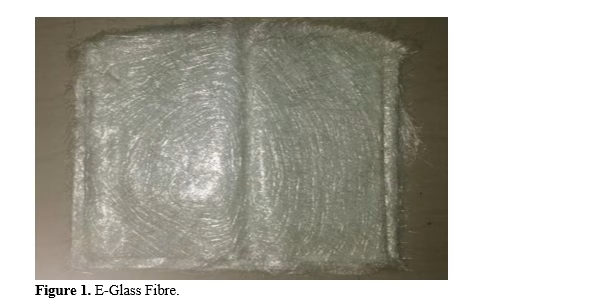
This paper centres on the autoclave moulding technique, offering a comprehensive analysis of the specimen fabrication process. The advanced composite manufacturing process involves the use of high temperatures and pressures during the curing step. This results in composite specimens that have a higher density and are devoid of any voids. Polyester, E-glass fibre, and SiC powder are the material components that make up the composite in this study. It is possible to construct composite specimens with nine different compositions by utilising the L9 orthogonal array, which is comprised of nine runs, four factors, and three levels. This array is utilized throughout the production process of the composite laminates. A total of nine distinct compositions were created by adjusting the parameters, which included the amount of time, the percentage of resin, fibre, and powder, and the amount of powder. Mechanical properties such as the specimens’ hardness, compression, and impact strength were tested as per the ASTM standard. To locate a superior specimen and determine whether the specimen is suitable for use in automotive applications, Grey Relational Analysis was utilized. The accomplishment was achieved through the optimization of the specimens that were placed throughout the entire testing process and the result was achieved.
Keywords: E-Glass fibre, polyester, SiC, Mechanical properties, Interior carpeting car door
[This article belongs to Special Issue under section in Journal of Polymer & Composites (jopc)]
References
- Hung PY, Lau K tak, Cheng L-K, et al. Impact response of hybrid carbon/glass fibre reinforced polymer composites designed for engineering applications. Compos Part B Eng. 2017 Sep 1;133.
- Khan F, Hossain N, Mim JJ, et al. Advances of composite materials in automobile applications – A review. J Eng Res. 2024;13(2):1001–23.
- Kim DH, Kim HG, Kim HS. Design optimization and manufacture of hybrid glass/carbon fiber reinforced composite bumper beam for automobile vehicle. Compos Struct. 2015;131:742–52.
- Bennbaia S, Mahdi E, Abdella G, et al. Composite Plastic Hybrid for Automotive Front Bumper Beam. J Compos Sci. 2023;7(4).
- Iorio Leandro, Quadrini Fabrizio, Gallo Nicola, et al. Out-of-autoclave molding of carbon fiber laminates by consolidation with shape memory polymer foams. J Compos Mater. 2023 Sep 19;57(26):4147–56.
- Fragassa C, Pavlovic A, Santulli C. Mechanical and impact characterisation of flax and basalt fibre vinylester composites and their hybrids. Compos Part B Eng. 2018;137:247–59.
- Ramasamy Anand Kumar, Selvaraj Sathish, Murugan Aravindh, Rathinasamy Senthil Kumar. Enhancement of mechanical properties of ramie and jute fibres reinforced epoxy hybrid composites: Influencing of SiC and Al2O3. Proc Inst Mech Eng Part C J Mech Eng Sci. 2023 Dec 28;238(11):5087–96.
- Braga RA, Magalhaes PAA. Analysis of the mechanical and thermal properties of jute and glass fiber as reinforcement epoxy hybrid composites. Mater Sci Eng C. 2015;56:269–73.
- Mahapatra Sourav Kumar, Satapathy Alok. Parametric study of drilling process in ramie-epoxy composites using grey relational approach and artificial neural networks. Proc Inst Mech Eng Part E J Process Mech Eng. 2025 Feb 5;09544089251316321.
- Kim YJ, Qian KZ. Compressive behavior of non-slender hollow GFRP structural shapes in thermomechanical loading. Compos Struct. 2017;160:813–23.
- Li MX, Mo HL, Lee SK, et al. Rapid Impregnating Resins for Fiber-Reinforced Composites Used in the Automobile Industry. Polymers (Basel). 2023;15(20).
- Melaibari A, Wagih A, Basha M, et al. Sandwich composite laminate with intraply hybrid woven CFRP/dyneema core for enhanced impact damage resistance and tolerance. J Mater Res Technol. 2022;21:1787–97.
- Wang JW, Haile CT, Kuo CFJ. Using The Taguchi Method and Grey Relational Analysis for Down Fabrics’ Heat Storage Modification and Process Optimization. Fibers Polym. 2025;26(2):909–31.
- Thekkeparambil Gopalaswamy U, Kavan P. Entropy-based Taguchi–Grey relational analysis for multi-output optimization of coating parameters in MoS2-coated sugar palm fiber and its characterization. J Ind Text. 2022;51(2_suppl):3347S-3371S.
- Almeshaal M, Palanisamy S, Murugesan TM, et al. Physico-chemical characterization of Grewia Monticola Sond (GMS) fibers for prospective application in biocomposites. J Nat Fibers. 2022 Dec 2;19(17):15276–90.
- Palaniappan M, Palanisamy S, Murugesan TM, et al. Novel Ficus retusa L. aerial root fiber: a sustainable alternative for synthetic fibres in polymer composites reinforcement. Biomass Convers Biorefinery. 2025;15(5):7585–601.

Journal of Polymer & Composites
| Volume | 13 | |
| Special Issue | 05 | |
| Received | 23/06/2025 | |
| Accepted | 19/07/2025 | |
| Published | 29/07/2025 | |
| Publication Time | 36 Days |