
Vikas,
B.S Walia,
Vanita Aggarwal,
- Ph.D Research Scholar, Department of Civil Engineering, Maharishi Markandeshwar (Deemed to be University), Mullana, Ambala, Haryana, India
- Professor, Department of Civil Engineering, Maharishi Markandeshwar (Deemed to be University), Mullana, Ambala, Haryana, India
- Professor, Department of Civil Engineering, Maharishi Markandeshwar (Deemed to be University), Mullana, Ambala, Haryana, India
Abstract
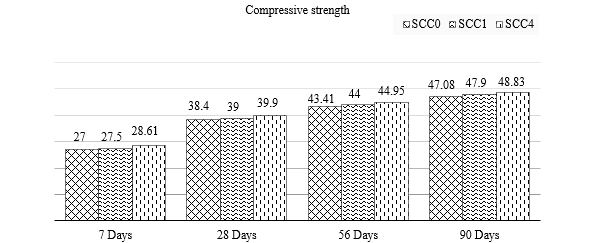
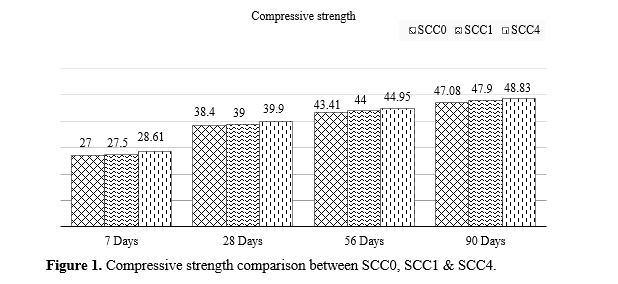
Building construction applications benefit from recent studies on alumino-silicate alkaline activation geo-polymers and their supplementary modifier alccofine as well as new process advancements characteristics including flexural strength and split tensile strength determine structural performance and durability. The construction sector utilizes supplementary cementitious materials, waste materials, and Geo Polymer Concrete (GPC) for concrete composites because it requires environmental sustainability along with better functionality and longer service life of concrete structures. This research explores the combined effect of using 16% alccofine cement replacement alongside porcelain waste aggregate as a substitute for coarse and fine aggregates at various percentages between 1% to 5% in self-compacting concrete composite(SCC). The research analyzes how varying percentages of PWA (1% to 5%) together with 16% Alccofine affect the tensile strength in split and flexural testing of SCC. The investigation determine the PWA replacement ratio which maximizes the mechanical qualities and durability of SCC to enable sustainable and long-lasting structures. Researchers created concrete composite mixes through the combination of 16% Alccofine cement substitutions with PWA that replaced coarse and fine aggregates at five different percentages between 1% and 5%. The mechanical properties strength and tensile strength were assessed by following recognized testing procedures. The researchers tested specimens through four stages of curing which lasted for 7, 28, 56 and 90 days comparing control samples with no alccofine or PWA. The combination of 16% Alccofine with 3% PWA produced the best outcomes in Geo Polymer Concrete (GPC) by strengthening both flexural and split tensile strength measurements. The composite material reached outstanding mechanical achievements and structural resilience benefits through adding 3% PWA yet replacements below this amount demonstrated minimal effect.
Keywords: Alccofine (AL), porcelain waste aggregate (PWA), self-compacting concrete composites (SCC), geo polymer concrete (GPC).
[This article belongs to Special Issue under section in Journal of Polymer & Composites (jopc)]
References
- Patel, Y., & Shah, B. K. (2013). Study on durability of high performance concrete with Alccofine and fly ash. International Journal for Scientific Research & Development (IJSRD), 1, 1998.
- http://www.wagner.com.au/main/what-we-do/earth-friendly-concrete/efc-home.
- Upadhyay, S. P., &Jamnu, M. A. (n.d.). Effect on compressive strength of high performance concrete incorporating Alccofine and fly ash (Vol. 2, Issue 2).
- Soni, D., Kulkarni, S., & Parekh, V. (2013). Experimental study on high performance concrete with mixing of alccofine and flyash. International Journal of Engineering Research and Applications, 3(4), [page numbers if available]. ISSN 2250-1991.
- Okoye, J. Durgaprasad, N. Singh, Mechanical properties of alkali activated flyash/Kaolin based geopolymer concrete, Constr. Build. Mater. 98 (2015) 685– 691.
- Pawar, M. S., &Saoji, A. C. (2013). Effect of alccofine on self-compacting concrete. International Journal of Engineering Sciences (IJES), 2(6), 5–9. ISSN (e): 2319-1813, ISSN (p): 2319-1805.
- Saurav, & Gupta, A. K. (2014). Experimental study of strength relationship of concrete cube and concrete cylinder using ultrafine slag Alccofine. International Journal of Scientific & Engineering Research, 5(5), 102–107.
- Parmar, A., & Patel, D. M. (2013). Experimental study on high performance concrete by using alccofine and fly ash – hard concrete properties. International Journal of Engineering Research & Technology (IJERT), 2(12). Retrieved from https://www.ijert.org/research/experimental-study-on-high-performance-concrete-by-using-alccofine-and-fly-ash-hard-concrete-properties-IJERTV2IS121061.pdf
- Temuujin, A. van Riessen, K. MacKenzie, Preparation and characterisation of fly ash based geopolymer mortars, Constr. Build. Mater. 24 (10) (2010) 1906– 1910
- Kavitha, S., & Kala, T. F. (2016). Evaluation of strength behavior of self-compacting concrete using alccofine and GGBS as partial replacement of cement. Indian Journal of Science and Technology, 9(22), 1–5. https://doi.org/10.17485/ijst/2016/v9i22/95145
- Sharma, D., Sharma, S., &Goyal, A. (2016). Utilization of waste foundry slag and alccofine for developing high strength concrete. International Journal of Electrochemical Science, 11(1), 3190–3205. Retrieved from https://www.electrochemsci.org/papers/vol11/110403190.pdf
- Suthar, B. S., & Shah, B. K. (2013). Study on strength development of high strength concrete containing alccofine and fly-ash. Indian Journal of Research, 2(3), 102–104. Retrieved from https://www.worldwidejournals.com/indian-journal-of-research-(IJR)/fileview/March_2013_1362577680_30b6e_34.pdf
- Suthar, S., Shah, B. K., & Patel, P. J. (2013). Study on effect of alccofine & fly ash addition on the mechanical properties of high performance concrete. International Journal of Science and Research and Development (IJSRD), 1(3), 464–467. Retrieved from https://www.ijsrd.com/articles/IJSRDV1I3048.pdf
- Reddy, M. V. S., Ashalatha, K., &Surendra, K. (2016). Studies on eco-friendly concrete by partial replacement of cement with Alccofine and fine Fly Ash. ARPN Journal of Engineering and Applied Sciences, 11(5), 3445–3448.
- Sumesh, K. R., Palanisamy, S., Khan, T., Ajithram, A., & Ahmed, O. S. (2024). Mechanical, Morphological and Wear Resistance of Natural Fiber / Glass Fiber-based Polymer Composites. BioResources, 19(2), 3271–3289. Retrieved from https://ojs.bioresources.com/index.php/BRJ/article/view/23391
- Palanisamy, S., Kalimuthu, M., Palaniappan, M., Alavudeen, A., Rajini, N., Santulli, C., & Al-Lohedan, H. (2022). Characterization of acacia caesia bark fibers (ACBFs). Journal of Natural Fibers, 19(15), 10241-10252.
- Almeshaal, M., Palanisamy, S., Murugesan, T. M., Palaniappan, M., & Santulli, C. (2022). Physico-chemical characterization of Grewia Monticola Sond (GMS) fibers for prospective application in biocomposites. Journal of Natural Fibers, 19(17), 15276-15290.
- Palaniappan, M., Palanisamy, S., Murugesan, T. M., Alrasheedi, N. H., Ataya, S., Tadepalli, S., & Elfar, A. A. (2025). Novel Ficus retusa L. aerial root fiber: a sustainable alternative for synthetic fibres in polymer composites reinforcement. Biomass Conversion and Biorefinery, 15(5), 7585-7601.
- Palanisamy, S., Kalimuthu, M., Santulli, C., Palaniappan, M., Nagarajan, R., & Fragassa, C. (2023). Tailoring epoxy composites with Acacia caesia bark fibers: Evaluating the effects of fiber amount and length on material characteristics. Fibers, 11(7), 63.
- Palanisamy, S., Keerthiveetil Ramakrishnan, S., Santulli, C., Khan, T., & Ahmed, O. S. (2024). Mechanical and wear performance evaluation of natural fiber/epoxy matrix composites. BioResources, 19(4), 845.
- Palanisamy, S., Kalimuthu, M., Azeez, A., Palaniappan, M., Dharmalingam, S., Nagarajan, R., & Santulli, C. (2022). Wear properties and post-moisture absorption mechanical behavior of kenaf/banana-fiber-reinforced epoxy composites. Fibers, 10(4), 32.
- Gayathri, K., Ravichandran, K., &Saravanan, J. (2016). Durability and cementing efficiency of Alccofine in concretes. International Journal of Engineering Research and Technology, 5(5), 460–467.
- Suthar, S. B., & Shah, B. K. (2013). Study on strength development of high strength concrete containing Alccofine and Fly Ash. Indian Journal of Research, 2(3), 102–104.
- Suthar, S., Shah, B. K., & Patel, P. J. (2013). Study on effect of Alccofine & Fly Ash addition on the mechanical properties of high performance concrete. International Journal for Scientific Research & Development, 1(3), 464–467.
- Saurav, & Gupta, A. K. (2014). Experimental study of strength relationship of concrete cube and concrete cylinder using ultrafine slag Alccofine. International Journal of Scientific and Engineering Research, 5(5), 102.
- Gharibi, H., &Mostofinejad, D. (2022). Thermal and mechanical properties of concrete containing porcelain ceramic tile waste as fine and coarse aggregates. Magazine of Concrete Research, 75(3), 113–123. https://doi.org/10.1680/jmacr.22.00076
- Wang, H., & Meyer, C. (2019). Recycling of ceramic waste as aggregate in concrete. Journal of Materials in Civil Engineering, 31(7), 04019102. https://doi.org/10.1061/(ASCE)MT.1943-5533.0002761
- Sathyan, D., &Anand, K. B. (2019). Influence of superplasticizer family on the durability characteristics of fly ash incorporated cement concrete. Construction and Building Materials, 204, 864–874. https://doi.org/10.1016/j.conbuildmat.2019.01.193

Journal of Polymer & Composites
| Volume | 13 | |
| Special Issue | 05 | |
| Received | 29/04/2025 | |
| Accepted | 11/06/2025 | |
| Published | 17/07/2025 | |
| Publication Time | 79 Days |