
er Shailesh Dabral,
Karan Babbar,
- M.Tech Scholar, Department of Civil Engineering, Quantum University, Roorkee, Uttarakhand, India
- Assistant Professor, Department of Civil Engineering, Quantum University, Roorkee, Uttarakhand, India
Abstract
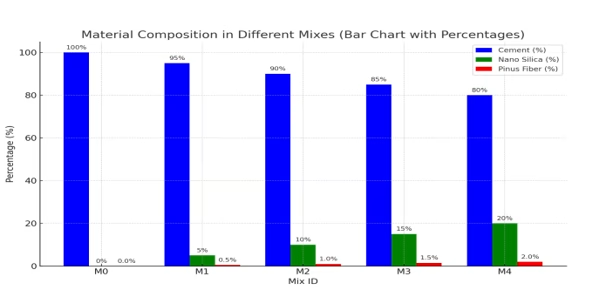
This study investigates the partial replacement of cement in M30 grade concrete paver blocks using nano silica and Pinus fiber, with a primary focus on mechanical performance, sustainability, and long-term durability and promoting sustainability. Portland cement, a major contributor to global CO₂ emissions, can be partially substituted using supplementary materials to create eco-efficient construction solutions. Nano silica, due to its high pozzolanic reactivity and ultrafine size, improves the microstructure and compressive strength of concrete. Pinus fiber—a lignocellulosic, biodegradable natural fiber derived from pine needles—functions as a micro-reinforcement that enhances ductility, tensile strength, and crack resistance. From a composite material perspective, the integration of fibers into cementitious matrices transforms the concrete into a fiber-reinforced composite. While polymer-based fiber composites have been widely studied, natural fiber reinforcement in concrete matrices presents a sustainable and cost-effective alternative. In this context, Pinus fiber interacts synergistically with nano silica, bridging microcracks and contributing to post-cracking toughness, while nano silica densifies the matrix and boosts hydration. The hybrid composite formed offers enhanced toughness, durability, and resistance to water absorption. The concrete mix was designed using IS 10262:2019 [1], with five variants incorporating nano silica (5–20%) and Pinus fiber (0.5–2%). Experimental results revealed that the optimum mix—comprising 10% nano silica and 1% Pinus fiber (Mix M2)—demonstrated a ~15.4% increase in compressive strength and ~18.75% reduction in water absorption compared to the control. These findings support the viability of developing fiber-reinforced, nano-modified concrete composites using sustainable materials, particularly for non-structural applications such as paving blocks.
Keywords: M30 concrete, nano silica, Pinus fiber, cement replacement, paver blocks, sustainable construction, mechanical properties, natural fibers, fiber-reinforced composites, polymer-cement composites, hybrid concrete composites, lignocellulosic fibers, green concrete
[This article belongs to Journal of Polymer & Composites ]

References
- Standard I. Guidelines for concrete mix design proportioning. Bureau of Indian Standard, New Delhi. 2009.
- BIS I. 516 Indian Standard methods of tests for strength of concrete. Bur Indian Stand New Delhi, India. 1959.
- Concrete masonry units – Specification. New Delhi: BIS; 2005.
- Singh LP, Karade SR, Bhattacharyya SK, Yousuf MM, Ahalawat S. Beneficial role of nanosilica in cement based materials–A review. Construction and building materials. 2013 Oct 1;47:1069-77.
- Savastano Jr H, Warden PG, Coutts RS. Mechanically pulped sisal as reinforcement in cementitious matrices. Cement and Concrete Composites. 2003 Apr 1;25(3):311-9.
- Li H, Zhang MH, Ou JP. Abrasion resistance of concrete containing nano-particles for pavement. Wear. 2006 Jun 30;260(11-12):1262-6.
- Jawaid MH, Khalil HA. Cellulosic/synthetic fibre reinforced polymer hybrid composites: A review. Carbohydrate polymers. 2011 Aug 1;86(1):1-8.
- Jalal M, Pouladkhan A, Harandi OF, Jafari D. RETRACTED: Comparative study on effects of Class F fly ash, nano silica and silica fume on properties of high performance self compacting concrete.
- Onuaguluchi O, Banthia N. Plant-based natural fibre reinforced cement composites: A review. Cement and Concrete Composites. 2016 Apr 1;68:96-108.
- Afroughsabet V, Biolzi L, Ozbakkaloglu T. High-performance fiber-reinforced concrete: a review. Journal of materials science. 2016 Jul;51(14):6517-51.
- Zhang MH, Islam J. Use of nano-silica to reduce setting time and increase early strength of concretes with high volumes of fly ash or slag. Construction and Building Materials. 2012 Apr 1;29:573-80.
- Bentur A, Mindess S. Fibre reinforced cementitious composites. CRC press; 2006 Nov 16.
- Li H, Xiao HG, Yuan J, Ou J. Microstructure of cement mortar with nano-particles. Composites part B: engineering. 2004 Mar 1;35(2):185-9.
- Siddique R, Klaus J. Influence of metakaolin on the properties of mortar and concrete: A review. Applied Clay Science. 2009 Mar 1;43(3-4):392-400.
- Aggarwal P, Singh RP, Aggarwal Y. Use of nano-silica in cement based materials—A review. Cogent Engineering. 2015 Dec 31;2(1):1078018.
- Thomas BS, Gupta RC. Long term behaviour of cement concrete containing discarded tire rubber. Journal of Cleaner Production. 2015 Sep 1;102:78-87.
- Siddique R, Mehta A. Effect of carbon nanotubes on properties of cement mortars. Construction and Building Materials. 2014 Jan 15;50:116-29.
- Nili M, Afroughsabet V. The effects of silica fume and polypropylene fibers on the impact resistance and mechanical properties of concrete. Construction and Building Materials. 2010 Jun 1;24(6):927-33.
- Khitab A. Effect of pine needle fibers on properties of cementitious mortars: Pine needles-reinforced mortars. Proceedings of the Pakistan Academy of Sciences: A. Physical and Computational Sciences. 2020;57(4):33-46.
- De Sensale GR. Effect of rice-husk ash on durability of cementitious materials. Cement and Concrete Composites. 2010 Oct 1;32(9):718-25.

Journal of Polymer & Composites
| Volume | 13 | |
| Issue | 06 | |
| Received | 18/06/2025 | |
| Accepted | 30/06/2025 | |
| Published | 06/08/2025 | |
| Publication Time | 49 Days |