
Harish Reddy Gantla,
Praveena Murala,
Hameed Miyan,
Prince Sood,
Suvidha,
C. M. Sheela Rani,
- Associate Professor, Department of Computer Science and Engineering, Vignan Institute of Technology and Science, Hyderabad, Telangana, India
- Assistant Professor, Department of Computer Science and Engineering, QIS College of Engineering and Technology, Andhra Pradesh, India
- Associate Professor, School of Electrical and Communication Science, Department of Electronics and Telecommunication Engineering, JSPM University, Pune, Maharashtra, India
- Assistant Professor, Department of Computer Science and Engineering, Swami Vivekananda Institute of Engineering and Technology, Ramnagar, Punjab, India
- Assistant Professor, Department of Computer Science and Engineering, Swami Vivekananda Institute of Engineering and Technology, Ramnagar, Punjab, India
- Professor, Department of Computer Science and Engineering, K L University, Green Fields, Vaddeswaram, Guntur, Andhra Pradesh, India
Abstract
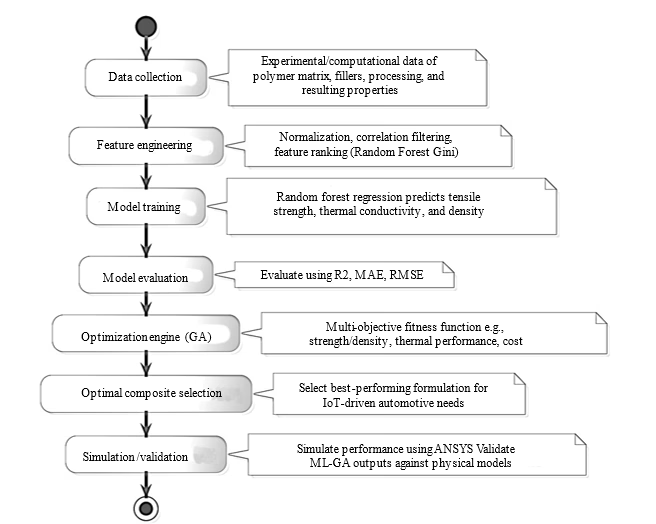
This study aims to develop an integrated machine learning and optimization framework for the intelligent design of lightweight polymer composites suited for IoT-enabled automotive applications. The goal is to enhance material performance while satisfying multiple design constraints such as mechanical strength, thermal stability, and process compatibility. A curated dataset of polymer composite formulations was used to train a Random Forest Regression (RFR) model capable of predicting tensile strength, thermal conductivity, and density based on filler-matrix composition and processing parameters. A Genetic Algorithm (GA) was incorporated for multi-objective optimization using a composite-specific fitness function. The optimized formulations were validated through finite element simulation under ASTM D638 conditions. The RFR model achieved high accuracy with an R² of 0.93 for tensile strength prediction. The GA converged rapidly, identifying formulations that improved tensile strength by 22.4% and maintained high elongation at break. Comparative analysis showed the proposed ML-GA framework outperformed SVR, DNN, and Linear Regression in both accuracy and robustness. The optimized material system met structural, thermal, and functional criteria for automotive IoT components. This work introduces a closed-loop, data-driven design pipeline that integrates machine learning, evolutionary optimization, and application-level validation. Unlike prior empirical or single-objective approaches, this methodology is scalable, multi-objective, and application-aware, representing a significant advancement in polymer composite engineering for smart mobility.
Keywords: Polymer composites; machine learning; genetic algorithm; random forest; multi-objective optimization; IoT-integrated materials; automotive applications; RGO-reinforced composites; materials informatics; finite element validation
[This article belongs to Journal of Polymer & Composites ]
References
- Hu, W., E, J., Qiu, H., & Sun, Z. (2025). Discovering polyimides and their composites with targeted mechanical properties through explainable machine learning. Journal of Materials Informatics, 5(1). https://doi.org/10.20517/jmi.2024.59
- Sorour, S. S., Saleh, Ch. A. R., & Shazly, M. (2024). A Review on Machine Learning Implementation for Predicting and Optimizing the Mechanical Behaviour of Laminated Fiber-Reinforced Polymer Composites. Heliyon, e33681. https://doi.org/10.1016/j.heliyon.2024.e33681
- Mamodiya and I. Kishor, “A Comparative Study on the Performance of DualAxis Solar Tracking Systems and Fixed Solar Arrays,” in Proc. 5th Int. Conf. on Information Management & Machine Intelligence (ICIMMI ’23), Jaipur, India, 2024, Art. no. 116, pp. 1–4, doi: 10.1145/3647444.3647943
- Isabona, L. L. Ibitome, A. L. Imoize, U. Mamodiya, A. Kumar, M. M. Hassan, et al., “Statistical characterization and modeling of radio frequency signal propagation in mobile broadband cellular next generation wireless networks”, Computational Intelligence and Neuroscience, vol. 2023, no. 1, pp. 5236566, 2023 S. K. Sunori,
- Sharma, A., Mukhopadhyay, T., Rangappa, S. M., Siengchin, S., & Kushvaha, V. (2022). Advances in Computational Intelligence of Polymer Composite Materials: Machine Learning Assisted Modeling, Analysis and Design. Archives of Computational Methods in Engineering, 29(5), 3341–3385. https://doi.org/10.1007/s11831-021-09700-9
- Chen, Y., Zhang, J., Li, Z., Zhang, H., Chen, J., Yang, W., Yu, T., Liu, W., & Li, Y. (2023). Intelligent methods for optimization design of lightweight fiber-reinforced composite structures: A review and the-state-of-the-art. Frontiers in Materials, 10. https://doi.org/10.3389/fmats.2023.1125328
- Chen, C.-T., & Gu, G. X. (2019). Machine learning for composite materials. MRS Communications, 9(2), 556–566. https://doi.org/10.1557/MRC.2019.32
- Mamodiya and N. Tiwari, “Design and implementation of an intelligent single axis automatic solar tracking system”, Mater. today Proc., vol. 81, pp. 1148-1151, 2023
- Kishor, A Prototype Framework for Customizing Virtual Reality Interactions for Paralyzed Patients Integrating Physical and Rehabilitation Modalities,” in Recent Advances in Sciences, Engineering, Information Technology & Management, 1st ed., London, U.K.: CRC Press, Taylor & Francis Group, 2025, pp. [insert actual page range if known]. doi: 10.1201/9781003598152-47.
- Fairfield, P. (2022). A deep learning-based composite design strategy for efficient selection of material and layup sequences from a given database. Composites Science and Technology, 230, 109154. https://doi.org/10.1016/j.compscitech.2021.109154
- Mamodiya and I. Kishor, “A Comparative Study on the Performance of DualAxis Solar Tracking Systems and Fixed Solar Arrays,” in Proc. 5th Int. Conf. on Information Management & Machine Intelligence (ICIMMI ’23), Jaipur, India, 2024, Art. no. 116, pp. 1–4, doi: 10.1145/3647444.3647943
- Liu, X., Tian, S., Tao, F., Du, H., & Yu, W. (n.d.). How Machine Learning Can Help the Design and Analysis of Composite Materials and Structures? https://doi.org/10.48550/arxiv.2010.09438
- Zhang, H., Song, Z., Zhang, Y., Zhang, L., & Zhu, P. (2023). A concurrent design optimization framework for IMSFRP composite structures considering material and structural parameters simultaneously. Thin-Walled Structures. https://doi.org/10.1016/j.tws.2023.111449
- Wang, J., Zhao, Q., & Eskindir, E. (2023). An adaptive framework to accelerate optimization of high flame retardant composites using machine learning. Composites Science and Technology, 231, 109818. https://doi.org/10.1016/j.compscitech.2022.109818
- Mamodiya and N. Tiwari, “Design and implementation of an intelligent single axis automatic solar tracking system”, Mater. today Proc., vol. 81, pp. 1148-1151, 2023
- Hu, H., Wei, Q., Wang, T., Ma, Q., Jin, P., Pan, S., Li, F., Wang, S., Yang, Y., & Li, Y. (2024). Experimental and Numerical Investigation Integrated with Machine Learning (ML) for the Prediction Strategy of DP590/CFRP Composite Laminates. Polymers, 16(11), 1589. https://doi.org/10.3390/polym16111589
- Ferdousi, S., Advincula, R. C., Sokolov, A. P., Choi, W., & Jiang, Y. (2023). Investigation of 3D printed lightweight hybrid composites via theoretical modeling and machine learning. https://doi.org/10.1016/j.compositesb.2023.110958
- Chew, A. K., Afzal, M. A. F., Chandrasekaran, A., Kamps, J. H., & Ramakrishnan, V. (2024). Designing the Next Generation of Polymers with Machine Learning and Physics-Based Models. Machine Learning: Science and Technology. https://doi.org/10.1088/2632-2153/ad88d7
- Rabby, M. M., Das, P. P., Rahman, M., Vadlamudi, V., & Raihan, R. (2023). Fast and accurate prediction of cure quality and mechanical performance in fiber‐reinforced polymer composite using dielectric variables and machine learning. Polymer Composites. https://doi.org/10.1002/pc.27891
- Esangbedo, M. O., & Samuel, B. O. (2024). Application of Machine Learning and Grey Taguchi Technique for the Development and Optimization of a Natural Fiber Hybrid Reinforced Polymer Composite for Aircraft Body Manufacture. Oxford Open Materials Science. https://doi.org/10.1093/oxfmat/itae004
- McNeill, D., Pal, A., Mohanty, A. K., & Misra, M. (2023). High Biomass Filled Biodegradable Plastic in Engineering Sustainable Composites. Composites Part C: Open Access. https://doi.org/10.1016/j.jcomc.2023.100388
- Arora, P. Agarwal, A. Mittal, U. Mamodiya and P. Juneja, “SA based Optimization of Controller Parameters for Crystallization Unit of Sugar Factory,” 2022 6th International Conference on Trends in Electronics and Informatics (ICOEI), Tirunelveli, India, 2022, pp. 341-346, doi: 10.1109/ICOEI53556.2022.9776904
- Benchouia, H. E., Boussehel, H., Guerira, B., Sedira, L., Tedeschi, C., Becha, H. E., & Cucchi, M. (2024). An experimental evaluation of a hybrid bio-composite based on date palm petiole fibers, expanded polystyrene waste, and gypsum plaster as a sustainable insulating building material. Construction and Building Materials. https://doi.org/10.1016/j.conbuildmat.2024.135735
- Zhang, H., Liao, W., Chen, G., & Ma, H. Q. (2023). Development and Characterization of Coal-Based Thermoplastic Composite Material for Sustainable Construction. Sustainability. https://doi.org/10.3390/su151612446
- Colucci, G., Sacchi, F., Bondioli, F., & Messori, M. (2024). Fully Bio-Based Polymer Composites: Preparation, Characterization, and LCD 3D Printing. Polymers, 16. https://doi.org/10.3390/polym16091272
- Rehman, N. U., Ullah, K. S., Sajid, M., Ihsanullah, I., & Waheed, A. (2024). Preparation of Sustainable Composite Materials from Bio‐Based Domestic and Industrial Waste: Progress, Problems, and Prospects‐ A Review. Advanced Sustainable Systems. https://doi.org/10.1002/adsu.202300587

Journal of Polymer & Composites
| Volume | 13 | |
| Issue | 05 | |
| Received | 21/05/2025 | |
| Accepted | 28/05/2025 | |
| Published | 22/07/2025 | |
| Publication Time | 62 Days |