
Parameswaran P. Subramanian,
Vaisakh S.S.,
Chithra Sekhar V,
Manoj N,
- Professor, Postgraduate Department of Chemistry and Research Center, Sanatana Dharma College, Alappuzha, Kerala, India
- Assistant Professor, Postgraduate Department of Chemistry and Research Center, Sanatana Dharma College, Alappuzha, Kerala, India
- Assistant Professor, Postgraduate Department of Chemistry and Research Center, Sanatana Dharma College, Alappuzha, Kerala, India
- Assistant Professor, Postgraduate Department of Chemistry and Research Center, Sanatana Dharma College, Alappuzha, Kerala, India
Abstract
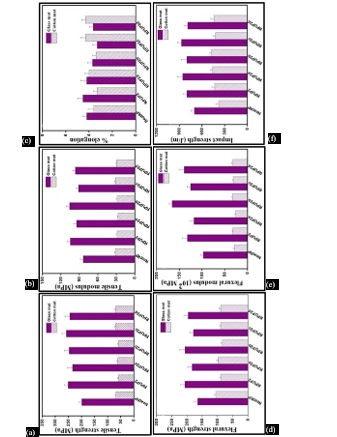
Fiber reinforced polymer (FRP) composite based on resol phenolics awaits special attention due to excellent inherent properties of the resol phenolics. In this study, modified resol phenolics by unsaturated polyester (UP) and epoxidised novolacs of simple phenol, o-cresol and p-cresol were used to fabricate glass and cotton FRPs. An overall enhancement of 25% in tensile strength and 40% in impact strength is achieved upon modification for both the modified laminates. The amount of modifiers required to achieve this enhancement in the mechanical properties is approximately 10% by weight of resol phenolics. Among the FRPs, glass reinforced composites demonstrated better enhancement in mechanical properties compared to cotton reinforced composites. The results of the water sorption, DMA, and SEM analyses indicate that the modifiers improve the characteristics of the glass fiber-matrix by strengthening the fiber-matrix interface. However, the cotton fiber reinforced composites do not exhibit any appreciable enhancement in the fiber-matrix adhesion by resol modification. Theoretical modelling studies that correlate the volume fraction of fiber with tensile strength of composites have been carried out. It also supports the enhancement of interfacial adhesion in glass-reinforced composites upon matrix modification compared to cotton-reinforced composites. Among the modified resins, UP modified resins impart better properties for the FRP composite than the epoxy modified resins.
Keywords: Resol, modification of resol, FRP, glass laminates, water sorption
[This article belongs to Journal of Polymer & Composites ]

References
- Bibekananda De, Madhab Bera, Debashish Bhattacharjee et al. A comprehensive review on fiber-reinforced polymer composites: Raw materials to applications, recycling, and waste management. Prog. Mater. Sci.. 2024; 146: 101326. Available from: https://doi.org/10.1016/j.pmatsci.2024.101326
- mahboubizadeh, S., Sadeq, A., Arzaqi, Z. et al.Advancements in fiber-reinforced polymer (FRP) composites: an extensive review. Discov Mater 2024; 4, 22. Available from: https://doi.org/10.1007/s43939-024-00091-9
- Kumar, R., Ul Haq, M. I., Raina, A., & Anand, A. Industrial applications of natural fibre-reinforced polymer composites – challenges and opportunities. J. Sustain. Eng., 2019; 12(3), 212–220. Available from: https://doi.org/10.1080/19397038.2018.1538267
- Muhammad Yasir Khalid, Ans Al Rashid, Zia Ullah Arif et al. Natural fiber reinforced composites: Sustainable materials for emerging applications. Results in Engineering, 2021; 11, 100263. Available from: https://doi.org/10.1016/j.rineng.2021.100263
- Scudamore M.J. Fire performance studies on glass-reinforced plastic laminates. Fire Mater., 1994; 18(5), 313-325. Available from: https://doi.org/10.1002/fam.810180507.
- Kandola, B. K., Krishnan, L., Ebdon, J. R., & Myler, P., Structure-property relationships in structural glass fibre reinforced composites from unsaturated polyester and inherently fire retardant phenolic resin matrix blends. Compos. B: Eng., 2020; 182, 107607. Available from: doi:10.1016/j.compositesb.2019.107607.
- Yang X, Zhi M, Li Y, et al. Improved flame retardancy and smoke suppression properties of phenolic resin by incorporating MoO3 particles. High Performance Polymers. 2023;35(6):559-570. Available from: doi:1177/09540083231153336.
- Xu Y., Guo L., Zhang H., Zhai H., Ren H. Research status, industrial application demand and prospects of phenolic resin. RSC Adv. 2019; 9, 28924–28935. Available from: org/10.1039/C9RA06487G
- Renda, C.G.; Bertholdo, R. Study of phenolic resin and their tendency for carbon graphitization. J. Polym. Res. 2018; 25, 241. Available from: org/10.1007/s10965-018-1635-y
- Zhang D, Liu X, Bai X, et al. Synthesis, characterization and properties of phthalonitrile-etherified resole resin. E-Polymers. 2020; 20, 500–509. Available from: org/10.1515/epoly-2020-0051
- Loganathan, T.M., Sultan, M.T.H., Ahsan, Q. et al.Physico‐mechanical and Flammability Properties of Cyrtostachys renda Fibers Reinforced Phenolic Resin Bio-composites. J Polym Environ. 2021; 29(11), 3703–3720. Available from: doi:10.1007/s10924-021-02135-0
- Parameswaran PS, Bhuvaneswary MG, Eby TT. Control of microvoids in resol phenolic resin using unsaturated polyester. J Appl Polym Sci. 2009; 113, 2, 802-810. Available from: org/10.1002/app.29667.
- Parameswaran PS, Lity AV, Rethikala PK. Epoxidized Novolac Modification in Resol Phenolic underOpen Mold Heat Curing for Microvoid Reduction, Asian Journal of Chemistry. 2024; 36(9),2169-217. Available from: org/10.14233/ajchem.2024.32231
- Espert A, Vilaplana F, Karlsson S. Comparison of water absorption in natural cellulosic fibres from wood and one-year crops in polypropylene composites and its influence on their mechanical properties. Composites Part A: Applied Science and Manufacturing. 2004; 35, 1267–76 . Available from: org/10.1016/j.compositesa.2004.04.004.
- Lin Q, Zhou X, Dai G. Effect of hydrothermal environment on moisture absorption and mechanical properties of wood flour–filled polypropylene composites, J Appl Polym Sci. 2002; 85, 14, 2824–32. Available from: org/10.1002/app.10844
- Pavlidou S, Papaspyrides CD. The effect of hygrothermal history on water sorption and interlaminar shear strength of glass/polyester composites with different interfacial strength. Composites Part A: Applied Science and Manufacturing. 2003; 34, 11, 1117-1124. Available from: org/10.1016/S1359-835X(03)00214-8
- Mathew G, Singh RP, Nair NR, Thomas S. Development and characterization of novel EPDM/NR prophylactic waste composites. Journal of Materials Science. 2003; 38, 2469–2481. Available from: org/10.1023/A:1023965420749
- Sreekala MS, Kumaran MG and Thomas S. Water sorption in oil palm fiber reinforced phenol formaldehyde composites. Composite: Part A. 2002, 33, 763-777. Available from: org/10.1016/S1359-835X(02)00032-5.
- Gupta MK, Srivastava RK. Mechanical, thermal and water absorption properties of hybrid sisal/jute fiber reinforced polymer composite. Indian Journal of Engineering and Materials Sciences.2016; 23, 231-238.
- Chihaoui B, Serra-Parareda F, Tarrés Q et al. Effet of the Fiber Treatment on the Stiffness of Date Palm Fiber Reinforced PP Composites: Macro and Micromechanical Evaluation of the Young’s Modulus. Polymers. 2020; 12, 1693. Available from: doi:10.3390/polym12081693.
- Luo Z, Li X, Shang J et al. Modified rule of mixtures and Halpin–Tsai model for prediction of tensile strength of micron-sized reinforced composites and Young’s modulus of multiscale reinforced composites for direct extrusion fabrication. Advances in Mechanical Engineering. 2018; 10, 7, 1-10. Available from: doi:10.1177/1687814018785286.
- Sherwani SFK, Salit MSB, Zainudin ES bin et al. Physical and flammability properties of treated sugar palm fibre reinforced polylactic acid composites. Journal of Industrial Textiles. 2022; 52, 1–28. Available from: doi:10.1177/15280837221133574.

Journal of Polymer & Composites
| Volume | 13 | |
| Issue | 04 | |
| Received | 11/04/2025 | |
| Accepted | 05/07/2025 | |
| Published | 17/07/2025 | |
| Publication Time | 97 Days |