
Ravi Shankar Rai,
Vikas Kumar,
Rajeev Kumar,
- Assistant Professor, Department of Automation and Robotics, JSPM’s Rajarshi Shahu College of Engineering, Pune, Maharashtra, India
- Assistant Professor, Department of Automation and Robotics, Sandip Institute of Technology and Research Centre, Nashik, Maharashtra, India
- Assistant Professor, Department of Mechanical Engineering, Sandip Institute of Technology and Research Centre, Nashik, Maharashtra, India
Abstract
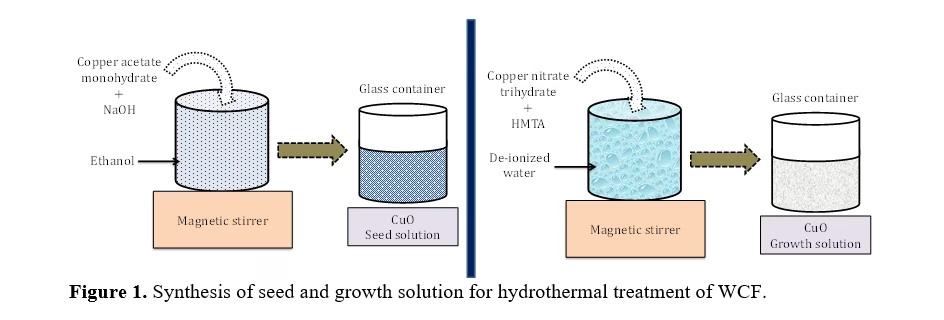
In order to produce a nanostructured interphase that improves the interfacial interaction with an epoxy resin matrix, copper oxide (CuO) nanostructures were hydrothermally formed onto woven carbon fibers (WCF). Hexagonal CuO nanorods were created using a two-step, seed-assisted solvothermal technique on plain woven carbon fiber. This study investigates the effects of surface modification of carbon fibers by the formation of CuO nanostructures using a hydrothermal technique on the mechanical properties of carbon fiber-reinforced polymer composites. To make hybrid composites, carbon fiber fabric that had been CuO-treated was used as reinforcement in a bisphenol-A epoxy resin matrix. In a regulated reaction mixture, the CuO nanostructures were created on the carbon fibers by first seeding them and then growing them. At a fixed growth temperature of 90 °C and a 4-hour hydrothermal period, various CuO nanostructure forms, such as nanowires, hexagonal rods, and nanoflower morphologies, were produced by adjusting the molar concentrations in the solution. The resulting morphologies were characterized using energy-dispersive X-ray spectroscopy and field emission scanning electron microscopy. The final nanostructure development was significantly influenced by the timing of the seeding and growing phases. After that, the CuO-coated woven carbon fiber was vacuum-bagged and added to a laminated composite with an epoxy resin matrix. CuO-treated WCF was vacuum-bagged into a matrix composed of a bisphenol-A epoxy resin and dimethyl aniline hardener combination to create laminated hybrid composites. By reducing the void content, this procedure raised the volume fraction of CuO nanostructure, which improved the mechanical characteristics. Drop-down impact testing and a universal testing machine were used to assess the tensile and impact strengths of the epoxy composite samples reinforced with CuO-coated WCF. The results demonstrate significant gains for the CuO-coated WCF reinforced composites in impact energy absorption (increased by 74.8%), elastic modulus (52% increase), tensile strength (42% increase), and in-plane shear strength (32% increase). This study shows that by increasing the interfacial surface area between the fiber and matrix, CuO nanostructures can significantly prevent delamination and improve composite performance, boosting the materials’ potential uses in structural contexts. Because of their excellent mechanical qualities at a very cheap cost and little experimental setup, the produced hybrid composites samples are a good substitute for standard carbon fiber reinforced polymer composites for a variety of applications
Keywords: CFRP, Nanostructures Delamination, Hydrothermal Technique, CuO, Composites.
[This article belongs to Special Issue under section in Journal of Polymer & Composites (jopc)]
References
- Vijayan DS, Sivasuriyan A, Devarajan P, Stefańska A, Wodzyński Ł, Koda E. Carbon Fibre-Reinforced Polymer (CFRP) Composites in Civil Engineering Application—A Comprehensive Review. Buildings. 2023.
- Geier N, Patra K, Anand RS, Ashworth S, Balázs BZ, Lukács T, et al. A critical review on mechanical micro-drilling of glass and carbon fibre reinforced polymer (GFRP and CFRP) composites. Composites Part B: Engineering. 2023.
- Li X, Liu P, Cheng H, Li Y, Liu C, Zhang K. Impact damage prediction of CFRP laminates with rubber protective layer using back-propagation neural networks. Int J Adv Manuf Technol. 2023;
- Hossain MK, Chowdhury MMR, Imran KA, Salam MB, Tauhid A, Hosur M, et al. Effect of low velocity impact responses on durability of conventional and nanophased CFRP composites exposed to seawater. Polym Degrad Stab. 2014;
- Wang A, Liu X, Yue Q, Xian G. Comparative study on the low-velocity impact properties of unidirectional flax and carbon fiber reinforced epoxy plates. Mech Adv Mater Struct. 2024;
- Rai RS, Bajpai V. Surface functionalization of carbon fiber by hydrothermally synthesized ZnO nanostructures for mechanical strengthening of polymer composites. Polym Compos [Internet]. 2023 [cited 2023 Dec 28]; Available from: https://onlinelibrary.wiley.com/doi/full/10.1002/pc.27901
- Rai RS, Bajpai V. Improvement of interfacial adhesion of CuO nanostructured carbon fiber reinforced polymer composites. Polym Compos. 2023;
- Shankar Rai R. Carbon fiber fabrics functionalized with monoclinic CuO nanostructures using seed-assisted hydrothermal growth treatment. Ceram Int. 2024 Nov 1;50(21):44635–47.
- Kong K, Deka BK, Seo JW, Park Y Bin, Park HW. Effect of CuO nanostructure morphology on the mechanical properties of CuO/woven carbon fiber/vinyl ester composites. Compos Part A Appl Sci Manuf. 2015;
- Ngadong S, Chekke T, Narzary R, Bayan S, Das U. Metal oxide nanocomposite based flexible nanogenerator: synergic effect of light and pressure. Nanotechnology. 2023;
- Kong K, Deka BK, Kwak SK, Oh A, Kim H, Park Y Bin, et al. Processing and mechanical characterization of ZnO/polyester woven carbon-fiber composites with different ZnO concentrations. Compos Part A Appl Sci Manuf [Internet]. 2013;55:152–60. Available from: http://dx.doi.org/10.1016/j.compositesa.2013.08.013
- Hazarika A, Deka BK, Kim DY, Kong K, Park Y Bin, Park HW. Growth of aligned ZnO nanorods on woven Kevlar® fiber and its performance in woven Kevlar® fiber/polyester composites. Compos Part A Appl Sci Manuf [Internet]. 2015;78:284–93. Available from: http://dx.doi.org/10.1016/j.compositesa.2015.08.022
- Deka BK, Kong K, Seo J, Kim D, Park Y Bin, Park HW. Controlled growth of CuO nanowires on woven carbon fibers and effects on the mechanical properties of woven carbon fiber/polyester composites. Compos Part A Appl Sci Manuf [Internet]. 2015;69:56–63. Available from: http://dx.doi.org/10.1016/j.compositesa.2014.11.001
- Kim BJ, Cha SH, Kang GH, Kong K, Ji W, Park HW, et al. Interfacial control through ZnO nanorod growth on plasma-treated carbon fiber for multiscale reinforcement of carbon fiber/polyamide 6 composites. Mater Today Commun. 2018;
- Sayam A, Rahman ANMM, Rahman MS, Smriti SA, Ahmed F, Rabbi MF, et al. A review on carbon fiber-reinforced hierarchical composites: mechanical performance, manufacturing process, structural applications and allied challenges. Carbon Letters. 2022.
- Htwe YZN, Al-Janabi AS, Wadzer Y, Mamat H. Review of tribological properties of nanoparticle-based lubricants and their hybrids and composites. Friction. 2024.
- Huang X, Zhao G, Wang X. Fabrication of reduced graphene oxide/metal (Cu, Ni, Co) nanoparticle hybrid composites via a facile thermal reduction method. RSC Adv. 2015;
- Li J, Dong H, Tang Z, Li P, Wu B, Ma Y, et al. Influence of surface pretreatment on the bonding mechanism and mechanical properties of AA5052/CFRP friction stir spot welded joint. J Manuf Process. 2023;
- Devi M, Kumar A. Surface modification of reduced graphene oxide-polyaniline nanotubes nanocomposites for improved supercapacitor electrodes. Polym Compos. 2020;
- Rai RS, P GJ, Bajpai V, Khan MI, Elboughdiri N, Shanableh A, et al. An eco-friendly approach on green synthesis, bio-engineering applications, and future outlook of ZnO nanomaterial: A critical review. Environ Res [Internet]. 2023 Mar 15 [cited 2023 Feb 2];221:114807. Available from: https://linkinghub.elsevier.com/retrieve/pii/S001393512202134X
- Rai RS, Bajpai V. Recent advances in ZnO nanostructures and their future perspective. Adv Nano Res. 2021;
- Zhang Q, Zhang K, Xu D, Yang G, Huang H, Nie F, et al. CuO nanostructures: Synthesis, characterization, growth mechanisms, fundamental properties, and applications. Progress in Materials Science. 2014.
- Naz S, Gul A, Zia M, Javed R. Synthesis, biomedical applications, and toxicity of CuO nanoparticles. Applied Microbiology and Biotechnology. 2023.
- Deka BK, Hazarika A, Kim J, Park Y Bin, Park HW. Multifunctional CuO nanowire embodied structural supercapacitor based on woven carbon fiber/ionic liquid-polyester resin. Compos Part A Appl Sci Manuf [Internet]. 2016;87:256–62. Available from: http://dx.doi.org/10.1016/j.compositesa.2016.05.007
- Rai RS, Bajpai V. Hydrothermally grown ZnO NSs on Bi-Directional woven carbon fiber and effect of synthesis parameters on morphology. Ceram Int [Internet]. 2021;47(6):8208–17. Available from: https://doi.org/10.1016/j.ceramint.2020.11.180
- Rai RS, Bajpai V. Synthesis of ZnO Nanostructures on Woven Kevlar Fabric and Impact of Hydrothermal Conditions on Growth of Nanorods. In: Chakrabarti A. SS. AM, editor. Lecture Notes in Mechanical Engineering [Internet]. Singapore: Springer; 2023 [cited 2022 Jul 28]. p. 219–29. Available from: https://link.springer.com/10.1007/978-981-19-0561-2_20
- Shankar Rai R, Rai RS, Bajpai V. Carbon fiber fabrics functionalized with monoclinic CuO nanostructures using seed-assisted hydrothermal growth treatment. 2022 Sep 20 [cited 2022 Sep 20]; Available from: https://www.researchsquare.com
- Kong K, Cheedarala RK, Kim M, Roh HD, Park Y Bin, Park HW. Electrical thermal heating and piezoresistive characteristics of hybrid CuO-woven carbon fiber/vinyl ester composite laminates. Compos Part A Appl Sci Manuf. 2016;
- Thangapandian E, Palanisamy P. An experimental and numerical study to enhance the thermal characteristics of LA/CuO/Al2O3 nanocomposites as a phase change material for building cooling applications. Polym Compos [Internet]. 2022 Aug 1 [cited 2022 Nov 16];43(8):5426–41. Available from: https://onlinelibrary.wiley.com/doi/full/10.1002/pc.26845
- Gounder Thangamani J, Khadheer Pasha SK. Hydrothermal synthesis of copper (׀׀) oxide-nanoparticles with highly enhanced BTEX gas sensing performance using chemiresistive sensor. Chemosphere. 2021;
- Wang S, Cong F, Li X, He J, Cui X. Hybrid effect of carbon nano-fillers on the interlaminar fracture toughness of fiber metal laminates. Polym Compos. 2021;

Journal of Polymer & Composites
| Volume | 13 | |
| Special Issue | 05 | |
| Received | 16/01/2025 | |
| Accepted | 04/02/2025 | |
| Published | 22/07/2025 | |
| Publication Time | 187 Days |