
Samuthira Pandi V,
Aishwarya D,
Helina Rajini Suresh,
B. Thilakavathi,
Tupili Sangeetha,
Veeraiyah Thangasamy,
A. Anandh,
- Research Head, Centre for Advanced Wireless Integrated Technology, Chennai Institute of Technology, Chennai, Tamil Nadu, India
- Assistant Professor, Department of Computer science and Engineering, Sathyabama Institute of Science and Technology, Chennai, Tamil Nadu, India
- Associate Professor, Department of Electronics and Communication Engineering, Vel Tech Rangarajan Dr. Sagunthala R&D Institute of Science and Technology, Chennai, Tamil Nadu, India
- Professor, Department of Electronics and Communication Engineering, Rajalakshmi Engineering College, Thandalam, Chennai, Tamil Nadu, India
- Associate Professor, Department of Computer Science and Engineering, R. M. D Engineering College, R. S. M Nagar, Kavaraipettai, Chennai, Tamil Nadu, India
- Professor, Department of Electronics and Communication Engineering, V.S.B. Engineering College, Karur, Chennai, Tamil Nadu, India
- Associate Professor, Department of Computer science and Engineering, Kamaraj College of Engineering and Technology, Virudhunagar, Chennai, Tamil Nadu, India
Abstract
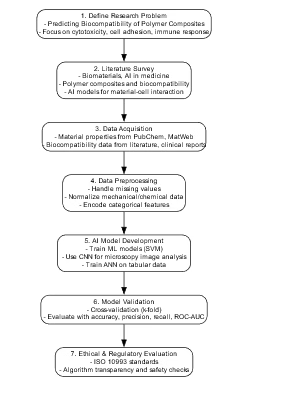
The use of polymers in biomaterials was now key to designing the next generation of medical implants, which need to be strong and also compatible with living tissue. Tests for biocompatibility, such as those done in the laboratory and by doing experiments on animals, require much time and many resources, so the need for computer-based approaches becomes clear. An artificial intelligence approach was provided in this study to determine how polymer composites are biocompatible according to main physical, chemical, and mechanical factors. A synthetic clinical dataset made up of surface roughness, elastic modulus, degradation rate, hydrophilicity, tensile strength, and cytotoxicity was created and examined. During data preprocessing, I normalized the data, coded all the categorical variables, and imputed the missing entries. The research team used support vector machines and ensemble methods to classify biological compatibility and tested convolutional neural networks (CNNs) on the images of cell morphology. A combination of feature importance analysis, correlation maps, and visual analytics allowed us to find out which attributes guide cellular interactions the most. These models were found to be reliable by measuring accuracy, precision, recall, and ROC-AUC. The results confirmed that AI systems could model the complex ways in which materials affect biological results. Making sure data was correct, algorithms could be understood, and their results interpretable helped ensure matter in clinical practice. This study shows that machine learning can help in designing better biomaterials, speeding up experiments, and promoting safer implants for different needs in regenerative medicine.
Keywords: Polymer matrix composites, AI-assisted material design, biomedical polymers, smart composites, artificial intelligence in biopolymers.
[This article belongs to Special Issue under section in Journal of Polymer & Composites (jopc)]
References
- Gokcekuyu, Y., Ekinci, F., Guzel, M. S., Acici, K., Aydin, S., & Asuroglu, T. (2024). Artificial Intelligence in Biomaterials: A Comprehensive Review. Applied Sciences, 14(15), 6590.
- Wang, F., Semirumi, D. T., He, A., Pan, Z., & Alizadeh, A. (2024). Physical, mechanical characterization, and artificial neural network modeling of biodegradable composite scaffold for biomedical applications. Engineering Applications of Artificial Intelligence, 136, 108889.
- Bhatt, K., Ahmed, N., & Chauhan, P. Green Artificial Intelligence: Biodegradable and Biocompatible Materials. In Artificial Intelligence Techniques for Sustainable Development (pp. 317-335). CRC Press.
- Omidian, H. (2025). AI-powered breakthroughs in material science and biomedical polymers. Journal of Bioactive and Compatible Polymers, 40(2), 161-174.
- Suwardi, A., Wang, F., Xue, K., Han, M. Y., Teo, P., Wang, P., … & Loh, X. J. (2022). Machine learning‐driven biomaterials evolution. Advanced Materials, 34(1), 2102703.
- Fan, J., Xu, J., Wen, X., Sun, L., Xiu, Y., Zhang, Z., … & Xing, D. (2024). The Future of Bone Regeneration: Artificial Intelligence in Biomaterials Discovery. Materials Today Communications, 109982.
- Mateu-Sanz, M., Fuenteslópez, C. V., Uribe-Gomez, J., Haugen, H. J., Pandit, A., Ginebra, M. P., … & Samara, A. (2024). Redefining biomaterial biocompatibility: challenges for artificial intelligence and text mining. Trends in biotechnology, 42(4), 402-417.
- Necolau, M. I., Ionita, M., & Pandele, A. M. (2025). Poly (propylene fumarate) Composite Scaffolds for Bone Tissue Engineering: Innovation in Fabrication Techniques and Artificial Intelligence Integration. Polymers, 17(9), 1212.
- Rajitha, A., Kansal, L., Raj, G., Kalra, R., Dhamija, K., & Abdul-Zahra, D. S. (2024). Biomaterials and Artificial Intelligence: Predictive Modeling and Design. In E3S Web of Conferences (Vol. 505, p. 01003). EDP Sciences.
- Goyal, R., Khosla, C., Goyal, K., Singh, J., & Singh, K. (2022, April). Review on machine learning driven biomedical metallic composites. In 2022 2nd International Conference on Advance Computing and Innovative Technologies in Engineering (ICACITE) (pp. 1714-1718). IEEE.
- Goyal, R., Khosla, C., Goyal, K., Singh, J., & Singh, K. (2022, April). Review on machine learning driven biomedical metallic composites. In 2022 2nd International Conference on Advance Computing and Innovative Technologies in Engineering (ICACITE) (pp. 1714-1718). IEEE.
- Kolomenskaya, E., Butova, V., Poltavskiy, A., Soldatov, A., & Butakova, M. (2023). Application of artificial intelligence at all stages of bone tissue engineering. Biomedicines, 12(1), 76.
- Xie, S. (2023). Perspectives on development of biomedical polymer materials in artificial intelligence age. Journal of Biomaterials Applications, 37(8), 1355-1375.
- Shokrani, H., Shokrani, A., Seidi, F., Kucińska-Lipka, J., Makurat-Kasprolewicz, B., Saeb, M. R., & Ramakrishna, S. (2023). Artificial intelligence for biomedical engineering of polysaccharides: A short overview. Current Opinion in Biomedical Engineering, 27, 100463.
- Dananjaya, S. A. V., Chevali, V. S., Dear, J. P., Potluri, P., & Abeykoon, C. (2024). 3D printing of biodegradable polymers and their composites–Current state-of-the-art, properties, applications, and machine learning for potential future applications. Progress in Materials Science, 101336.
- Mavi, S., Kadian, S., Sarangi, P. K., Sahoo, A. K., Singh, S., Yahya, M. Z. A., & Abd Rahman, N. M. M. (2025, February). Advancements in machine learning and artificial intelligence in polymer science: A comprehensive review. In Macromolecular Symposia (Vol. 414, No. 1, p. 2400185).
- Rajitha, A., Kansal, L., Raj, G., Kalra, R., Dhamija, K., & Abdul-Zahra, D. S. (2024). Biomaterials and Artificial Intelligence: Predictive Modeling and Design. In E3S Web of Conferences (Vol. 505, p. 01003). EDP Sciences.
- Goyal, R., Khosla, C., Goyal, K., Singh, J., & Singh, K. (2022, April). Review on machine learning driven biomedical metallic composites. In 2022 2nd International Conference on Advance Computing and Innovative Technologies in Engineering (ICACITE) (pp. 1714-1718). IEEE.
- Kolomenskaya, E., Butova, V., Poltavskiy, A., Soldatov, A., & Butakova, M. (2023). Application of artificial intelligence at all stages of bone tissue engineering. Biomedicines, 12(1), 76.
- Xie, S. (2023). Perspectives on development of biomedical polymer materials in artificial intelligence age. Journal of Biomaterials Applications, 37(8), 1355-1375.
- Shokrani, H., Shokrani, A., Seidi, F., Kucińska-Lipka, J., Makurat-Kasprolewicz, B., Saeb, M. R., & Ramakrishna, S. (2023). Artificial intelligence for biomedical engineering of polysaccharides: A short overview. Current Opinion in Biomedical Engineering, 27, 100463.
- Zarei, A., & Farazin, A. (2024). Synergizing additive manufacturing and machine learning for advanced hydroxyapatite scaffold design in bone regeneration. Journal of the Australian Ceramic Society, 1-17.
- Mavi, S., Kadian, S., Sarangi, P. K., Sahoo, A. K., Singh, S., Yahya, M. Z. A., & Abd Rahman, N. M. M. (2025, February). Advancements in machine learning and artificial intelligence in polymer science: A comprehensive review. In Macromolecular Symposia (Vol. 414, No. 1, p. 2400185).
- Fouly, A., Taha, M., Albahkali, T., Shar, M. A., Abdo, H. S., & Nabhan, A. (2024). Developing artificial intelligence models for predicting the tribo-mechanical properties of HDPE nanocomposite used in artificial hip joints. IEEE Access, 12, 14787-14799.
- Montazeran, A. H., Saber Samandari, S., & Khandan, A. (2018). Artificial intelligence investigation of three silicates bioceramics-magnetite bio-nanocomposite: hyperthermia and biomedical applications. Nanomedicine Journal, 5(3), 163-171.
- Kerner, J., Dogan, A., & von Recum, H. (2021). Machine learning and big data provide crucial insight for future biomaterials discovery and research. Acta Biomaterialia, 130, 54-65.
- Panda, A., Dyadyura, K., Dmitrishin, D., Smorodin, A., & Prokopovich, I. (2024). Decision Support System for the Design Process of Apatite Biopolymer Composite Parts. Management Systems in Production Engineering, (4 (32), 548-554.
- Kerner, J., Dogan, A., & von Recum, H. (2021). Machine learning and big data provide crucial insight for future biomaterials discovery and research. Acta Biomaterialia, 130, 54-65.
- Sharma, S., Gupta, V., Mudgal, D., & Srivastava, V. (2023). Predicting biomechanical properties of additively manufactured polydopamine coated poly lactic acid bone plates using deep learning. Engineering Applications of Artificial Intelligence, 124, 106587.
- Tepla, T. L., Izonin, I. V., Duriagina, Z. A., Tkachenko, R. O., Trostianchyn, A. M., Lemishka, I. A., … & Kovbasyuk, T. M. (2018). Alloys selection based on the supervised learning technique for design of biocompatible medical materials. Archives of Materials Science and Engineering, 93(1), 32-40.]
- Fatahian, R., & Erfani, R. (2025). Surrogate modeling of electrospun PVA/PLA nanofibers using artificial neural network for biomedical applications. Scientific Reports, 15(1), 12886.
- Omigbodun, F. T., Osa-Uwagboe, N., Udu, A. G., & Oladapo, B. I. (2024). Leveraging Machine Learning for Optimized Mechanical Properties and 3D Printing of PLA/cHAP for Bone Implant. Biomimetics, 9(10), 587.
- Motadayen, M., Nehru, D., & Agarwala, S. (2024). Advancing Sustainability: Biodegradable Electronics and New Materials through AI and Machine Learning.
- Karadag, A., & Ulkir, O. (2025). Prediction of Dimensional Accuracy and Surface Quality in Additively Manufactured Biomedical Implants Using ANN. International Journal of Precision Engineering and Manufacturing, 1-27.
- Basu, B., Gowtham, N. H., Xiao, Y., Kalidindi, S. R., & Leong, K. W. (2022). Biomaterialomics: Data science-driven pathways to develop fourth-generation biomaterials. Acta Biomaterialia, 143, 1-25.
- Zhu, Z., Ng, D. W. H., Park, H. S., & McAlpine, M. C. (2021). 3D-printed multifunctional materials enabled by artificial-intelligence-assisted fabrication technologies. Nature Reviews Materials, 6(1), 27-47.
- Sun, Q. J., Lai, Q. T., Tang, Z., Tang, X. G., Zhao, X. H., & Roy, V. A. (2023). Advanced functional composite materials toward E‐skin for health monitoring and artificial intelligence. Advanced Materials Technologies, 8(5), 2201088.
- Ahmed, E., Mulay, P., Ramirez, C., Tirado-Mansilla, G., Cheong, E., & Gormley, A. J. (2024). Mapping biomaterial complexity by machine learning. Tissue Engineering Part A, 30(19-20), 662-680.
- Agarwal, R., Singh, J., & Gupta, V. (2022). Predicting the compressive strength of additively manufactured PLA‐based orthopedic bone screws: A machine learning framework. Polymer Composites, 43(8), 5663-5674.
- Goh, G. D., Lee, J. M., Goh, G. L., Huang, X., Lee, S., & Yeong, W. Y. (2023). Machine learning for bioelectronics on wearable and implantable devices: challenges and potential. Tissue Engineering Part A, 29(1-2), 20-46.

Journal of Polymer & Composites
| Volume | 13 | |
| Special Issue | 06 | |
| Received | 20/05/2025 | |
| Accepted | 26/06/2025 | |
| Published | 07/07/2025 | |
| Publication Time | 48 Days |