
Harish Reddy Gantla,
Kasthuri Rajendra Prasad,
Anirbit Sengupta,
Biyyapu Vishnu Priya,
Manna Sheela Rani Chetty,
Parul Goyal,
- Associate Professor, Department of Computer Science and Engineering, Vignan Institute of Technology and Science, Hyderabad, Telangana, India
- Assistant Professor, Department of Computer Science and Engineering, Sreenidhi Institute of Science and Technology, Hyderabad, Telangana, India
- Assistant Professor, Department of Computer Science and Engineering – AI, Brainware University, West Bengal, India
- Assistant Professor, Department of Computer Science and Engineering, QIS College of Engineering and Technology, Andhra Pradesh, India
- Professor, Department of Computer Science and Engineering, Koneru Lakshmaiah Education Foundation (KLEF), Green Fields, Vaddeswaram, Guntur, Andhra Pradesh, India
- Professor, Department of Computer Science & Engineering, M.M. Engineering College, Maharishi Markandeshwar (Deemed to be University), Mullana, Ambala, Haryana, India
Abstract
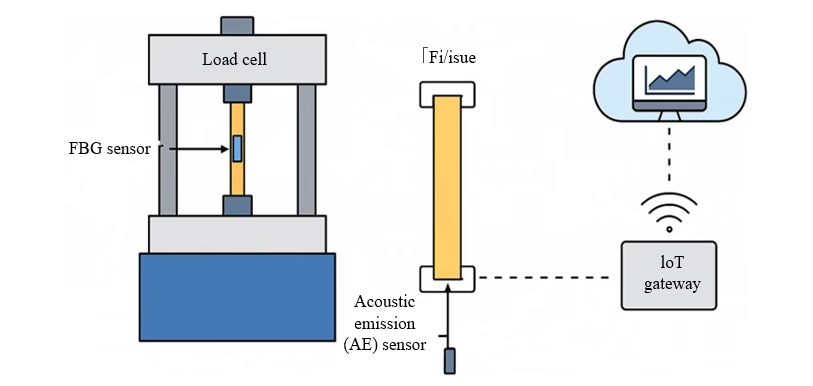
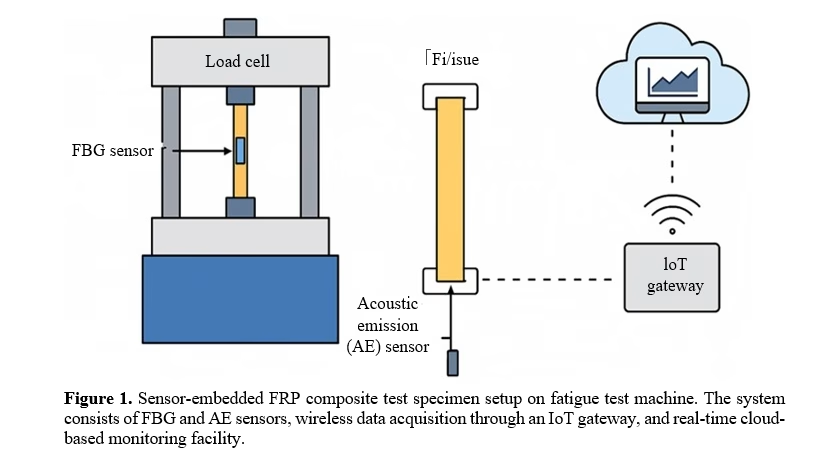
The accurate prediction of fatigue life in fiber-reinforced polymer (FRP) composites remains a major challenge due to their nonlinear, multi-mechanism degradation behavior under variable loading conditions. This study presents a data-driven framework, H-LiProNet, which combines real-time IoT sensing with hybrid machine learning to estimate remaining useful life (RUL) in FRP composites. The proposed system integrates embedded Fiber Bragg Grating (FBG) and acoustic emission (AE) sensors to capture strain and damage signatures during fatigue testing. Extracted features are processed through a hybrid learning architecture, wherein XGBoost ranks and selects key features, and Long Short-Term Memory (LSTM) networks perform temporal modeling for accurate life prediction. The model is implemented on a cloud-based IoT platform with support for real-time inference and visualization in dashboards. Experimental results show H-LiProNet to outperform the standard models like Miner’s Rule, Support Vector Regression (SVR), and single LSTM by a big margin with an RMSE of 580 cycles and R² of 0.92. The model was very precise even in the presence of artificial noise (σ = 0.05), validating the model strength. Statistical tests (p < 0.05) determined significance of the performance gains. This study is among the first to combine hybrid AI modeling, real-time sensor fusion, and cloud-based deployment for predictive maintenance of FRP composites. The approach enables intelligent, adaptive lifecycle monitoring applicable to aerospace, civil, and renewable energy sectors.
Keywords: Fiber-Reinforced polymer composites, fatigue life prediction, machine learning, structural health monitoring, real-time analytics, smart materials, remaining useful life (RUL).
[This article belongs to Journal of Polymer & Composites ]
References
- Machello, C., Bazli, M., Rajabipour, A., Mehdizadeh Rad, H., Arashpour, M., & Hadigheh, A. (2023). Using machine learning to predict the long-term performance of fibre-reinforced polymer structures: A state-of-the-art review. Construction and Building Materials. https://doi.org/10.1016/j.conbuildmat.2023.133692
- Osa-uwagboe, N., Udu, A. G., Ghalati, M. K., Silberschmidt, V. V., Aremu, A., & Demirci, E. (2024). A machine learning-enabled prediction of damage properties for fiber-reinforced polymer composites under out-of-plane loading. Engineering Structures. https://doi.org/10.1016/j.engstruct.2024.117970
- Hu, H., Wei, Q., Wang, T., Ma, Q., Jin, P., Pan, S., Li, F., Wang, S., Yang, Y., & Li, Y. (2024). Experimental and Numerical Investigation Integrated with Machine Learning (ML) for the Prediction Strategy of DP590/CFRP Composite Laminates. Polymers, 16(11), 1589. https://doi.org/10.3390/polym16111589
- Agnihotri, S., & Ramkumar, K. (2024). Machine learning algorithms for data-driven systems in IoT. 112–126. https://doi.org/10.1201/9781003497318-6
- Sorour, S. S., Saleh, Ch. A. R., & Shazly, M. (2024). A Review on Machine Learning Implementation for Predicting and Optimizing the Mechanical Behaviour of Laminated Fiber-Reinforced Polymer Composites. Heliyon, e33681. https://doi.org/10.1016/j.heliyon.2024.e33681
- Champa-Bujaico, E., Garcia-Diaz, P., & Díez-Pascual, A. M. (2022). Machine Learning for Property Prediction and Optimization of Polymeric Nanocomposites: A State-of-the-Art. International Journal of Molecular Sciences, 23(18), 10712. https://doi.org/10.3390/ijms231810712
- Mamodiya and I. Kishor, “A Comparative Study on the Performance of DualAxis Solar Tracking Systems and Fixed Solar Arrays,” in Proc. 5th Int. Conf. on Information Management & Machine Intelligence (ICIMMI ’23), Jaipur, India, 2024, Art. no. 116, pp. 1–4, doi: 10.1145/3647444.3647943
- Nawafleh, N., & Al-Oqla, F. (2022). Artificial neural network for predicting the mechanical performance of additive manufacturing thermoset carbon fiber composite materials. Journal of the Mechanical Behavior of Materials, 31(1), 501–513. https://doi.org/10.1515/jmbm-2022-0054
- Pugar, J., Gang, C., Huang, C., Haider, K. W., & Washburn, N. R. (2022). Predicting Young’s Modulus of Linear Polyurethane and Polyurethane-Polyurea Elastomers: Bridging Length Scales with Physicochemical Modeling and Machine Learning. ACS Applied Materials & Interfaces, 14(14), 16568–16581. https://doi.org/10.1021/acsami.1c24715
- Arora, P. Agarwal, A. Mittal, U. Mamodiya and P. Juneja, “SA based Optimization of Controller Parameters for Crystallization Unit of Sugar Factory,” 2022 6th International Conference on Trends in Electronics and Informatics (ICOEI), Tirunelveli, India, 2022, pp. 341-346, doi: 10.1109/ICOEI53556.2022.9776904
- Moumen, A., Lakhdar, A., Laabid, Z., & Mansouri, K. (2022). Towards smart modeling of mechanical properties of a bio composite based on a machine learning. International Journal of Electrical and Computer Engineering, 12(3), 3138. https://doi.org/10.11591/ijece.v12i3.pp3138-3145
- Baturynska, I. (2019). Application of Machine Learning Techniques to Predict the Mechanical Properties of Polyamide 2200 (PA12) in Additive Manufacturing. Applied Sciences, 9(6), 1060. https://doi.org/10.3390/APP9061060
- Isabona, L. L. Ibitome, A. L. Imoize, U. Mamodiya, A. Kumar, M. M. Hassan, et al., “Statistical characterization and modeling of radio frequency signal propagation in mobile broadband cellular next generation wireless networks”, Computational Intelligence and Neuroscience, vol. 2023, no. 1, pp. 5236566, 2023 S. K. Sunori,
- Cassola, S., Duhovic, M., Schmidt, T., & May, D. (2022). Machine learning for polymer composites process simulation– a review. 246, 110208. https://doi.org/10.1016/j.compositesb.2022.110208
- Mamodiya and N. Tiwari, “Design and implementation of an intelligent single axis automatic solar tracking system”, Mater. today Proc., vol. 81, pp. 1148-1151, 2023
- Kumar B N, D., & Dutt K, M. (2023). A Study On Mechanical Properties Of 3d Printed Hybrid Polymer Composites. Journal of Namibian Studies : History Politics Culture. https://doi.org/10.59670/btwhrn64
- Kishor, A Prototype Framework for Customizing Virtual Reality Interactions for Paralyzed Patients Integrating Physical and Rehabilitation Modalities,” in Recent Advances in Sciences, Engineering, Information Technology & Management, 1st ed., London, U.K.: CRC Press, Taylor & Francis Group, 2025, pp. [insert actual page range if known]. doi: 10.1201/9781003598152-47.
- Greco, P. F., Pepi, C., & Gioffrè, M. (2024). A novel biocomposite material for sustainable constructions: Metakaolin lime mortar and Spanish broom fibers. Journal of Building Engineering. https://doi.org/10.1016/j.jobe.2023.108425
- Yun Debbie, S. X., Muiruri, J. K., Wu, W.-Y., Yeo, J. C. C., Wang, S., Tomczak, N., Thitsartarn, W., Tan, B. H., Wang, P., Wei, F., Suwardi, A., Xu, J., Loh, X. J., Yan, Q., & Zhu, Q. (2024). Bio-Polyethylene and Polyethylene Biocomposites: An Alternative Towards a Sustainable Future. Macromolecular Rapid Communications, e2400064. https://doi.org/10.1002/marc.202400064
- Zulfiqar, A., Shah, A. ur R., Khalil, M. S., Azad, M. M., Zulfiqar, Y., Naseem, M. S., & Song, J.-I. (2023). Enhancing properties of jute/starch bio-composite material through incorporation of magnesium carbonate hydroxide pentahydrate: A sustainable approach. Materials Chemistry and Physics. https://doi.org/10.1016/j.matchemphys.2023.128690
- Wang, S., Muiruri, J. K., Soo, X. Y. D., Liu, S., Thitsartarn, W., Tan, B. H., Suwardi, A., Li, Z., Zhu, Q., & Loh, X. J. (2022). Bio-Polypropylene and Polypropylene-based Biocomposites: Solutions for a Sustainable Future. Chemistry-an Asian Journal, 18(2), e202200972. https://doi.org/10.1002/asia.202200972
- Rehman, N. U., Ullah, K. S., Sajid, M., Ihsanullah, I., & Waheed, A. (2024). Preparation of Sustainable Composite Materials from Bio‐Based Domestic and Industrial Waste: Progress, Problems, and Prospects‐ A Review. Advanced Sustainable Systems. https://doi.org/10.1002/adsu.202300587
- McNeill, D., Pal, A., Mohanty, A. K., & Misra, M. (2023). High Biomass Filled Biodegradable Plastic in Engineering Sustainable Composites. Composites Part C: Open Access. https://doi.org/10.1016/j.jcomc.2023.100388
- Benchouia, H. E., Boussehel, H., Guerira, B., Sedira, L., Tedeschi, C., Becha, H. E., & Cucchi, M. (2024). An experimental evaluation of a hybrid bio-composite based on date palm petiole fibers, expanded polystyrene waste, and gypsum plaster as a sustainable insulating building material. Construction and Building Materials. https://doi.org/10.1016/j.conbuildmat.2024.135735
- Zhang, H., Liao, W., Chen, G., & Ma, H. Q. (2023). Development and Characterization of Coal-Based Thermoplastic Composite Material for Sustainable Construction. Sustainability. https://doi.org/10.3390/su151612446
- Colucci, G., Sacchi, F., Bondioli, F., & Messori, M. (2024). Fully Bio-Based Polymer Composites: Preparation, Characterization, and LCD 3D Printing. Polymers, 16. https://doi.org/10.3390/polym16091272

Journal of Polymer & Composites
| Volume | 13 | |
| Issue | 04 | |
| Received | 16/05/2025 | |
| Accepted | 28/05/2025 | |
| Published | 19/06/2025 | |
| Publication Time | 34 Days |