
M Chrispin Das,
S Prathap Singh,
R Malkiya Rasalin Prince,
K. Gnanasekaran,
S Manikandan,
A Dhanush,
D S Sujith Kumar,
S Yuva Praveen,
- Associate Professor, Department of Mechanical Engineering, St. Joseph’s Institute of Technology, Chennai, Tamil Nadu, India
- Assistant Professor, Department of Mechanical Engineering, St. Joseph’s Institute of Technology, Chennai, Tamil Nadu, India
- Associate Professor, Department of Mechanical Engineering, Karunya Institute of Technology and Sciences, Coimbatore, Tamil Nadu, India
- Assistant Professor, Department of Mechanical Engineering, St. Joseph’s Institute of Technology, Chennai, Tamil Nadu, India
- UG Student, Department of Mechanical Engineering, St. Joseph’s Institute of Technology, Chennai, Tamil Nadu, India
- UG Student, Department of Mechanical Engineering, St. Joseph’s Institute of Technology, Chennai, Tamil Nadu, India
- UG Student, Department of Mechanical Engineering, St. Joseph’s Institute of Technology, Chennai, Tamil Nadu, India
- UG Student, Department of Mechanical Engineering, St. Joseph’s Institute of Technology, Chennai, Tamil Nadu, India
Abstract
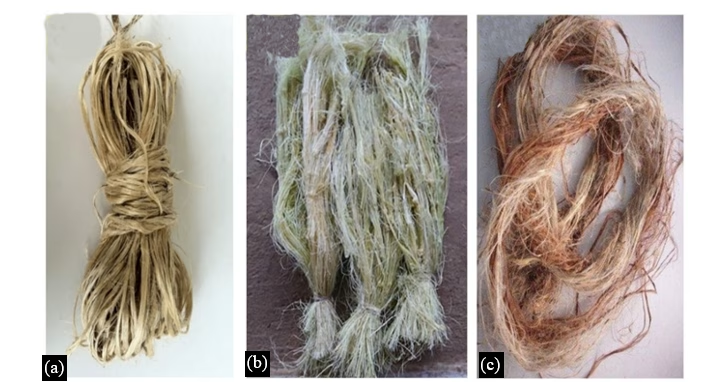
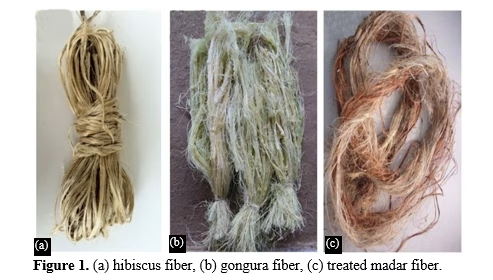
In this study, the effect of alkali treatment on the tensile strength of the hibiscus fiber, gongura fiber, and treated madar fiber-reinforced Polymer Matrix Composite (PMC) is studied. The Sodium Hydroxide (NaOH) solution is utilized for madar fiber treatment. The traditional hand layup methodology was used for fabrication. The influence of tensile property control variables such as duration of fiber treatment, concentration of NaOH for treatment, and proportion of fiber hybridization on the tensile strength is examined. Taguchi’s Signal to Noise Ratio (SNR) and Analysis of Variance (ANOVA) are used to find the optimum control variables and percentage contribution of control variables on the tensile strength, respectively. The 24 hours of fiber treatment, 15% concentration of NaOH, and 70% fiber hybridization were found to be the optimum control variables. Moreover, the duration of fiber treatment contributed more to the tensile behaviour of the PMC. The prolonged treatment durations can enhance the removal of contaminants, waxes, and non-cellulosic compounds. This process strengthens the matrix-fiber interaction, thereby raising the tensile strength. Finally, the Scanning Electron Microscope (SEM) is used to examine the surface of the best tensile sample, and it showed signs of fiber pullout, fiber splitting, debonding, matrix cracking, and fiber-matrix interaction.
Keywords: Natural fiber, polymer matrix composite, alkali treatment, tensile strength, matrix-fiber interaction
[This article belongs to Special Issue under section in Journal of Polymer & Composites (jopc)]
References
- Prabhuram T, Prathap Singh S, Elil Raja D, Immanuel Durairaj J, Chrispin Das M, Ravichandran P. Development and mechanical characterization of jute fibre and multi-walled carbon nanotube-reinforced unsaturated polyester resin composite. Materials today proceeding 2023.
- Chrispin Das M, Prathap Singh S, Rangarajan V, Prabhuram T. Characterization of pineapple leaf fiber, areca fiber and egg shell powder reinforced phenolic resin composites and finding optimal parameters for sustainable machining. Materials today proceeding 2023.
- Chrispin das M, Arthur Jebastine Sunderraj D, Arun Vasantha Geethan K, Elilraja D, Prabhuram T, Prathap Singh S. Mechanical and moisture absorption behaviour of Woven pineapple leaf phenol formaldehyde composites. Materials today proceeding 2023; 62(2): 1303-1307.
- Khan ZR, Srivastava SK, Gupta MK. Tensile and flexural properties of natural fiber reinforced polymer composites: A review. J. Reinf. Plast. Compos. 2018; 37 (24):1-21.
- Ayushi Gupta, Narendra Kumar, Anish Sachdeva. Factors affecting the ageing of polymer composite: A state of art. Polymer Degradation and Stability. 2024; 221: 110670
- Qingguo Chen, Kailun Yang, Yu Feng, Liang Liang, Minghe Chi, Zhonghua Zhang, Xuesong Chen. Recent advances in thermal-conductive insulating polymer composites with various fillers. Composites Part A: Applied Science and Manufacturing. (2024); 178: 107998.
- Jun-Wei Zha, Fan Wang, Baoquan Wan. Polymer composites with high thermal conductivity: Theory, simulation, structure and interfacial regulation. Progress in Materials Science. (2024); 148: 101362.
- Khalid Mohammed, Rozli Zulkifli, Mohd Faizal Mat Tahir, Tayser Sumer Gaaz. A study of mechanical properties and performance of bamboo fiber/polymer composites. Results in Engineering (2024); 23: 102396.
- Monteiro SN, Santaf JR, Costa LL. In TMS Conference, San Francisco, CA, USA, 2009.
- Huang GU. Mater. Des. 2009, 30, 3931–3934.
- Annamalai Saravanakumaar, Arunachalam Senthilkumar, Balasundaram Muthu Chozha Rajan. Effect of Fillers on Natural Fiber–Polymer Composite: An Overview of Physical and Mechanical Properties. J. Polym. Anal. Charact. 2018; 23: 529-536.
- Asumani OML, Reid RG, Paskaramoorthy R. The effects of alkali–silane treatment on the tensile and flexural properties of short fibre non-woven kenaf reinforced polypropylene composites. Part A Appl. Sci. Manuf. 2012; 43:1431-1440.

Journal of Polymer & Composites
| Volume | 13 | |
| Special Issue | 04 | |
| Received | 23/01/2025 | |
| Accepted | 05/05/2025 | |
| Published | 12/05/2025 | |
| Publication Time | 109 Days |